The practical goal is not to "fix" anything or force yourself through every environment on the ship. It is to build the voyage around your own rhythm: identify what affects you, decide what support is genuinely useful, and verify it for your specific ship and sailing before you pay.
Sources and facts checked: September 12, 2026 (America/New_York). Accessibility policies, accommodation deadlines, onboard services and ship layouts change. Operator pages also use broad terms — "cognitive disability", "autism-friendly", "sensory support", "disability services" — without those terms meaning the same package across a fleet, or across two lines. Treat every such label as a starting point and confirm what exists on your ship in writing.
Start with a profile, not a label
Two neurodivergent travelers can respond completely differently to the same ship. Write a short profile in practical categories — what raises your load, and what actually helps.
| Input | Where it comes from onboard | What tends to help |
|---|---|---|
| Sound | PA announcements, music, cheering, engine vibration, chair scraping, crowded restaurants, overlapping conversation | Headphones, earplugs, a chosen seat, an earlier sitting |
| Lighting | Flashing effects, bright white light, glare, dim corridors, changing levels | Sunglasses, a hat, a cabin away from a venue, known routes |
| Crowds | Packed lifts, dense embarkation, standing queues, pool decks, theater exits, tender boarding | Off-peak timing, a seated wait, an exit plan agreed in advance |
| Smell and texture | Buffet odours, perfume, cleaning products, clothing, bedding | Own bedding where permitted, a different venue, room service |
| Motion | Ship movement, lifts, tenders, gangways, coach transfers | Cabin position, medication, skipping a tender port deliberately |
Then set out your communication preferences: written first or spoken first, short direct sentences, extra processing time, text or app notifications rather than verbal reminders, one designated contact person, advance notice of changes, no unexpected touch. Describe what overload looks like for you and what others should do about it — neutral and specific. "Please give me space and written information" works. Asking staff to interpret behavior does not.
Cabin location: ask better noise questions
The cabin is your base, not just a bed. Check the deck plan and ask where the specific cabin sits in relation to active spaces:
- Is the cabin directly below a pool deck, buffet, gym, theater, nightclub or crew area?
- Is it beside a lift, stairwell, service door, laundry, galley or public restroom?
- Is there a connecting door that may transmit sound?
- Is it near an outdoor smoking area, party venue or late-night entertainment?
- Is there known vibration from propulsion or machinery?
- Does the balcony face a venue, a pool deck or open ocean?
- Will the route from cabin to dining and muster cross a busy atrium or need long lift waits?
Midship may reduce motion without being quieter. A cabin far from venues means more walking. An interior cabin reduces light and removes daylight and orientation cues. There is no universally right answer — but there is a right answer for you, and a booking filter will not secure it. Confirm the cabin number in writing.
Embarkation and muster
Embarkation stacks transport, security, queues, document checks, unfamiliar instructions and luggage movement into one hour. Reduce the number of decisions waiting for you on arrival:
- Complete online check-in as early as the operator allows.
- Ask whether a timed arrival window, seated waiting area or other boarding arrangement exists for your documented needs.
- Keep sensory items, medication, food, chargers and written instructions in your carry-on.
- Identify who will communicate with terminal and ship staff.
- Ask how the operator will communicate changes to boarding times.
Muster is not optional, and that is the honest answer
Muster or assembly procedures are mandatory safety requirements under the international SOLAS framework. Do not plan around skipping one or substituting a personal arrangement.
What is negotiable is format. Lines may be able to offer individualised accommodations for sound, crowding, communication or processing needs, so ask the accessibility team what support is available for your sailing rather than asking to be excused. Disney Cruise Line's disability materials, for example, direct guests to Special Services for assistance involving autism, crowded environments and the assembly drill, and recommend contacting the line well before sailing — a line-specific procedure, not a standard every operator uses.
Queues, buffets and dining
A queue is not only a time problem. It is close physical proximity, noise, uncertain timing, bright lighting and repeated instructions at once. Ask whether the operator can provide an alternate process or a seated wait for a documented disability-related need, whether you can arrive at a quieter time, how dining reservations work if you need predictable timing, whether a host can seat you away from speakers, entrances and service stations, whether menus are available in the app, and whether room service is available and at what cost.
Do not assume "priority" means immediate access, or that a queue accommodation applies in every venue. Get the limits in writing. Buffets are especially demanding because they combine movement, choice, smells, people passing behind you and unpredictable seating — the main dining room, a quieter venue, an earlier or later meal, or a planned cabin meal are all legitimate alternatives. A consistent table or server helps, but it must be requested and confirmed rather than hoped for.
For a multigenerational group, allow different dining rhythms outright. One person eats early, another joins later, and the group still meets for a planned activity. Shared time does not require identical schedules.
Announcements and schedule changes
Routine announcements are loud, repetitive and hard to distinguish from important ones. Safety announcements are different, and you need a reliable route to them. Ask Guest Services:
- How are emergency announcements delivered?
- Are daily schedules available in the app, in print, or both?
- Can staff provide written clarification when an announcement is hard to make out?
- How will itinerary or venue changes be communicated?
- Who do I contact if a planned accommodation does not appear in the system?
Why there is no federal answer to point at. The DOT's passenger-vessel guidance addresses nondiscrimination and effective communication under 49 CFR Part 39. But Subpart E — which would carry vessel accessibility standards — is listed as Reserved rather than finalized. Subparts B, C and F carry the nondiscrimination and service-policy provisions that do apply. So there is a framework for how you must be treated and no finished physical-accessibility standard for a ship-specific sensory question. The operator's written answer is the only thing that actually binds.
Build flexibility in deliberately. Use anchor points rather than an hour-by-hour obligation: breakfast, one activity, a rest block, dinner, an optional evening plan. Keep a low-stimulation backup for canceled excursions, changed port times, or a venue that turns out nothing like its description.
Decompression and exit plans
Plan the exit before you need it. On the first day, identify:
- The quietest route back to your cabin.
- A lower-traffic outdoor area.
- A lounge or library that is calmer outside peak hours.
- The location of Guest Services.
- A place to sit while a companion collects belongings.
- A backup route when lifts are crowded.
Agree a simple signal that means "leave now", and do not require an explanation in the moment. Carry water, a familiar snack and whatever helps you regulate. Protect recovery time after embarkation, a port day, a show or a crowded meal. Staying on board during a port call is a valid travel choice — you do not have to disembark at every port to have had a good cruise.
Youth and family programs
If a child or teenager will use a youth program, ask before booking:
- What are the check-in and release procedures?
- Can the child leave the program when they ask to?
- What communication methods can staff use?
- What happens if the environment becomes overwhelming?
- Is one-to-one support available, or must a companion stay nearby?
- Are there toilet-training, age, participation or staffing requirements?
Do not treat a youth program as automatic respite care. Royal Caribbean and Disney both publish disability-related information for youth and family services, but availability and eligibility vary by ship, age group, staffing and sailing. Any claim about sensory rooms, sensory kits, quiet hours or guaranteed trained staff should be treated as unconfirmed until the operator confirms it for your sailing, in writing.
An emergency communication profile
Prepare one page: preferred name and pronouns, preferred communication method, what helps you understand instructions, what makes communication harder, whether you need extra processing time, who to contact first in your party, whether touch or physical guidance is unwelcome, any relevant food, medication, mobility, hearing or vision information, and the best way to confirm you have received an important change.
Share only what you are comfortable sharing. A diagnosis is not required to explain a communication preference or a sensory need. Ask the line to attach the request to the reservation and to confirm it in writing.
Devil's advocate: a cruise may not be the quieter choice
Cruising offers structure, but it is not inherently low-stimulation. Ships change lighting, move people through crowded terminals, announce constantly, and require passengers to adjust to weather, port operations and venue availability.
Adults-only does not mean quiet. A large ship offers more dining and retreat options and also more passengers and longer internal routes. A smaller ship feels less crowded and offers fewer alternate venues. A balcony gives privacy and can also bring wind, vibration and sound from nearby decks.
If your comfort depends on a specific quiet room, guaranteed staffing, a particular communication system or a highly predictable routine, do not rely on marketing language. Ask for a written answer before paying — and if the operator cannot confirm what you need, choose a different ship, a different sailing, or a different kind of trip.
Verify before you pay
- Identify the specific ship, sailing date, itinerary and cabin number.
- Write your sensory, communication, dining and emergency needs in functional language.
- Ask the operator which services exist on that ship and that sailing — not fleetwide.
- Confirm cabin location against nearby venues, lifts, service areas and outdoor spaces.
- Ask how embarkation, queues, muster, announcements and schedule changes will be handled.
- Submit the accessibility or special-services form by the operator's stated deadline.
- Get written confirmation showing reservation number, guest name, sailing date, cabin and each accommodation.
- Treat every unconfirmed promise as unconfirmed, and chase it.
- Reconfirm before departure and again at embarkation.
- Keep the written response, contact names and your emergency communication profile with your documents.
Frequently asked
Is every cruise line "autism-friendly"?
No. "Autism-friendly", "sensory support" and "disability services" are not standardized terms, and a line may publish support for cognitive or developmental disabilities without offering the same services on every ship. Treat the label as a starting point for a conversation, and verify what exists on your exact sailing in writing.
Should I book a particular cabin type?
There is no universally best cabin. Compare noise, motion, lighting, foot traffic, distance to venues and your need for natural light. A midship cabin may reduce motion without being quieter; an interior cabin reduces light but removes daylight and orientation cues; near a lift is short but busy. Confirm the exact cabin number before paying — a booking filter or a general preference note will not hold a specific location.
Can I skip the muster drill?
Do not assume so. Muster and assembly procedures are mandatory safety requirements under the international SOLAS framework, and they are not something a line can simply waive. What lines may be able to offer is an individualised accommodation for sound, crowding, communication or processing needs — ask the accessibility team what format and support are available for your sailing.
Should I avoid the buffet?
Not necessarily. Buffets combine movement, choice, smells, people passing behind you and unpredictable seating, which is a lot at once — but you can go at a quieter period, use another venue, request a suitable table, or eat in the cabin where that is available. Match the meal to the day you are actually having.
What if the itinerary changes?
Keep a low-demand backup ready and ask in advance how important changes will be communicated. Treat the day’s schedule as a set of options rather than a test you have to complete. Staying on board during a port call is a valid choice, not a wasted day.
Does federal regulation cover sensory access on ships?
Not in the way people expect. Under 49 CFR Part 39, Subpart E — which would address vessel accessibility standards — is listed as Reserved rather than finalized. Subparts B, C and F carry the nondiscrimination and service-policy provisions that do apply. So there is a framework for how you must be treated, but no finished federal physical-accessibility standard to point at when you ask a ship-specific sensory question. That is why the written answer from the operator matters so much.
Sources and facts checked: September 12, 2026 (America/New_York). No claim in this article asserts that a sensory program, kit, quiet room, queue alternative or trained-staff service is universal, because none of them is — these terms are not standardized and a line may offer very different support on two of its own ships. Treat every published label as the start of a conversation and confirm what exists on your exact ship and sailing, in writing, with the operator. The Part 39 point is worth keeping in mind when you do: vessel accessibility standards under Subpart E are Reserved rather than finalized, while Subparts B, C and F carry the nondiscrimination and service-policy provisions that apply. There is a framework for how you must be treated and no finished federal standard for a ship-specific sensory question, which is why the operator's written answer is the thing that actually binds.
Sources
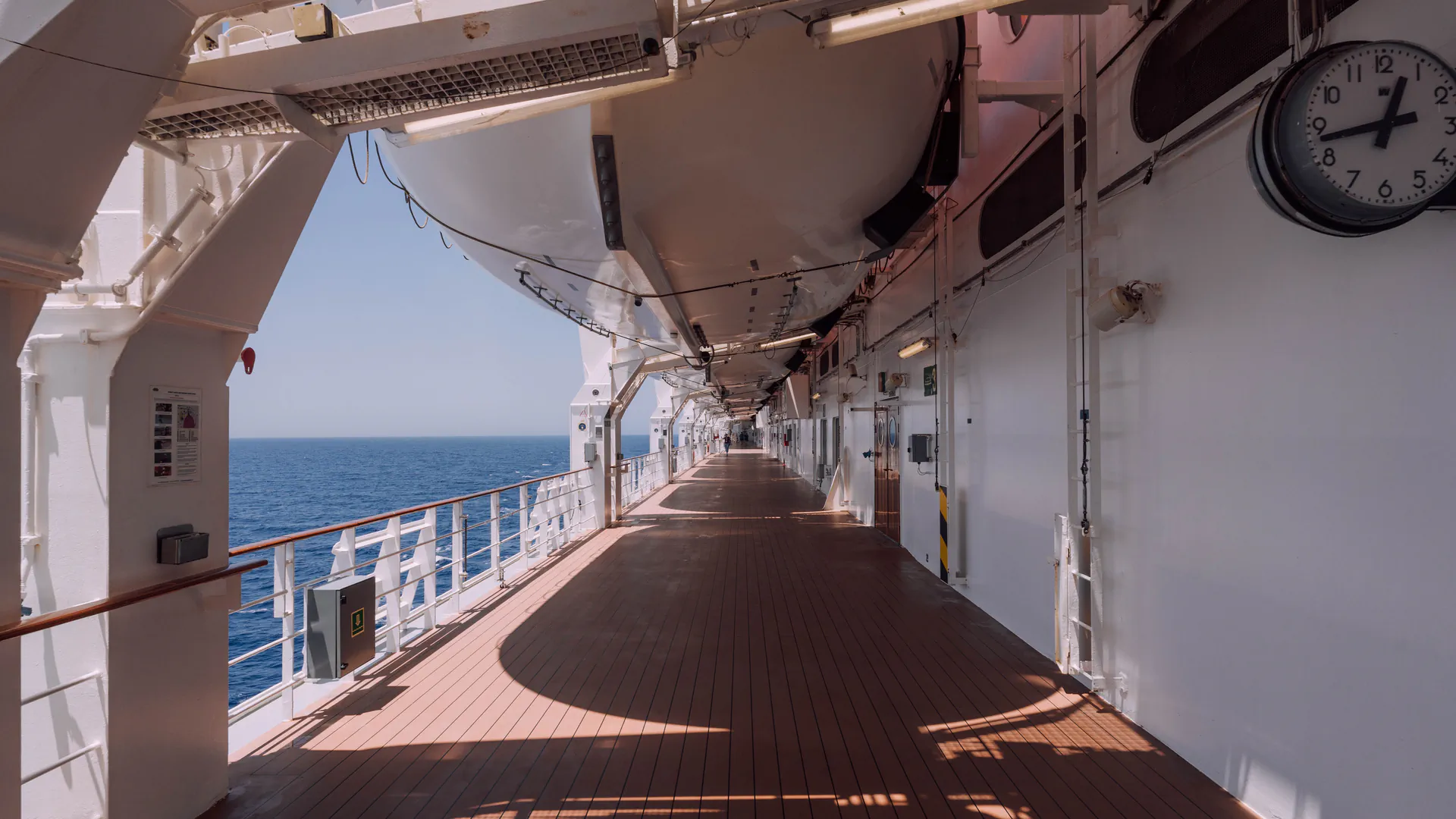
Photographs. An empty promenade deck at sea — Joan Costa, Pexels Cropped and resized for the web; not otherwise altered. Neither the photographers nor the licensors endorse this article.
This article is informational only. It does not diagnose, prescribe, or determine whether cruising is appropriate for any individual. OTGG is an independent travel advisory business; this article is not sponsored and contains no affiliate links. Cruise line policies, rates, accessibility procedures and onboard services change and must be verified with the operator or an accredited travel advisor. Consult a qualified healthcare professional for medical advice, and a legal professional for questions about disability rights or applicable law.
Want the ship chosen around your rhythm?
Tell me what raises your load and what helps, and I will work the cabin position, the dining pattern, the embarkation timing and the muster format against real deck plans and written operator answers — then say plainly if the sailing you are looking at is the wrong one.
Begin the Journey