River cruising can offer a slower, more scenic way to see Europe. It also creates a planning problem that ocean cruising sometimes hides. Every handoff between vessel, dock, gangway, waterfront, city route, excursion vehicle, hotel and transfer has to work — and one workable part does not guarantee the next.
Sources and facts checked: September 12, 2026 (America/New_York). Policies, routes, dock conditions, river levels, vessels, excursions, transfer arrangements and schedules all change. This is OTGG planning guidance, separate from official operator policy, legal guidance, medical advice and any accessibility guarantee. Use the questions below to get specific written answers before payment and again before departure.
What changes from ocean cruising
Ocean ships generally operate from larger terminals with more predictable fixed infrastructure. That does not make every ocean itinerary accessible, but it reduces the number of variables between the ship and the city.
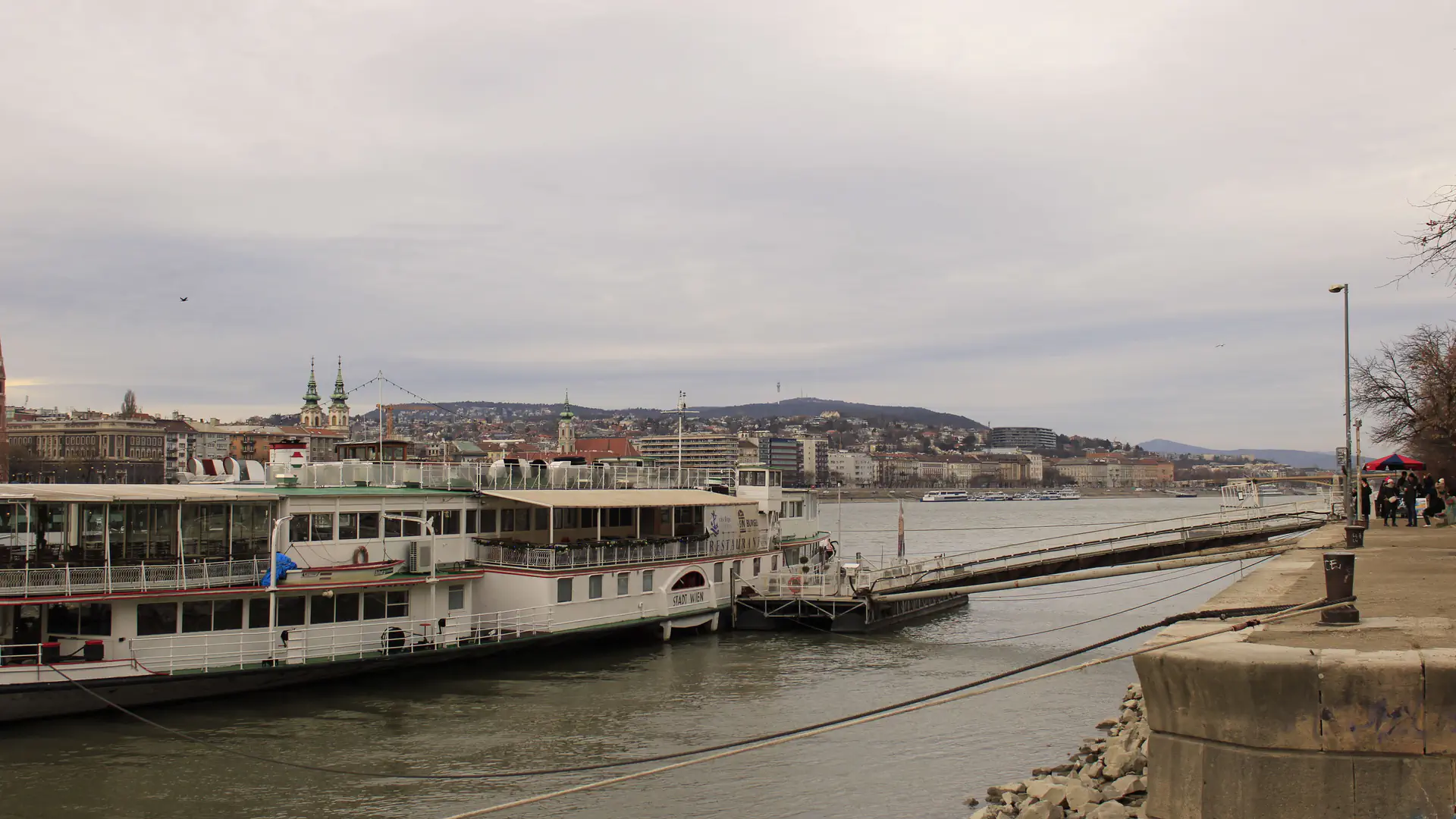
River cruising is tied to the riverbank. The vessel may use a floating dock, a narrow landing, a shared pier or a temporary mooring, and the path from ship to shore can change with water levels, construction, local port operations or ship positioning. A river itinerary may also involve frequent embarkation and disembarkation points, walking routes over cobblestones and uneven waterfronts, ships rafted side by side so guests cross another vessel to reach shore, coaches with steps rather than lifts, and last-minute transfers when docking plans change.
The question is not "is the ship accessible?" It is: can I complete every movement from my cabin to the ship's exit, from the exit to the dock, from the dock to the vehicle or city route — and back again?
The chain, link by link
| Stage | What may be described | What you must verify |
|---|---|---|
| Cabin | Accessible cabin | Door width, bathroom layout, turning space, bed, emergency route |
| Ship to dock | Accessible boarding | Dock type, gangway angle, steps, rafting, river conditions |
| Dock to city | Walkable waterfront | Paving, slopes, bridges, distance, curb cuts |
| Excursion | Easy or gentle | Actual terrain, duration, restrooms, pace, communication access |
| Coach | Accessible transport | Lift, ramp, seated transfer, device storage, securement |
| Port changes | Operational flexibility | Replacement pier, revised route, new vehicle, backup plan |
| Hotel or transfer | Accessible room or vehicle | Exact room, bathroom, pickup point, equipment, confirmation |
An accessible cabin can solve only one part of the journey. You still need a workable path to shore, a workable shore route, a workable vehicle, and a workable return.
Floating docks and gangways
A floating dock rises and falls with the river, and that movement changes the angle, length and stability of the gangway. A route that was manageable yesterday can feel very different after rainfall, low water or a changed mooring position. Ask the operator:
- What is the expected embarkation and disembarkation pier?
- Is the landing fixed or floating?
- What is the gangway's width, surface, handrail design and steepest expected angle?
- Are there steps between the gangway and the pontoon, or a raised threshold?
- Can crew give verbal guidance without physically lifting or transferring a guest?
- Will the ship be rafted beside another vessel — and if so, must guests cross it to reach shore?
- Can a manual wheelchair, power wheelchair, scooter or walker use the route?
- What happens if the planned pier becomes unavailable?
What the federal guidance does and does not say
The U.S. Access Board's proposed passenger-vessel guidelines recognize that gangways operate in a difficult marine environment, including locations with severe water fluctuations. Those guidelines remain proposed rather than adopted or enforceable, and they are not a blanket guarantee for any existing vessel or river landing.
For small passenger vessels specifically, the Access Board's advisory material provides a methodology for developing gangway technical provisions rather than final provisions themselves. Read all of it as planning context, never as proof that a particular dock will work for you.
Waterfront paving, bridges and city access
The shore gap continues after you leave the gangway. River cities combine historic streets, uneven paving, drainage channels, steep approaches, narrow bridges, tram tracks and crowded waterfront paths. A city may offer an accessible museum while the route from the dock to its entrance remains impractical. Ask for a route-level description:
- How far is the accessible route from the landing to the vehicle or attraction?
- Does it include cobblestones, gravel, steep slopes, stairs, bridges or narrow passages?
- Are there curb cuts or step-free alternatives, and does the route cross a pedestrian bridge?
- Can the vehicle stop directly at the attraction entrance?
- Is there a restroom with the features you need during the excursion?
- Can the tour be shortened without separating you from your companion?
- Is a quiet route, captioning, sign-language support, audio description or tactile information available?
Do not accept "the city is accessible" as an answer. Accessibility is often block-by-block.
Bicycles and active excursions
Many river itineraries promote bicycles, e-bikes, walking tours and hikes, and those options often share the same waterfront space guests use entering and leaving the ship. Ask whether bicycles are stored on the ship, dock or coach; whether guests must handle them themselves; whether crew may assist with bicycles or mobility equipment; whether the cycling route uses the same steep gangway; whether adaptive cycles exist; whether the excursion vehicle can carry a mobility device; and whether a non-cycling alternative is available without paying for an unsuitable activity.
An "easy cycling" label describes the cyclist's fitness requirement. It says nothing about the dock, the vehicle, storage, transfer or the adaptive-equipment process.
Coach transfers and daily port changes
Coaches are the second shore gap. Standard touring coaches commonly have entrance steps; a lift-equipped vehicle is not automatic, and space for a folded wheelchair does not mean a passenger can remain seated in the device. Ask the transfer provider and the excursion operator separately:
- Is the coach step-free, and is a lift or ramp available?
- Can the traveler remain in their wheelchair?
- What are the vehicle's device dimensions and weight limits, and can it secure the chair safely?
- Is a companion seat available beside the traveler?
- Where will the vehicle load and unload?
- What is the backup if the accessible vehicle fails?
- Does the hotel transfer use the same vehicle standard?
Daily port changes multiply all of it. A ship may dock in a different part of town, substitute a coach transfer, or move the shore meeting point. Get the revised arrangement in writing rather than relying on a previous port description.
Cabin and public-area questions
A cabin advertised as accessible may provide useful features without meeting your complete needs. Confirm the exact cabin number on the exact ship, and ask about:
- Clear entry-door width, threshold height, and turning space in cabin and bathroom.
- Bed height and clearance.
- Roll-in shower dimensions, shower-seat type and transfer space.
- Grab-bar placement, toilet height and side-transfer space.
- Sink clearance and reach range; storage and controls.
- Elevator access to dining, lounges and outdoor decks.
- Accessible restroom locations outside the cabin.
- Emergency communication features.
- Muster and evacuation procedure for guests who cannot use stairs.
The Access Board's passenger-vessel guidance discusses accessible routes, guest rooms, alarms, communication features and means of escape — but again as proposed guidance, not an adopted standard and not a certification for a particular ship. Where an operator has not answered, mark the item unresolved and chase it. Do not replace an unanswered question with an assumption.
Tenders, boarding and the weather backup
Some ports may require local boats or tenders if the vessel cannot use the expected landing. PONANT's official FAQ — which covers its own fleet rather than any universal river-cruise standard — notes that some ports require offshore anchoring and tender or local-boat disembarkation, and that landings are subject to the captain's approval. Ask:
- Can I board the tender or local boat with my mobility device?
- Must I transfer to a fixed seat, and who handles the device?
- What wind, rain, current or water-level conditions cancel the landing?
- What is the onboard alternative if I cannot go ashore?
- Is the excursion refundable if access changes?
Never assume a tender is equivalent to a gangway.
The request timeline
Start accessibility planning before you select the sailing, not after.
- Before payment. Identify the exact ship, cabin, piers, excursions, coaches, transfers and hotels, and send specific questions to each provider.
- At booking. Submit the operator's accessibility and medical requests. Keep the confirmation number and every written response.
- At the operator's own deadline. These are line-specific, not universal, and river operators frequently publish none at all. Ask yours directly and in writing.
- Forty-eight hours before each arrival or transfer. Reconfirm the vehicle, driver, pickup location, room, equipment and accessibility features with the supplier.
- Before leaving home. Carry one document with all confirmations, measurements, contact numbers and fallback arrangements.
A note on deadlines, because a wrong one is worse than none. Published windows belong to individual lines. Virgin Voyages, for example, asks travelers to "make every effort to contact us at least 45 days in advance of your voyage date" — a single window that covers its Accessibility and Medical Request Form, including a distilled-water request for CPAP use. That is one ocean line's figure, not a river deadline, and it does not transfer. Our deadlines and paper-trail guide carries the current cross-line table.
Devil's advocate: should you choose an ocean cruise instead?
Possibly. If you need to remain in your power wheelchair throughout boarding, cannot manage a steep or changing gangway, cannot transfer into a coach seat, or require a highly predictable step-free shore route, many river itineraries carry too much operational uncertainty to be worth the fare.
That does not make river cruising impossible. It means the deciding factor is functional fit, not the presence of an accessible cabin. A shorter segment, a ship with confirmed features, fewer active excursions, private accessible transfers, or a land-based itinerary may all serve you better — and the honest answer is sometimes "not until every handoff is verified."
Verify before you pay
Request direct written confirmation from the cruise line or booking entity, the river operator, the exact ship, every embarkation and disembarkation port, the transfer provider, each excursion operator, and every pre- and post-cruise hotel. Confirm:
- Exact ship and cabin number, with cabin measurements and bathroom features.
- Elevator and public-area access confirmed.
- Gangway width, gradient, steps and handrails.
- Whether the dock is floating or fixed.
- Rafting and cross-ship access.
- Waterfront paving, slopes, bridges and route distance.
- Coach lift, ramp, securement and device limits.
- Bicycle and active-excursion arrangements.
- Tender and weather procedures.
- CPAP equipment, distilled water, medication and medical documentation.
- Cancellation or substitution terms if the confirmed access plan changes.
Labels such as "accessible", "easy", "gentle", "limited walking" and "suitable for reduced mobility" are descriptions. They are not guarantees, and they are not answers.
Frequently asked
Is river cruising accessible for wheelchair users?
Sometimes, but there is no universal answer. Confirm the exact ship, pier, gangway, shore route, coach, excursion and hotel. A suitable cabin does not establish full-itinerary access, and river landings vary more than ocean terminals do.
Are river-cruise gangways always step-free?
No universal claim is safe. Gangways vary by ship, pier, water level and local port arrangement, and a floating dock changes angle as the river rises and falls. Ask for the expected gradient, width, steps, handrails and backup plan in writing.
Can I take a mobility scooter on a river cruise?
Some operators may allow certain devices; others restrict dimensions, batteries, storage or boarding. Ask the operator for the exact ship’s policy and give them your device’s measurements and specifications, including battery chemistry.
Will an accessible excursion use a lift-equipped coach?
Do not assume so. Standard touring coaches commonly have entrance steps, and space for a folded wheelchair does not mean a passenger can remain seated in the device. Ask the excursion operator whether you can stay in your device, whether a lift or ramp exists, and how the device will be secured.
What happens if the ship changes ports?
The route may become less accessible. Reconfirm the new pier, gangway, vehicle, walking route, excursion and return timing. If the replacement cannot meet your needs, ask what alternatives or refunds apply — and get the revised arrangement in writing rather than relying on the previous port description.
When should I file the accessibility request?
At booking, and before you pay wherever possible. Deadlines are line-specific rather than universal: Virgin Voyages asks travelers to make every effort to make contact at least 45 days in advance, and that single window covers the Accessibility and Medical Request Form including a distilled-water request for CPAP use. That is a Virgin figure and not a river-operator deadline. Ask your actual operator for its own window in writing.
Can I rely on crew assistance at the gangway?
Ask specifically. Assistance policies vary and crew may not be permitted to lift, transfer or physically support a guest. Written confirmation should describe what assistance is and is not available, not simply say that help exists.
Sources and facts checked: September 12, 2026 (America/New_York). Accessibility request windows are set by each cruise line individually — they are not an industry standard and they do not transfer between operators, so confirm the deadline that applies to your own booking directly with the line in writing. The U.S. Access Board's passenger-vessel material is described here as proposed guidance, which is what it is: it has not been adopted or made enforceable, and for small passenger vessels it sets out a methodology for developing gangway provisions rather than final provisions. The PONANT references describe PONANT's own fleet and policies and do not establish a standard for river operators generally. Dock type, gangway gradient, rafting arrangements, coach specifications and shore routes are all vessel-, port- and date-specific: verify each with the operator, the port agent, the transfer provider and the excursion operator before you pay.
Sources
Photographs. River vessel at a Danube landing, Budapest — Anna Chamberlain, Pexels Cropped and resized for the web; not otherwise altered. Neither the photographers nor the licensors endorse this article.
This is general planning information, not medical, legal, accessibility-certification or insurance advice. OTGG is an independent travel advisor and intermediary. This article contains no compensated links, sponsored placements or paid endorsements. Cruise line policies, rates, routes, dock conditions, transfer arrangements and accessibility procedures change without notice — verify every detail with the operator, supplier, port, hotel, transfer provider, excursion operator or an accredited advisor before payment and again before departure. Nothing here guarantees that any vessel, landing, route or vehicle will meet your needs.
Want the handoffs verified before you pay?
Tell me the sailing and what you need at each stage — boarding, gangway, coach, shore route. I will put the questions to the line, the port agent, the transfer provider and each excursion operator, get the answers in writing, and tell you plainly when a river itinerary is the wrong shape for what you need.
Begin the Journey