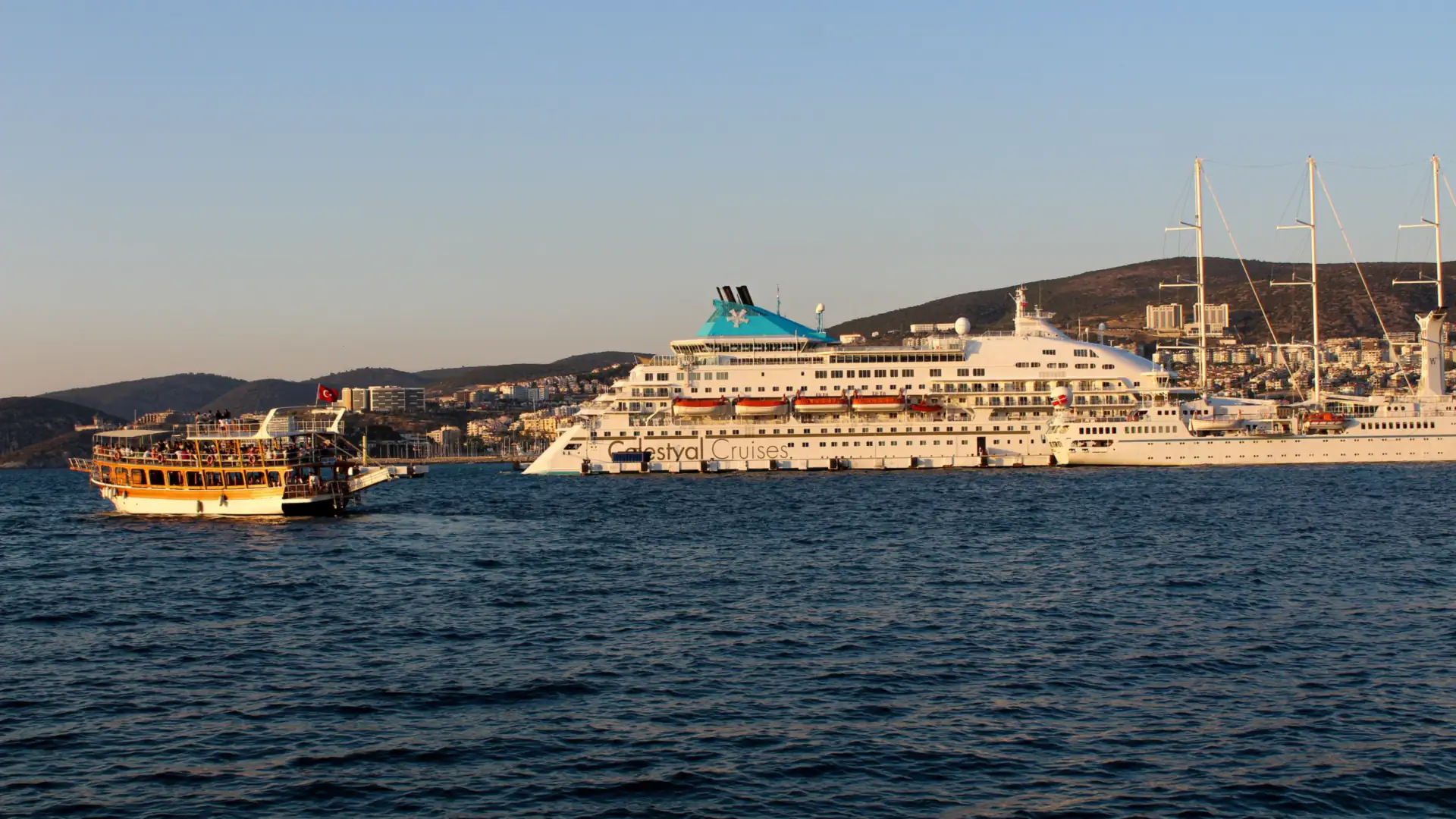
A cruise ship can be highly accessible onboard and still call at ports that do not work for your wheelchair, scooter, or power chair.
Sources and facts checked: September 13, 2026 (America/New_York). Tender policies depend on the ship, the tender, the port, the weather and the crew’s safety assessment on the day. Check and verify every tender call, device limit and request deadline with the cruise line or vendor before you pay.
Tender ports create the biggest gap between “accessible cruise” and “accessible day ashore.” The ship anchors offshore, and guests transfer to a smaller boat. That transfer may involve steps, a steep gangway, a moving platform, a device transfer, or a shore landing with no accessible pier.
Some ports simply will not work for some travelers. That is not a planning failure. It is information you need before paying for the voyage or excursion.
This guide focuses on Virgin Voyages, Royal Caribbean, Princess Cruises, and Norwegian Cruise Line. Policies vary by ship, tender, port, weather, sea state, and the crew’s safety assessment. Treat every platform label, excursion description, and general accessibility statement as a starting point, not a guarantee.
What Tendering Means for Mobility Access
At a docked port, the ship usually connects to the terminal through a gangway. At a tender port, the ship remains offshore and uses smaller boats to transport guests to land.
That changes the questions you must ask:
- Can you take steps onto the tender?
- Can you transfer from your wheelchair or scooter to a seat?
- Does the tender have a genuine roll-on ramp or lift?
- Can your device fit, fold, and be safely secured?
- Can you get from the tender to the shore landing?
- Is the shore facility accessible after you arrive?
- Can you reboard safely if wind, waves, or tide conditions change?
A port may be listed as tendered on the itinerary, but the exact method can vary by call. A scheduled docked visit can also become a tender operation because of berth availability, weather, tidal conditions, or operational decisions.
The reverse is also true: a port with a tender reputation may use a pier on a specific sailing. Do not build your plan around either assumption. Obtain written confirmation for your ship and sailing.
Cross-Line Policies: What the Published Rules Say
Virgin Voyages
Virgin states that guests must generally be able to take steps to board most tenders. A nonmotorized wheelchair must be collapsible. Motorized wheelchairs and mobility scooters are not permitted unless roll-on capability is available.
Virgin also states that roll-on capability cannot be guaranteed. Crew are prohibited from carrying individuals on or off water shuttles, and the captain or staff make the final decision about tender boarding.
Read Virgin’s Tender Ports policy and Accessibility guidance.
Virgin asks guests to contact the line as early as possible and make every effort to submit accessibility information at least 45 days before sailing. Check and verify with the cruise line or vendor. Submit your needs at booking anyway, then reconfirm them before departure.
Royal Caribbean
Royal Caribbean says guests who cannot take a few steps may be unable to board a tender unless roll-on capability is available. Most tender situations require the ability to take steps and use a collapsible manual wheelchair. Motorized wheelchairs and scooters generally cannot go on tenders without roll-on access.
Royal’s policy also states that staff are not permitted to lift guests or equipment. Guests are directed to ask Guest Relations onboard about tender roll-on capability, but that conversation is not a guarantee that the equipment will be available or usable on the day.
Review Royal Caribbean’s Additional Assistance policy and Mobility Disabilities guidance.
Royal Caribbean asks guests to provide advance notice for special-needs equipment and services, including 30 days for certain requests. Check and verify with the cruise line or vendor. The practical rule is simpler: notify the line at booking, submit the Guest Special Needs Form, and reconfirm the specific tender question before sailing.
Princess Cruises
Princess states that some guests may need to transfer to a stair climber or may be unable to go ashore because of gangway steepness, weather, tidal conditions, or shore-side facilities.
Princess staff are not allowed to physically lift more than 50 pounds. At tender ports, a mobility device will not be transferred if doing so would require lifting beyond that limit. Even when a guest can board the tender, the shore landing may not be wheelchair accessible.
The captain makes the final decision about tendering and disembarkation. Princess also states that missed ports caused by these limitations do not generate a refund or credit.
Read Princess’s Accessibility at Sea guidance and its Passengers with Limited Mobility document.
Complete the Princess Mobility Questionnaire when required and ask the Access Office to address the exact ship, port, device, and transfer method. Princess's official Mobility Questionnaire and related accessibility pages state that the questionnaire should be submitted at least 60 days before sailing. Submit it as early as possible and reconfirm with the Access Office before final payment and again before departure.
Norwegian Cruise Line
NCL warns that tendering and gangways may not be fully accessible and that some guests may not be able to go ashore.
NCL states that mobility devices must fold to be accommodated onboard a tender. It also says the line cannot provide assistance from ship to tender or tender to shore for scooters and wheelchairs with a combined weight of 100 pounds or more. Great Stirrup Cay may be exempt, but that exception still requires direct confirmation.
Review NCL’s Cruise Tender Ports policy and Mobility Challenges guidance.
NCL asks guests to contact the Access Desk at least 45 days before sailing for needs other than interpreters. Check and verify with the cruise line or vendor. Do not wait for that window. Notify the Access Desk at booking and reconfirm before departure.
Crew Cannot Be Your Lift Plan
Do not book a tender port assuming crew will lift you, your chair, or your scooter.
Across the policies above, the practical rule is consistent:
- Crew may push or guide equipment in permitted situations.
- Crew may provide limited embarkation or disembarkation assistance.
- Crew cannot be relied upon to lift passengers.
- Crew cannot be relied upon to lift heavy wheelchairs, scooters, or power chairs.
- Crew cannot turn an unsafe tender transfer into a safe one through effort or goodwill.
A travel companion may assist with ordinary support if they are physically able and the line permits it. That does not mean a companion should attempt a dangerous manual lift. Ask what transfer is expected and whether the passenger remains seated throughout the movement.
If you require a mechanical lift, roll-on ramp, or trained transfer procedure, obtain that answer in writing from the cruise line and the operator.
Powered Devices and Roll-On Restrictions
Powered wheelchairs and scooters are usually the first devices affected by tender restrictions because they are heavier, larger, and harder to stabilize.
“Roll-on” should mean more than “we have a lift somewhere.” Ask:
- Can you remain seated in the device?
- Does the device roll directly from ship to tender?
- Is there a ramp, platform lift, or stair climber?
- Can the tender accommodate the device’s width, length, turning radius, and weight?
- Does the device remain with you during the transfer?
- Is the same equipment available for the return trip?
A manual wheelchair may be collapsible yet still unusable if you cannot take steps or transfer. A scooter may fit within a published width limit yet remain prohibited because the tender lacks roll-on access.
Never treat a website icon, “accessible” filter, or excursion activity label as proof that your exact device can be accommodated.
Notify Accessibility Teams at Booking, and Reconfirm
Tell the cruise line about your mobility needs when you book. Include:
- Device type and model
- Folded and operating dimensions
- Device weight, including battery
- Battery type
- Whether you can stand or take steps
- Whether you can transfer to a fixed seat
- Whether you need to remain in your device
- Whether you travel with a companion who provides assistance
- Every tender port on the itinerary
- Any accessible transportation or excursion requirement
Submit the applicable accessibility or medical form. Keep the confirmation number, submitted form, and written replies.
Then reconfirm:
- After the booking is fully ticketed.
- Before final payment or any nonrefundable excursion purchase.
- Before departure.
- With Guest Relations or the ship’s Access Officer after boarding.
- On the morning of each tender call, if conditions or the tender assignment may affect access.
Ask the line to answer the specific question: “Can this passenger, using this device, board and return from the tender at this port on this sailing?”
“Your request is noted” is not the same as “your transfer is confirmed.”
Questions to Ask the Ship
Send these questions to the cruise line’s accessibility team and request a written reply:
- Is this port expected to be docked or tendered for this exact sailing?
- If tendered, can the passenger remain seated in the device?
- Is roll-on access available, and is it confirmed for this ship and tender operation?
- How many steps are required?
- Is a transfer to a fixed seat required?
- Can a collapsible manual wheelchair be taken onboard?
- What are the maximum device dimensions and weight?
- Does the stated weight include the battery?
- Can the device reach the shore landing?
- Can it be used for the return tender?
- Who makes the final boarding decision?
- What happens if the port changes from docked to tendered?
- Is there a no-refund or no-credit rule if the passenger cannot go ashore?
For a group or multigenerational trip, ask whether everyone can use the same route. An accessible plan that works for one traveler may not work for a parent, grandparent, child, or companion with a different mobility requirement.
Questions to Ask the Port or Excursion Operator
The cruise line may confirm that a tour is listed as accessible. The local operator must confirm whether the actual vehicle, lift, pier, and attraction work for you.
Ask for written confirmation of:
- Vehicle type and lift or ramp design
- Maximum combined passenger-and-device weight
- Maximum device width, length, and height
- Whether the passenger must transfer out of the device
- Whether the device can remain occupied during travel
- Steps between the pier and vehicle
- Accessible restroom availability
- Surface conditions at the attraction
- Cancellation terms if the ship cannot tender
- A direct contact for the operator on the day
Some Carnival excursion listings specify a maximum combined guest-and-device weight limit for lift use, such as 450 pounds. That figure applies to the specific listing, not every Carnival excursion. Check the individual Carnival shore excursion requirements, then obtain written confirmation from Carnival or the operator.
Do the same with independent excursion platforms. “Wheelchair accessible” can mean a step-free museum entrance, not a wheelchair-accessible tender, transfer vehicle, or beach landing.
Build a Plan B Before You Pay
If a tender port is essential to your trip, choose an itinerary with enough docked alternatives that one missed call does not ruin the voyage.
If the port will not work for your device:
- Stay onboard and use the ship’s accessible facilities without treating the day as a failure.
- Choose a docked port excursion instead.
- Select an itinerary with fewer tender ports.
- Ask whether a different sailing uses a pier or accessible tender arrangement.
- Avoid nonrefundable independent tours until transfer access is confirmed.
- Arrange a low-complexity port day for the rest of the group.
- Give solo travelers a clear plan that does not depend on finding physical assistance onboard.
- For multigenerational groups, schedule a shared onboard activity when some guests go ashore.
A shore day is optional. A safe return to the ship is not.
Devil’s Advocate: No Guarantee Language
Here is the less glamorous version of accessible cruise planning:
- A cruise line can approve your form and still deny tender boarding for safety reasons.
- A tender can be accessible in calm conditions and unsuitable after the weather changes.
- A port can be listed as docked and operate as a tender call.
- A roll-on tender can exist but not be assigned to your ship or sailing.
- An accessible excursion vehicle does not make the tender accessible.
- A collapsible wheelchair does not eliminate the need to stand or transfer.
- A companion cannot guarantee that a crew member will permit a transfer.
- A published weight limit does not guarantee that the lift will be available.
- A “yes” from a call-center representative may not reflect the onboard captain’s authority.
The honest standard is not “the website says accessible.” The honest standard is written confirmation from the relevant cruise line, port, transfer provider, equipment vendor, and excursion operator, where each is involved, checked again before you sail.
Verify before you pay
- Identify every tender port on the exact itinerary.
- Ask whether each call is docked, tendered, or variable.
- Measure the device, including folded dimensions.
- Record passenger weight, device weight, and combined weight.
- Confirm battery type and transport requirements.
- Submit the cruise line’s accessibility form at booking.
- State whether you can take steps or transfer.
- Request written confirmation from the cruise line.
- Request written confirmation from each excursion or transfer operator.
- Confirm pier, vehicle, lift, ramp, and restroom access.
- Reconfirm before departure and onboard.
- Identify a realistic Plan B for every tender port.
- Do not pay for a nonrefundable excursion based only on an accessibility icon.
Frequently asked
Can I take a scooter on a tender?
Sometimes, but only when the tender has confirmed roll-on capability and the device meets the line’s restrictions. Many tender operations do not accept scooters.
Can crew lift me into the tender?
Do not plan on it. Cruise-line policies restrict or prohibit crew from lifting passengers and equipment. Ask what transfer method is required.
Is a collapsible wheelchair always accepted?
No. You may still need to take steps, transfer to a seat, or manage a difficult shore landing.
If my tender request is approved, can the captain still refuse boarding?
Yes. The captain or designated staff may make the final safety decision based on the actual conditions.
Will I receive a refund if I cannot go ashore?
Policies vary, but Virgin Voyages, Royal Caribbean, and Princess state that missed tender access caused by safety or mobility limitations does not create a refund or credit. Verify the current terms before booking.
Should I skip every itinerary with tender ports?
Not necessarily. Choose based on your actual mobility requirements. If you cannot transfer or rely on a powered device, prioritize itineraries with more docked calls and treat tender ports as possible onboard days.
Sources and facts checked: September 13, 2026 (America/New_York). Published accessibility and tender guidance from Virgin Voyages, Royal Caribbean, Princess Cruises and Norwegian Cruise Line was reviewed on the date shown, along with Carnival’s shore-excursion requirements. Policies, tender assignments, equipment, port facilities and safety decisions change. Get written confirmation from the cruise line and, where involved, the port, transfer provider, equipment vendor and excursion operator before payment.
Sources
- virginvoyages.com — Tender Ports policy ↗
- virginvoyages.com — Accessibility guidance ↗
- royalcaribbean.com — Additional Assistance policy ↗
- royalcaribbean.com — Mobility Disabilities guidance ↗
- royalcaribbean.com — Guest Special Needs Form, ↗
- princess.com — Accessibility at Sea guidance ↗
- princess.com — Passengers with Limited Mobility document ↗
- ncl.com — Cruise Tender Ports policy ↗
- ncl.com — Mobility Challenges guidance ↗
- carnival.com — Carnival shore excursion requirements, ↗
Photographs. A tour boat crossing in front of an anchored cruise ship — Gülüzar İlgin, Pexels Cropped and resized for the web; not otherwise altered. Neither the photographers nor the licensors endorse this article.
This article is general information, not medical, physical-therapy, legal or safety advice. It does not determine whether a specific traveler can safely transfer or travel — consult an appropriate licensed professional for individualized transfer planning. OTGG is an independent travel advisor; this article contains no affiliate links. Cruise line policies, tender assignments and excursion conditions change — verify directly with the operator or an accredited travel advisor before booking or paying.
Planning an itinerary around tender ports and a mobility device?
Send me the device, its dimensions and weight, and the sailings you are considering. I will flag every tender call, put the exact boarding question to the line and the excursion operators in writing, and build a realistic Plan B for each port before you pay.
Begin the Journey