An accessible day out is decided by details that rarely make the brochure: deck gaps, lift dimensions, whether the changing facility is a real Changing Places, and how many wheelchairs the shuttle takes per trip. All five of these work. None of them is uniformly step-free, and four of the five need something arranged before you leave home.
Every figure below comes from the venue's own published information, checked on 28 August 2026. Where a measurement exists it is here, because "confirm the dimensions" is not a plan when the dimensions are already public.
The five, compared
| Destination | Best for | Access provision | Toilet facilities | The catch |
|---|---|---|---|---|
| Clevedon Pier ~20 miles · coastal | A short, low-commitment outing with a view | Step-free to the pier; lift to the Glass Box restaurant, the Porthole Room and an accessible toilet | Accessible toilet. No Changing Places advertised | Uneven deck planks with gaps — the Pier warns narrow wheels need extra care |
| Bath ~13 miles · city | The richest history and culture day, if you plan the route | Roman Baths 90% accessible with lifts to the Great Bath and East Baths; Bath Abbey level on the ground floor | Abbey has a Changing Places — below ground, reached by lift | Cobbles and historic paving between venues. Abbey tower is stairs only |
| Birdland Bourton-on-the-Water, ~45 miles | The most predictable facilities of the five | Mostly level tarmac; free wheelchair hire, bookable in advance | True Changing Places with hoist and bench, by The Nest café, plus two accessible toilets | Some gravel and grass. Village pavements outside the park vary |
| Stonehenge ~40 miles · heritage | A single, well-supported destination — do not pair it | Accessible shuttle, no pre-booking; 22 accessible bays 100m from the centre; two loan wheelchairs | Adult changing area — not described as Changing Places | One wheelchair, scooter or pushchair per shuttle. Class 2 scooters max 600 × 1000 mm |
| Wells ~20 miles · heritage pair | Best heritage value; Cathedral and Palace sit together | Cathedral level to Nave via a ramp; Palace has wide level paths and a platform lift | Adult changing facility behind the Town Hall — confirm key collection | Book the Palace’s 3 blue-badge bays 48 hours ahead. Chapter House is 31 steps |
“Changing Places” is a standard, not a description. A registered Changing Places has a hoist, an adult-sized changing bench and space for two carers. An “adult changing area” or “accessible toilet” is something else. Of these five, Birdland and Bath Abbey have real Changing Places; Stonehenge has an adult changing area that English Heritage does not describe as Changing Places; and Wells points to a facility behind the Town Hall with key collection to arrange. If this is the thing your day depends on, it is worth being pedantic about the wording.
What has to be arranged in advance
Four of the five ask for something ahead of time, and only one of those is a hard requirement. Missing it is the difference between a day out and a car park.
| Where | Notice | What to arrange | Contact |
|---|---|---|---|
| The Bishop’s Palace, Wells | 48 hours | Three on-site blue-badge spaces must be reserved | 01749 988111, or by email |
| Wells Cathedral | Optional, recommended | Wheelchairs available on arrival subject to availability, or pre-book | 01749 672773 · Visitor Services 01749 671663 |
| Bath Abbey | Optional, recommended | Free loan wheelchair; carers and support workers enter free | Verger team — [email protected], 01225 303328 |
| Birdland | Advance for a wheelchair | Free wheelchair hire in advance; free venue registration as an alternative to an Access Card | [email protected] |
| Stonehenge | None for the shuttle | Companion goes free — tell them on arrival or book the free place online | Shuttle runs from outside the shop; 10 minutes to the stones |
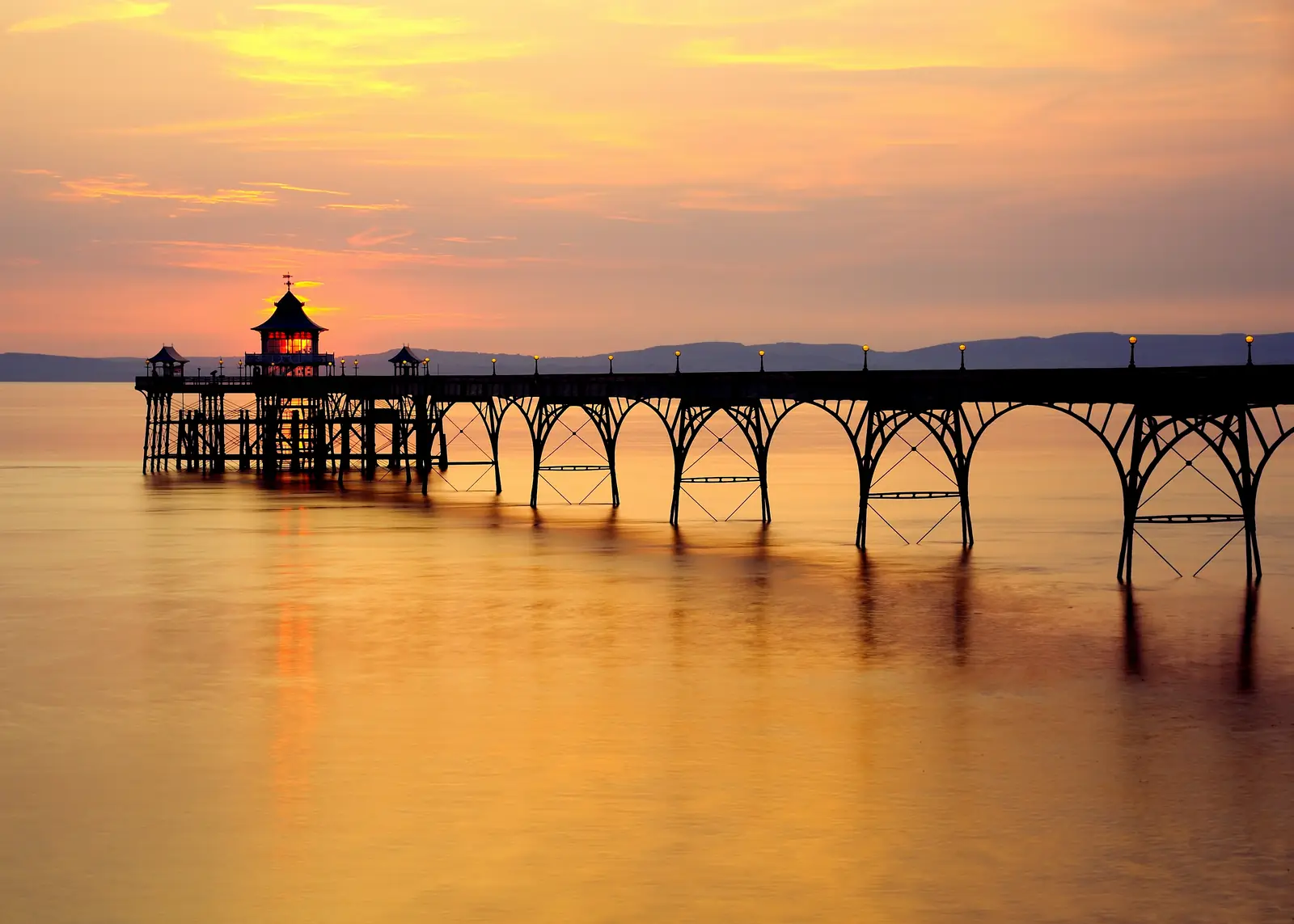
Clevedon Pier
The easiest of the five when the group wants sea air and a view rather than a heritage marathon. Access is step-free: you come in through large gates and follow a slope down towards the pier and the Glass Box restaurant, which has wide double-opening doors, and a lift serves the Porthole Room and an accessible toilet.
The Pier is candid about its own deck, and that is worth taking at face value: the planks are uneven and narrow wheels need extra care. Small front castors and some scooter wheels will feel the gaps considerably more than a large-wheeled manual chair. If you are self-propelling, having someone available for the slope and the deck is a sensible plan rather than a defeat.
Two things to confirm on the day rather than assume: blue-badge availability and signage near the pier, and assistance-dog access to the individual food and exhibition spaces. The Pier publishes a pet-dog policy listing restrictions in the Glass Box, the Pagoda Café and the Discovery Room; assistance dogs are a separate matter in law, but the arrangements per room are worth a phone call.
Bath
The richest day of the five and the one that punishes an improvised itinerary. Bath's venues are well set up; the friction is the ground between them.
The Roman Baths
The Roman Baths give the most useful single figure in this guide: the site is 90% accessible to wheelchair users. Lifts serve the mezzanine displays, the lower museum, the Great Bath and the East Baths, and assistance and guide dogs are fully welcome throughout.
The remaining tenth is the honest part. The baths sit below ground in a genuinely Roman structure, so some areas still involve steps and some surfaces are uneven — the Great Bath surround in particular. Check your chair or scooter against the lift dimensions before you travel, and ask about current wheelchair-loan arrangements and carer admission terms while you are on the phone.
Bath Abbey
Level access at the main entrance and throughout the ground floor and the Abbey Shop, with accessible gender-neutral toilets and baby changing. The Changing Places toilet is at below-ground level and is reached by lift — a detail worth holding onto, because if the lift is the thing that fails, so is the facility.
Carers and support workers enter free. A wheelchair can be borrowed at no charge; reserve it with the Verger team on 01225 303328 or [email protected]. The tower tour is stairs only and is not wheelchair accessible — that is structural rather than something to negotiate.
Bath's real constraint is between the venues, not inside them. Expect a mixture of paved and cobbled surfaces, busy pedestrian areas and route changes from events or street works. Choose one timed attraction, leave a generous buffer between parking, lunch and admission, and treat Pulteney Bridge as a viewpoint rather than an accessible shopping route. An accessible taxi between two points often beats a clever parking plan.
Bourton-on-the-Water and Birdland
Bourton delivers the postcard Cotswolds, and picturesque is not the same as smooth — village pavements, bridge approaches and older surfaces vary, so keep the riverside portion loose and do not promise anyone a continuous obstacle-free route.
Birdland Park & Gardens is the structured option, and it has the best facilities profile of the five. Most of the park is wide, level tarmac, with some gravel and grass in the garden areas. There are two accessible toilets — by Penguin Shore and by The Nest: Kitchen and Café — plus a genuine Changing Places beside The Nest, with a hoist, an adult changing bench, wall-mounted vertical grab rails and dropdown support rails. Assistance dogs are welcome on leads, and accessible parking is in the nearby pay-and-display.
Wheelchairs can be hired free of charge, booked in advance, which is worth doing rather than arriving hopeful. On companion tickets: Birdland works with the Access Card scheme and offers free registration at the venue as an alternative, so you do not need to hold a paid card to use the policy.
Stonehenge
English Heritage supports this site well, and the two numbers that shape your visit are both about the shuttle. Class 2 mobility scooters fit if they are within 600 mm wide by 1000 mm long — and each shuttle carries one wheelchair, scooter or pushchair per journey. The size limit is the one people check; the capacity limit is the one that actually costs you time on a busy afternoon.
The shuttle runs frequently from outside the shop, needs no pre-booking, takes about ten minutes to the stones and has kneeling and ramp facilities, with an optional stop at Fargo Plantation if you want to cover part of the approach yourself. There are 22 accessible bays about 100 metres from the visitor centre, and two wheelchairs on loan, first come first served. A companion goes free: tell them on arrival or book the free place online.
Facilities are concentrated at the Visitor Centre. There is limited seating around the stones themselves and the surrounding World Heritage landscape is uneven and not suitable for standard wheelchairs. Take the rest stop and the toilet before you board, not after. English Heritage also flags care on grass in wet weather — the paths around the circle are tarmac and grass, and the grass changes character after rain.
Wells
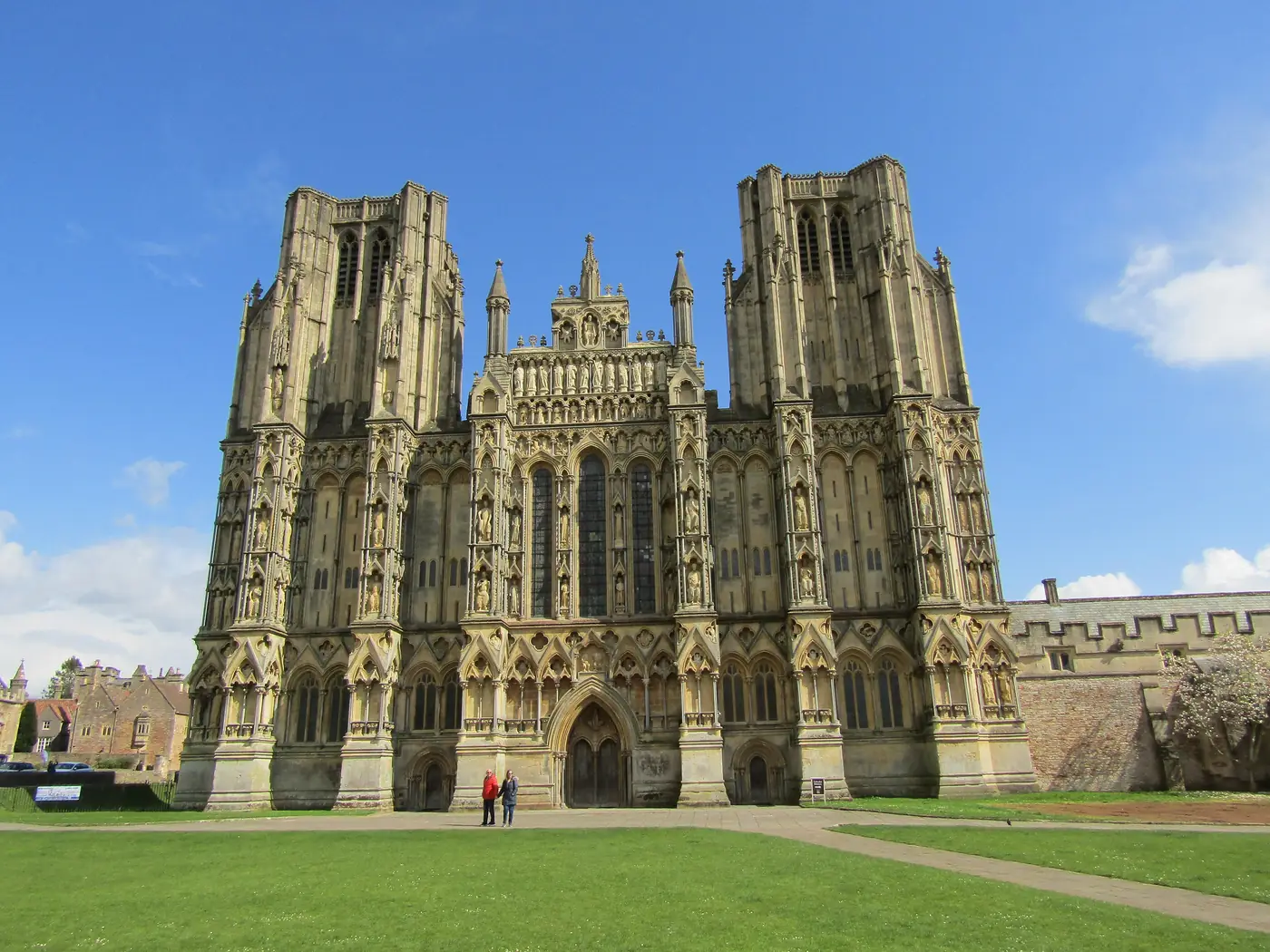
Wells Cathedral
The Visitor Entrance is on Cathedral Green, on your right as you face the building, and it has level access. Getting from there to the Nave is a ramp with a handrail — or five steps. That distinction matters and most summaries flatten it: a ramp is perfectly workable and it is not the same as level, and someone self-propelling deserves to know which they are about to meet.
From the Nave there is level access to the Quire, Cloisters, Undercroft, Camery Garden, Education Room, Choir Practice Rooms and the Cathedral Shop, with the Loft Café reached by lift. Accessible toilets sit in two blocks, one by the exit and one in the Friends Building. Wheelchairs are available on arrival subject to availability, or pre-book on 01749 672773.
The Chapter House is 31 well-worn steps with a handrail on the left, and the High Parts Tours involve extensive stairs, narrow passages and uneven floors. Neither is going to change. Assistance dogs are welcome.
The Bishop's Palace
Wide, mostly level garden paths, accessible toilets, and both a wheelchair and a mobility scooter available to hire. The platform lift has an 889 mm door, with a car 1473 mm wide and 965 mm deep — measure your chair against that rather than trusting the word "accessible". Some garden areas are gravel or grass, and the Rampart Walk and parts of the moat route involve steps.
The three blue-badge spaces must be booked at least 48 hours ahead — call 01749 988111 or email. This is the only hard advance requirement across all five days out, and Wells market days affect vehicle access through the centre independently of it. Make this the first call you make, not the last.
A Euan's Guide reviewer visiting in January 2025 praised the gardens, the staff and the accessible toilets but found the lift out of order, and described uneven cobbles near the entrance with smoother compressed gravel inside. One visit is not a permanent condition — it is a good illustration of why you confirm that the equipment is working on your date rather than that it exists.
Are these actually “easy” days out?
Not automatically, and the gap is worth naming. A venue can offer an accessible toilet and a ramp and still make for a hard day because of cobbles, gradients, distance between parking and entrance, crowding, a narrow lift, wet grass or a platform lift that is out of service. A free carer ticket solves an admission cost; it does not solve a transfer, fatigue or a missing Changing Places.
- Most predictable: Birdland and Stonehenge. Structured sites, published facilities, one focal point each.
- Most rewarding, most friction: Bath. The venues are good; the streets between them are historic.
- Best heritage value, most equipment-dependent: Wells. Two excellent sites, one platform lift, three parking spaces.
- Simplest in concept: Clevedon — provided the deck suits your wheels and the weather holds.
Before you go
- Book the Bishop's Palace parking 48 hours ahead if Wells is the plan.
- Send your measurements — chair or scooter width, length, weight and turning circle — rather than describing the device.
- Ask whether lifts, ramps, shuttles and accessible toilets are working on your date, not whether they exist.
- Confirm what a "changing facility" actually is — hoist and adult bench, or a wider cubicle.
- Check carer, companion and Access Card arrangements per venue; there is no single rule.
- Ask about assistance-dog access room by room, particularly cafés and exhibition spaces.
- Check event and market days, which change parking and pedestrian routing more than weather does.
- Get it in writing and reconfirm 48 hours out where the venue allows.
- Keep a fallback — a café, a toilet and a way home that does not depend on the thing you booked.
Common questions
Which day trip near Bristol is easiest for a wheelchair user?
Birdland at Bourton-on-the-Water has the most predictable facilities of the five: mostly level tarmac paths, free wheelchair hire bookable in advance, two accessible toilets and a genuine Changing Places with a hoist and changing bench beside The Nest café. Stonehenge is the other strong option because everything is concentrated around one visitor centre with an accessible shuttle. Clevedon Pier is the easiest short outing, though the deck planks are uneven. Bath offers the most to do and asks the most of your route planning.
Which of these have a Changing Places toilet?
Only two, and the distinction matters because Changing Places is a defined standard rather than a description. Birdland has a true Changing Places beside The Nest café, with a hoist, a changing bench, wall-mounted vertical grab rails and dropdown support rails. Bath Abbey has one too, but it is at below-ground level and reached by lift — worth knowing if the lift is what fails. Stonehenge provides an "adult changing area", which English Heritage does not describe as Changing Places. Wells has an adult changing facility behind the Town Hall, with key collection to confirm. Clevedon Pier and the Roman Baths list accessible toilets but do not advertise Changing Places.
Can a mobility scooter go on the Stonehenge shuttle?
A Class 2 scooter can, if it fits within 600 mm wide by 1000 mm long. The constraint people hit more often is capacity rather than size: each shuttle takes one wheelchair, scooter or pushchair per journey, so on a busy afternoon you may wait for the next one. The buses kneel and have ramps, no pre-booking is needed, and the run from outside the shop to the stones takes about ten minutes with an optional stop at Fargo Plantation if you want to walk or roll part of the way.
How accessible are the Roman Baths in Bath?
The Roman Baths state the site is 90% accessible to wheelchair users, with lifts serving the mezzanine displays, the lower museum, the Great Bath and the East Baths, and assistance and guide dogs fully welcome. The remaining 10% is the honest part: because the baths sit below ground in a genuinely Roman structure, some areas still require steps and some surfaces are uneven. Confirm your chair or scooter dimensions against the lifts before you travel, and ask about current wheelchair-loan arrangements and carer admission terms.
Do I need to book accessible parking at the Bishop\u2019s Palace in Wells?
Yes, and it is the single most missable requirement across these five days out. There are only three accessible spaces on site and they must be booked at least 48 hours before you arrive, on 01749 988111 or by email. Wells also holds regular market days that affect vehicle access through the city centre, so check the date as well as the space. If accessible parking is central to your plan, this is the phone call to make first, not last.
Is Wells Cathedral step-free?
Mostly, with one distinction worth knowing before you set off. The Visitor Entrance on Cathedral Green has level access, but getting from there to the main Cathedral floor means the West Cloister — either a ramp with a handrail or a set of five steps. From the Nave there is level access to the Quire, Cloisters, Undercroft, Camery Garden and Cathedral Shop, with the Loft Café reached by lift. The Chapter House is a well-worn flight of 31 steps with a handrail on the left, and the High Parts Tours involve extensive stairs, narrow passages and uneven floors. Wheelchairs are available on arrival subject to availability or can be pre-booked on 01749 672773.
Is Clevedon Pier suitable for a wheelchair?
Yes, with one caveat the Pier itself flags. Access is step-free: you enter through large gates and follow a slope down towards the pier and the Glass Box restaurant, which has wide double doors, and there is a lift serving the Porthole Room and an accessible toilet. The Pier\u2019s own information notes that the planks are uneven and that narrow wheels need a little extra care — so smaller front castors and some scooter wheels will feel the gaps more than others. Treat it as a short coastal outing paired with lunch locally rather than the start of a longer itinerary.
Do carers and companions get in free?
At several of these, yes, but the mechanism differs and that is what trips people up. Bath Abbey admits carers and support workers free. English Heritage admits a companion free at Stonehenge — either tell them on arrival or book the free place online in advance. Birdland operates a companion policy through the Access Card scheme and offers free registration at the venue as an alternative, so you do not have to hold a paid card to use it. Ask each venue rather than assuming a single national rule applies.
What if the lift is out of order when I arrive?
It happens, and it is the most common way an otherwise sound accessible day falls apart. A Euan\u2019s Guide reviewer visiting the Bishop\u2019s Palace in January 2025 found the lift out of service — one visit, not a permanent condition, but a good illustration of why written confirmation on the day matters more than a published access page. Ask specifically whether lifts, ramps, shuttles and accessible toilets are operational on your date, and have a fallback: for Wells that is the Cathedral and gardens rather than the Palace interior, and for Bath it is the Abbey ground floor rather than the Roman Baths lower levels.
How many of these can I combine in one day?
One, plus something small and local. Stonehenge in particular should be treated as a standalone destination — adding a second major attraction turns a manageable day into a rushed one, and the site has limited seating around the stones so the rest stops happen at the visitor centre. Wells is the only genuine pairing here because the Cathedral and the Bishop\u2019s Palace sit within a few minutes of each other. For a multigenerational group, plan one anchor plus one flexible add-on, assign one person to hold tickets, parking and equipment, and build in rest time that nobody has to ask permission for.
Fourth in our accessible-destination series. See also Accessible Madrid and Accessible Costa Blanca for Spain, where a 33% certified disability unlocks free entry at the state museums, and Accessible Los Angeles for the American version of this problem. For access at sea, the Royal Caribbean accessible cruising guide covers cabins, tenders and shore excursions.
Bristol as a base, or a UK stop before a cruise?
Send me your dates, your equipment and what the days have to achieve. I will confirm what is genuinely open and working when you travel, hold the answers in writing, and build the rest stops in — so the plan survives one broken lift.
Ask PaoloSources
- Clevedon Pier \u2014 Frequently asked questions and access
- The Roman Baths \u2014 Accessibility
- Bath Abbey \u2014 Accessibility
- Birdland Park & Gardens \u2014 Disabled access
- English Heritage \u2014 Stonehenge access
- English Heritage \u2014 Stonehenge accessibility guide (PDF)
- Wells Cathedral \u2014 Accessibility
- The Bishop’s Palace, Wells \u2014 Accessible tourist attraction
- Accessibility Guides \u2014 The Bishop’s Palace and Gardens
- Visit Bath \u2014 Accessible Bath
Images
- Clevedon Pier at sunset — Saffron Blaze, CC BY-SA 3.0, via Wikimedia Commons.
- Wells Cathedral west front — Colin Smith, CC BY-SA 2.0, via Wikimedia Commons.
Change disclaimer. Checked 28 August 2026. Opening hours, admission and companion policies, lift and shuttle availability, wheelchair-loan stock, parking arrangements and toilet facilities all change, and equipment can be out of service on any given day. This article is informational and is not a booking or a guarantee of availability. Where a venue's live information differs from anything here, theirs governs — confirm directly for your date.