A passenger cap is not a crowd-reduction scheme. It is a redistribution scheme — and the places receiving the redistributed passengers did not get any bigger.
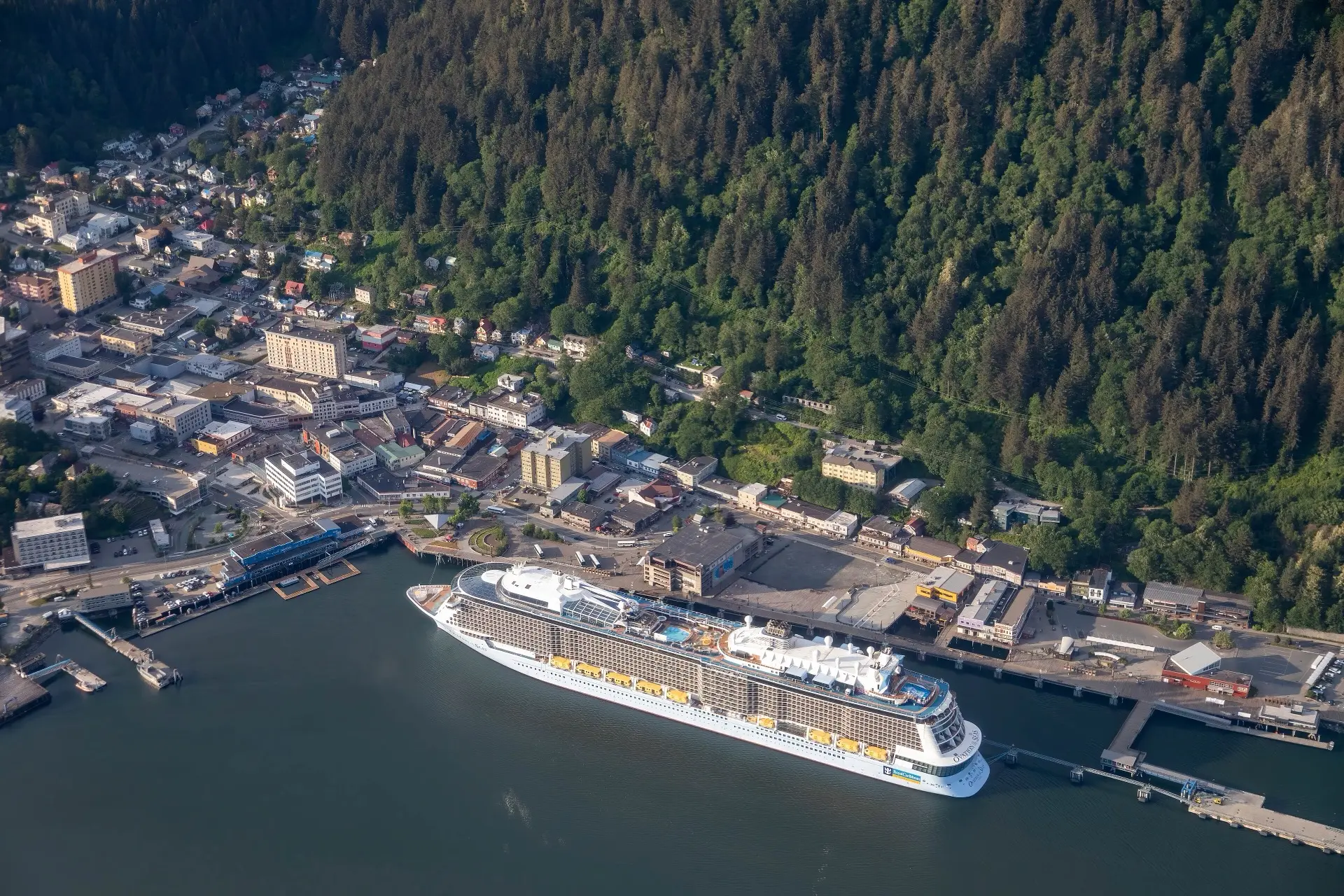
The 2026 Alaska season is the first under Juneau’s daily passenger limits, and the effect is exactly what you would expect: volume that cannot berth in Juneau berths somewhere else. Ketchikan is the main somewhere else. Meanwhile Skagway is running its largest dock under a restriction that has now been in place for four seasons and is not close to resolved.
None of this makes Alaska worse. It makes it a port-logistics problem rather than a show-up-and-wander one, and the difference between a good shore day and a rushed one is now mostly decided before you sail.
As of August 26, 2026 Port assignments, shuttle operations, mitigation timelines and excursion availability all change. Verify against the operator and the municipality before making any nonrefundable arrangement.
1 · Juneau: what the cap actually caps
Juneau’s limits come from an agreement between the City and Borough of Juneau and the Cruise Lines International Association — a negotiated arrangement with an annual review, not a municipal ordinance. Three numbers matter, and they did not all start at the same time.
- 16,000 passengers Sunday–Friday New for 2026 Scheduled lower-berth capacity, not a live headcount. Crew are not counted.
- 12,000 passengers Saturdays New for 2026 The deliberate quiet day. If your itinerary offers a choice, this is the one to take.
- Five ships Any single day Since 2024 Already in force for two seasons — not part of the 2026 change, though often reported as if it were.
The five-ship limit is routinely misreported as new. It has been in force since 2024. Only the passenger caps arrive in 2026. If you are comparing this season against last, the ship count is not what changed.
Two details decide how much the cap will actually be felt. It counts scheduled lower-berth capacity, not people who walk down the gangway — and ships routinely sail above lower-berth occupancy. And crew are excluded. The number of humans in downtown Juneau on a capped day is meaningfully higher than 16,000.
What the cap does remove is the extreme. Juneau previously saw up to roughly 21,000 passengers on its worst days. Flattening that is a real improvement. It is not the same as a quiet town.
Playing a capped Juneau day
- Take the earliest slot that exists. Mendenhall Glacier and the Mount Roberts Tramway are the two hard bottlenecks, and both are worst from mid-morning to early afternoon.
- Or invert it entirely. Late afternoon empties out as ships begin their all-aboard sequence. If your ship is a late departure, the last two hours ashore are the best two.
- Give independent transport a two-hour buffer against all-aboard. Ship excursions are held for; independent ones are not.
- If your itinerary includes a Saturday in Juneau, that is the good day — the cap is a quarter lower.
2 · Ketchikan: where the overflow went
Ketchikan is the port absorbing what Juneau turned away. Royal Caribbean cut downtown Juneau calls from four ships in 2025 to three in 2026 while keeping four ships in Alaska — the difference went to Ketchikan and Icy Strait Point. Ketchikan expects 58 ships this summer against 48 last year.
One correction worth making, because it is repeated everywhere. You will read that Ketchikan overtakes Juneau in 2026. That came from January scheduling projections. The figures published in March put Ketchikan at over 1.6 million passengers against Juneau’s 1.69 million — Juneau is still ahead. The accurate and more interesting claim is parity: two ports that were never close are now within a rounding error of each other.
-
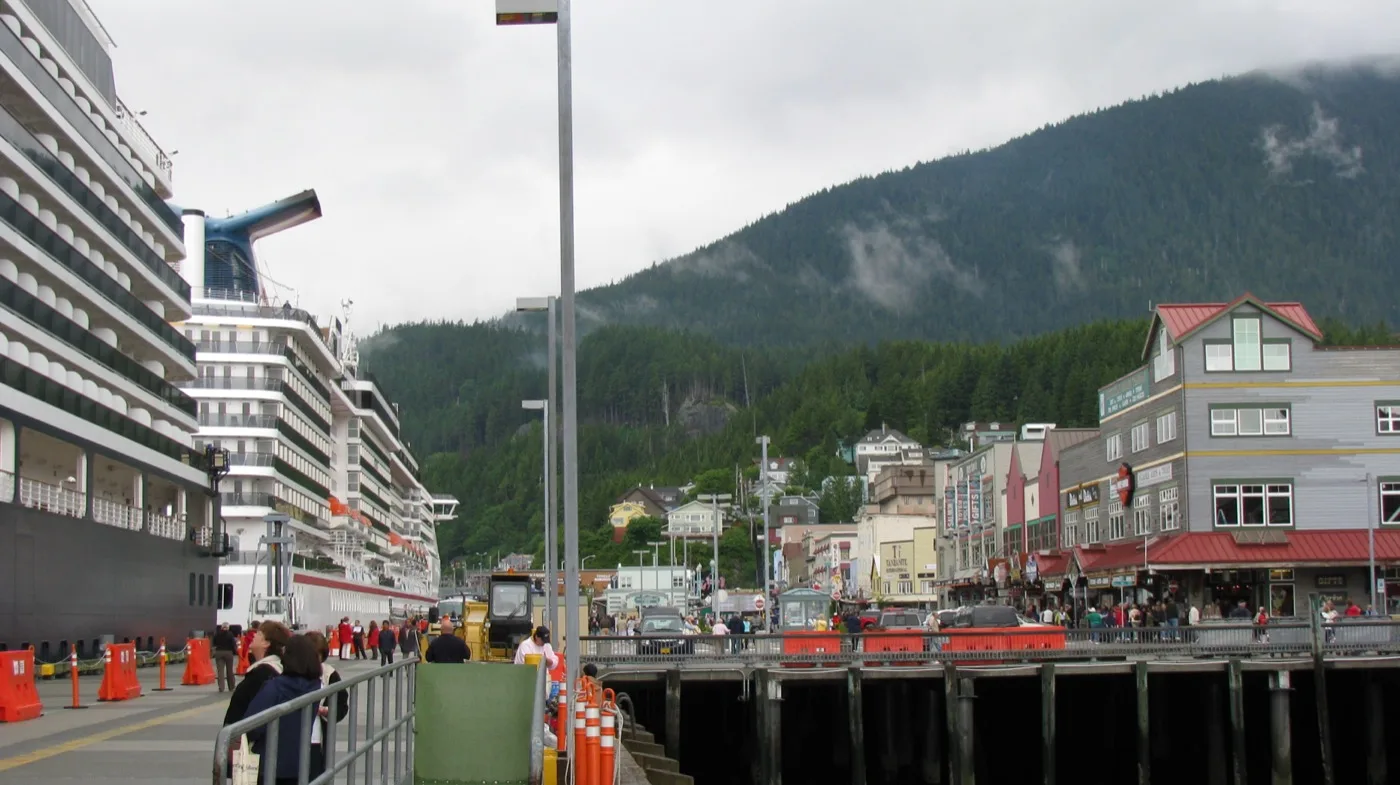
Downtown berths 1–4
Step ashore into town
You walk off the ship into Ketchikan. Creek Street, the totems and the shops are immediate. The trade-off is pavement density when several ships overlap — the sidewalks, not the attractions, are the bottleneck.
-
Ward Cove
About 7 miles north
A purpose-built facility with no town attached. A complimentary shuttle runs to downtown Berth IV, roughly a 20-minute drive each way. Your port day is structured entirely around that bus.
Ward Cove, run properly
- Choose excursions that collect at Ward Cove itself wherever the option exists — it removes the shuttle from the critical path entirely.
- If a tour departs downtown, budget a full hour each way, not the 20-minute drive. The queue, not the road, is the variable.
- Treat the second-to-last posted shuttle as your hard deadline. The last one is not a plan.
- Confirm your berth before you book anything. Assignments change, and Ward Cove versus downtown is the difference between a walkable morning and a bus-scheduled one.
The shuttle itself is free and the drive is short. The failure mode is not the road, it is the return queue at the end of the day when several thousand people want the same bus within the same hour.
3 · Skagway: the dock you cannot walk off
This is the most under-reported fact of the three ports. Skagway’s Railroad Dock — its largest — has been closed to pedestrians since summer 2022, after rockslides came down from the ridge above it. Reaching town means a shuttle bus or a small tender boat. That is the standing arrangement, not a bad-weather contingency, and it is now in its fourth season.
The fix is a roughly $20 million FEMA Building Resilient Infrastructure and Communities grant. Its recent history explains why nobody will give you a completion date:
- 2022Rockslides close the Railroad Dock to foot traffic.
- 2024–25Skagway is awarded the BRIC grant and receives $1.6M for Phase One design and engineering.
- Apr 2025FEMA moves to terminate the BRIC program; Skagway is reported as likely to lose nearly the whole $20M.
- 11 Dec 2025A federal court rules the termination of the congressionally mandated program unlawful.
- 6 Mar 2026The court orders FEMA to restart it. FEMA reopens the program and releases new funding.
- 2026Phase One — design and engineering only — is expected to complete. Construction is a later phase.
The practical reading: plan every Skagway call for 2026, and realistically beyond, as a transfer port. A tender cycle or a controlled pedestrian hold can add thirty to forty-five minutes to getting ashore. Never book a Skagway independent excursion with a tight, nonrefundable start time.
4 · Weather: the number everyone quotes is the wrong one
Almost every Alaska packing guide cites Juneau monthly rainfall averages. Those are nearly always Juneau Airport figures — and you will not be at the airport.
Downtown Juneau takes about 50% more precipitation a year than the airport eight miles away.
That is the Alaska Climate Research Center’s own comparison, and it reframes the whole packing question. If you have planned around a five-or-six-inch August, the waterfront you are actually standing on runs considerably wetter. September is wetter again than August across Southeast Alaska; Ketchikan is wetter still than Juneau; and Skagway is the consistent dry outlier, sitting in a rain shadow.
Daylight is the compensation. August still delivers roughly fifteen hours, which makes the early-morning and late-afternoon windows genuinely usable — and those are exactly the hours when the ports are quietest.
The three things that actually matter
- Waterproof, not water-resistant. A shell with taped seams. This is the one item where the upgrade is worth it.
- A dry bag for electronics. Phones die on tender boats and open excursion decks, not in the rain onshore.
- Non-slip footwear. Wet dock plating, wet gangways, wet rock.
Leave the umbrella on the ship. Narrow dock walkways and channel wind make it useless and slightly antisocial.
5 · If mobility is a factor
Alaska in 2026 is a harder accessibility problem than it was, because two of these three ports may put you on a shuttle or a tender rather than a gangway. Tendering is the single biggest variable for anyone using a mobility device, and it is decided by sea state on the morning.
Get the answers in writing before you commit to anything nonrefundable:
- Is this port a dock or a tender on my specific sailing date — in writing, per port?
- If Skagway is a tender or shuttle call, what is the boarding process for a mobility device?
- What is the vehicle ramp width and weight limit on this excursion?
- How many steps are there at each stop, and what is the surface underfoot?
- Must a mobility device fold to travel, and who lifts it?
The mechanics of getting those confirmations recorded against your booking — and the escalation route if an accommodation is missing when you board — are set out in our guide to documenting cruise accessibility requests.
Do the caps work?
Partly, and mostly for Juneau. The extreme days are gone and the town has a genuine quiet day each week. But a cap on one port is not a cap on a region: the ships still sail, and the passengers arrive somewhere. Ketchikan, Icy Strait Point and Sitka are absorbing the difference.
Juneau residents themselves are not uniformly sold. In the City and Borough’s own tourism survey, reported in January 2026, 31% said the visitor industry has an overall positive impact on their household and 10% said negative — with the largest group, 39%, saying both. Among that “both” group, 43% felt the positives outweigh the negatives against 31% the other way. Those last two numbers get quoted on their own as though they were the whole population’s view. They are not.
Planning Alaska well in 2026 is not about dodging other people. It is about knowing which berth you have, what stands between the ship and the town, and how much buffer that demands. Get those three right and the crowds stop being the story.
The Mediterranean is running the same experiment with different scenery — Santorini’s 8,000-passenger cap and the Corfu swaps are covered in our guide to 2026 Mediterranean port limits.
Planning an Alaska season
Berth assignments, tender exposure and shore-day sequencing are decided when the itinerary is chosen, not when you board. If you want an Alaska sailing built around the ports rather than the brochure, let’s talk.
Start planningFrequently asked
What is Juneau’s cruise passenger cap in 2026?
From the 2026 season, Juneau limits scheduled cruise arrivals to 16,000 passengers Sunday through Friday and 12,000 on Saturdays, under an agreement between the City and Borough of Juneau and the Cruise Lines International Association. A separate five-ship-per-day limit has already been in force since 2024. The caps count scheduled lower-berth capacity rather than live headcounts, and crew are excluded.
Does the Juneau cap mean the port will feel empty?
No. It removes the extreme days — Juneau previously saw up to around 21,000 passengers at peak — but 16,000 people is still a great many in a small downtown. Expect real congestion on Franklin Street, at the Mount Roberts Tramway and on Mendenhall Glacier transport between roughly mid-morning and early afternoon. The cap flattens the spike; it does not empty the town.
Has Ketchikan overtaken Juneau for cruise passengers?
Not quite, and the widely repeated claim that it has is based on January 2026 scheduling projections rather than counts. The figures reported in March 2026 put Ketchikan at over 1.6 million passengers for the summer against Juneau’s 1.69 million. The real story is parity: Ketchikan is expecting 58 ships against 48 in 2025, and the historic gap between the two ports has effectively closed for the first time.
What is the difference between Ward Cove and downtown Ketchikan?
Ward Cove is a cruise facility about seven miles north of Ketchikan, with no town attached. A complimentary shuttle connects it to downtown Berth IV in roughly 20 minutes each way. Downtown berths 1–4 put you directly into town on foot. Which one you get determines how you should plan the entire day, so confirm your berth before booking excursions.
Can you walk off the ship at Skagway’s Railroad Dock?
No. The Railroad Dock has been closed to pedestrians since summer 2022 following rockslides from the ridge above it. Passengers reach town by shuttle bus or by small tender boat. This is the standing arrangement rather than a weather contingency, so build the transfer into your day and avoid tight independent excursion connections.
How much does it rain on an Alaska cruise in August and September?
More than the commonly quoted figures suggest, because those are usually Juneau Airport numbers. The Alaska Climate Research Center notes that downtown Juneau — where your ship berths — receives about 50 percent more precipitation annually than the airport eight miles away. September is materially wetter than August across Southeast Alaska, Ketchikan is wetter still, and Skagway is the reliable dry outlier thanks to its rain shadow. Pack a waterproof shell rather than a water-resistant one.
Sources
- KTOO — Juneau negotiates a limit on cruise passengers
- KRBD / Alaska Public — Ketchikan expected to see record cruise passengers (March 2026)
- City and Borough of Juneau — Tourism Survey Report, 21 January 2026 (PDF)
- Municipality of Skagway — BRIC rockslide mitigation project
- KTOO — Skagway likely to lose nearly $20M in FEMA rockslide funds
- Alaska Climate Research Center (UAF) — Juneau climate
- The Mill at Ward Cove — shuttle schedules
Photography
- Ovation of the Seas at Juneau — David Brossard, CC BY-SA 2.0, via Wikimedia Commons (July 2023).
- Ketchikan downtown berths — Barek, Public domain, via Wikimedia Commons (cropped and resized).
Change disclaimer. This article is informational and is not a booking quote, nor medical, legal or accessibility advice. Cruise line policies, port assignments, berth allocations, shuttle operations, excursion availability and mitigation timelines all change. Everything here was verified at source on August 26, 2026. Confirm current details with the relevant municipality, operator or an accredited advisor before making nonrefundable arrangements.