Cabo is the only port in this series where the ship cannot come to you. Vessels anchor in the bay and tender passengers to the marina and Navy Dock area. The crossing is five to ten minutes; the queues at either end are what actually cost you the day, particularly with several ships in or a lively sea.
Everything below follows from that. One primary activity. Second stop within walking distance of the landing. The last hour untouchable. Cabo punishes ambition more than any other Caribbean or Mexican Riviera call — and it rewards a modest plan extremely well.
Pick one of three plans
| Plan | Cost | Distance from the tender landing | Risk | Best for |
|---|---|---|---|---|
| Marina and downtown only | Free, plus lunch | Stay within walking distance of the tender landing the whole day | Lowest — you can be back in the queue in minutes | Short calls, unsettled weather, mixed energy levels, access needs |
| Marina plus Medano Beach | Free walk, or ~$5 water taxi | 10–15 min on foot from the east side of the marina; 20–30 from the west | Low — you are still in town | Couples, solo travelers, anyone wanting a swim without a deadline |
| El Arco boat outing plus marina | ~$20 pp shared · ~$40–60 private hire | ~45 min on the water, departures roughly every 30 min from the marina | Moderate — boarding, sea state and return timing | The signature sight, if you accept the timing risk |
The low-commitment plan is not the lesser plan. On a short call, in unsettled weather, or with a group whose energy levels differ, staying near the marina is frequently the smartest thing you can do — and it is free. There is no prize for having boarded a boat.
El Arco: what it costs, and what you will be quoted
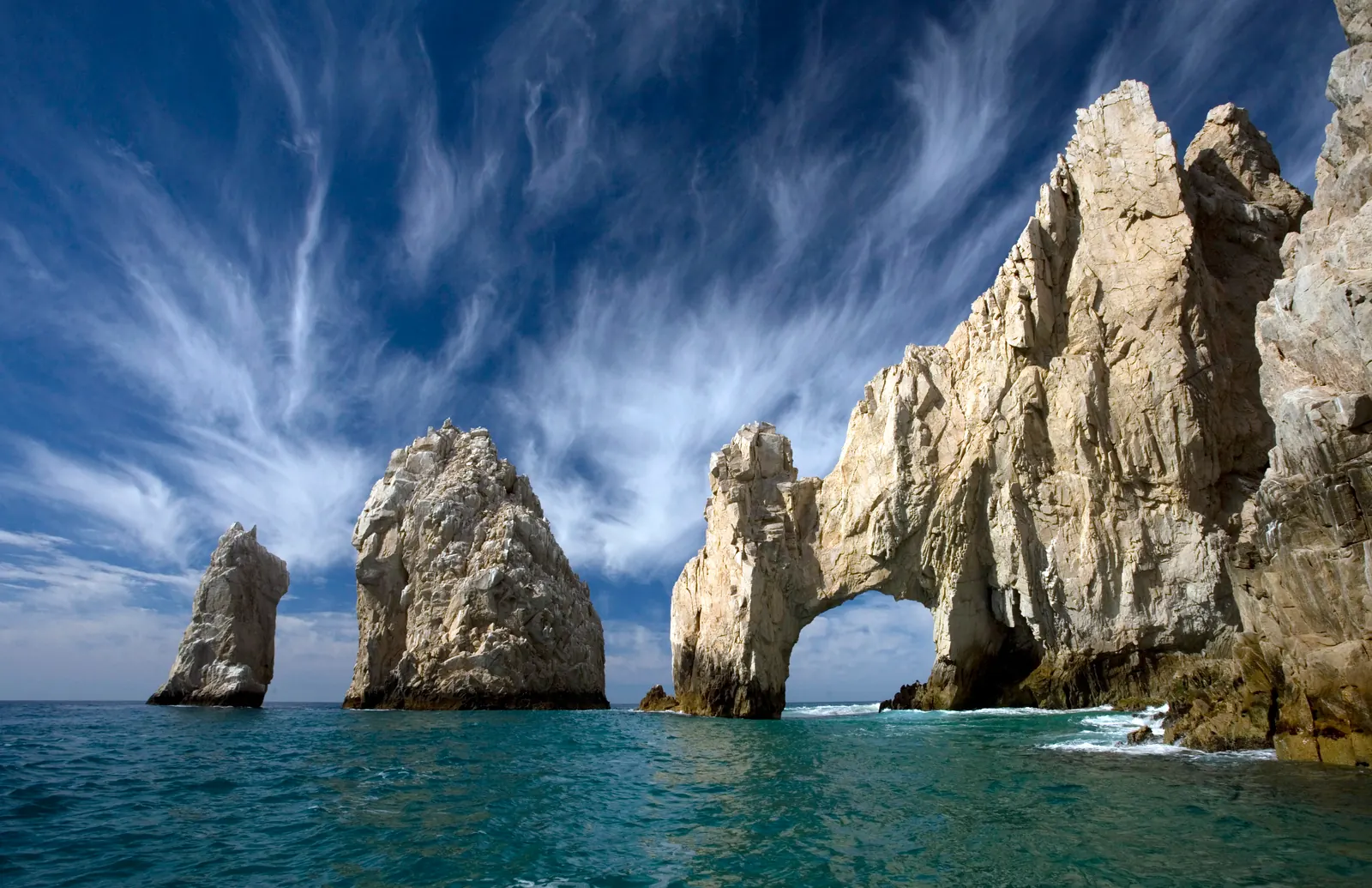
The Arch at Land's End is reachable only by water, and the standard way there is a shared glass-bottom water taxi from the marina — roughly 45 minutes, departures about every half hour, looping past the arch, the sea lion colony and Lover's Beach.
The going rate is about $20 per person — roughly 400 pesos. Expect the opening quote to be $40, $50 or $60. That is an anchor price to test whether you will take it, not the market. Twenty dollars is respectful and captains generally accept it immediately. A private boat runs about $40 to $60 for the whole vessel, which is the better buy from four people up. The draft advice to "confirm the price before paying" only works if you know what you are confirming it against.
What happens when the sea turns
A real answer rather than a caveat: the Harbor Master suspends landings at Lover's Beach when wind, wave height and currents make them unsafe. During a mar de fondo swell that can lift later the same day or persist for a couple of days. Reputable operators convert the outing to a bay cruise — photographs at the Arch and the sea lions, no landing. Ask what the operator does in that case, and whether the price changes, before you pay.
Boarding is the accessibility question, not the boat
Small open boats can mean stepping across a gap onto a moving platform, and the assistance available varies by operator rather than being standardized. Before money changes hands:
- Where exactly does boarding happen, and how many steps or transfers does it involve?
- Can you take a mobility device aboard, and is there somewhere to secure it?
- Is flotation equipment available in the right size?
- What happens if conditions change mid-outing?
- What is the guaranteed return time and arrangement?
Medano Beach: ten minutes, or five dollars
Medano is Cabo's main swimmable beach and the natural second stop. From the east side of the marina it is a 10 to 15 minute walk; from the west side, 20 to 30 minutes in full sun. There is also a water taxi from about 100 meters to the right of the tender pier for roughly $5 — the better call in heat, or with anyone who tires.
Beach access itself is free. The spend is on chairs, shade and service from the beach clubs along it. And reaching the beach is not the same as moving comfortably across soft sand: ask about chairs, shaded seating, accessible routes and beach-wheelchair availability before you commit a mobility-limited member of the group to it.
What the day costs
| Item | Cost | What it covers | The detail that matters |
|---|---|---|---|
| Shared water taxi to El Arco | ~$20 per person (~400 pesos) | Glass-bottom loop past El Arco, the sea lion colony and Lover’s Beach, ~45 min | Vendors open at $40–$60. $20 is the going rate and is usually accepted |
| Private water taxi | ~$40–$60 for the boat | Same loop, your own schedule | For four or more people this can beat the per-person rate |
| Water taxi to Medano Beach | ~$5 | From about 100 m right of the tender pier | The alternative to a 10–15 minute walk in full sun |
| Medano Beach itself | Free to access | Cabo’s main swimmable beach | Chairs, shade and service are club-operated — that is where the spend is |
| Marina and downtown | Free | The promenade, the shops, the restaurants, the view of the bay | The baseline this whole guide is built on |
For a couple: about $40 for the Arch, $10 in water taxis, and lunch. Under $100 for the pair including a decent meal, with the marina, the promenade and the beach itself costing nothing. Cabo is not an expensive port. It is a tight one.
The eight-hour clock
| Window | Phase | What you are doing | The thing people get wrong |
|---|---|---|---|
| 0:00–1:00 | Tender ashore, orient | Boarding, a 5–10 minute crossing, disembark. Find the return-tender point before you walk away | Note the last-tender time in writing. Not from memory, not from a verbal estimate |
| 1:00–3:00 | Your one primary activity | The Arch by boat, Medano, or the marina and downtown. Pick one | Cabo punishes ambition more than any other port in this series |
| 3:00–4:00 | Lunch | Somewhere near your return route. Confirm total, service charge and payment method first | Carry pesos and a card. Dollar acceptance, rates and change are not universal |
| 4:00–6:00 | One low-stress second thing | A marina stroll, a shaded drink, a short browse. Nothing that needs a boat | If the first activity ran late, this block becomes return preparation |
| 6:00–7:00 | Move toward the queue | Back to the marina / Navy Dock area, allowing for heat, regrouping and lines | Independent tours should target well inside the ship’s stated minimum |
| 7:00–8:00 | Ship buffer | Join the queue. Keep ID, medication, water and mobility equipment with you | 60 minutes is a floor, not a target. At a tender port it is the whole plan |
Find the return-tender point before you walk away from it, and note the last-tender time in writing — photograph the posted information if you are allowed to. At a docked port a vague memory of the all-aboard time is survivable. At an anchorage, with a queue between you and the ship, it is not.
Two things that are seasonal
- Whales: 15 December to 15 April. Operators must hold a SEMARNAT permit under NOM-131-SEMARNAT-2010 and fly that season's whale-watching flag — so you can check for a permit by looking at the boat. Approach limits are 60 to 80 meters by vessel size, and for the 2025–26 season the area around the Arch itself was restricted because of boat traffic, so do not assume Arch-plus-whales is one trip.
- Sea lions: September to May. The colony on the flat rocks near the Arch — La Lobera — heads north to breed in June, July and August and is largely absent then. If you are calling in high summer and the sea lions are why you are paying, ask what is currently on the rocks.
Accessibility: the transfer, not the promenade
Tender boarding is the issue, and nothing ashore solves it. The marina and waterfront are paved and among the more manageable port areas in the region — that is real, and it is irrelevant if the ship-to-shore transfer does not work.
Contact the cruise line's accessibility team before sailing and ask specifically: device dimensions and weight limits, whether a transfer out of the chair is required, what crew are permitted to lift, and whether tender access for mobility equipment can be withdrawn because of sea conditions. That last one catches people, because it is a judgment made on the morning, not a policy you can read in advance. Get the answers in writing.
Is Cabo safe?
Baja California Sur is rated Level 2, “Exercise Increased Caution” by the US State Department — the same tier as France, Italy, Germany and the United Kingdom — with no travel restrictions attached. That reference point is worth more than an adjective.
In practice the marina, downtown and Medano are active, heavily trafficked visitor zones. Use licensed operators, agree prices before committing, keep passports and medication secure, and expect the vendor approaches along the marina to be persistent rather than threatening. Solo travelers in particular: do not accept an informal boat invitation without confirming operator, price, duration, boarding point and return time.
Shaping the day around who you are with
- Solo: the marina plan, or a ship excursion with a stated return arrangement. Share your plan with someone aboard and keep your phone charged. The $20 shared water taxi is a sociable way to see the Arch without a full group day.
- Couples: marina plus Medano is the most forgiving shape. If you add the boat, ask about the operator's weather policy — refund, reschedule, or converted bay cruise.
- Multigenerational groups: one meeting point, different energy levels tolerated. Some walk to Medano, some stay on the promenade. Do not build a plan that requires the least mobile person to follow the most ambitious one.
- Access needs: settle the tender question with the cruise line before you sail. Everything else is downstream of it.
Where Cabo disappoints
Worth saying plainly. Cabo is a poor fit if you cannot manage a tender transfer and your cruise line has not confirmed a workable arrangement — the marina being pleasant does not solve the boarding problem. It also disappoints anyone expecting a quiet, untouched beach day: the marina and Medano are busy commercial visitor zones and the vendor approaches are constant. Heat, wind, swell, traffic and crowded tenders all take usable hours out of the day.
None of that makes it a bad port. It makes it a port where the modest plan wins and the ambitious one frequently does not.
Before you pay
- Confirm the actual port-call and all-aboard times, not the brochure schedule.
- Ask the cruise line about current tender and mobility-device rules — before sailing, not on the morning.
- Know the going rate before you negotiate: ~$20 per person for the shared Arch loop.
- Agree total price, currency, payment method and gratuity up front. Carry pesos and a card.
- Ask the weather-policy question — refund, reschedule, or converted bay cruise.
- Reconfirm tours, meeting points and return timing 48 hours out, and get promises in writing.
- If the ship changes the anchorage, tender process or all-aboard time, rebuild the plan.
Common questions
Is Cabo San Lucas a tender port?
Yes. Ships anchor in Cabo San Lucas Bay and passengers transfer by tender to the marina and Navy Dock area — the crossing itself is only about five to ten minutes, but the queues at each end are what actually cost you time, particularly when several ships are in or the sea state slows operations. That single fact should shape the whole day: plan one primary activity rather than three, keep your second stop within walking distance of the landing, and treat the last hour as untouchable.
How much should a water taxi to El Arco cost?
About $20 per person, roughly 400 pesos, for a shared glass-bottom run of around 45 minutes taking in El Arco, the sea lion colony and Lover’s Beach. Departures leave the marina roughly every half hour. Expect vendors to open at $40, $50 or even $60 per person — that is an anchor price to see whether you will take it, not the going rate. Twenty dollars is respectful and usually accepted immediately. A private boat runs about $40 to $60 for the whole vessel, which beats the per-person rate once you are four or more.
Can I walk to Medano Beach from the tender landing?
Yes, and how long it takes depends on where you come ashore. From the east side of the marina it is a 10 to 15 minute walk; from the west side, 20 to 30 minutes in full sun. There is also a water taxi from about 100 meters to the right of the tender pier for roughly $5, which is the better option in heat or with anyone who tires easily. Access to the beach is free — the money goes on chairs, shade and service from the beach clubs along it.
Can I see El Arco without booking a cruise-line excursion?
Easily — this is one of the more straightforward independent excursions in the region, with shared boats leaving the marina roughly every half hour for about $20 a head. What you take on is timing risk: nobody is holding the ship for a water taxi. Go early rather than late, tell the captain you are off a cruise ship and when you need to be back, and treat any outing that would return inside your buffer as a no. The convenience of booking through the ship is return protection, and at a tender port that is worth more than it sounds.
Are boat trips to El Arco accessible?
Do not assume so. Small open boats may require stepping across a gap onto a moving platform, and the assistance available varies by operator rather than being standardized. Ask before you pay: exactly where does boarding happen, how many steps or transfers are involved, can you take a mobility device aboard, is flotation equipment available in the right size, what happens if conditions change, and what is the guaranteed return arrangement. Get the answers before money changes hands, not at the dock.
What happens to a boat trip if the sea gets rough?
The Harbor Master monitors wind, wave height and currents and suspends landings at Lover’s Beach when conditions are unsafe — during a mar de fondo swell event that restriction can lift later the same day or last a couple of days. Reputable water-taxi and glass-bottom operators respond by converting the outing to a bay cruise, with photographs at El Arco and the sea lion colony but no landing. Ask what the operator does in that situation before you pay, and whether it changes the price.
When is whale watching season in Cabo San Lucas?
The official season runs 15 December to 15 April. Operators must hold a SEMARNAT permit under NOM-131-SEMARNAT-2010 and fly that season’s whale-watching flag, which is genuinely useful because it means you can check for a permit by looking at the boat rather than taking someone’s word. Boats must stay 60 to 80 meters off, depending on vessel size. Note that for the 2025–26 season the area around the Arch itself was restricted because of boat traffic, so a combined Arch-and-whales trip is not something to assume.
Will I see the sea lions?
Between September and May, reliably. The California sea lion colony on the flat rocks near El Arco — La Lobera — heads north for the breeding season in June, July and August and is largely absent then. If you are calling at Cabo in high summer and the sea lions are the reason you are paying for the boat, adjust your expectations, or ask the operator directly what is currently on the rocks before you book.
Is Cabo San Lucas safe for cruise passengers?
Baja California Sur is rated Level 2, "Exercise Increased Caution", by the US State Department — the same tier applied to France, Italy, Germany and the United Kingdom — with no travel restrictions attached. That reference point is more useful than an adjective. In practice the marina, downtown and Medano are active, heavily trafficked visitor zones. Use licensed operators, agree prices before you commit, keep passports and medication secure, and expect vendor approaches along the marina to be persistent rather than threatening.
What is the biggest accessibility issue at Cabo?
Tender boarding, and it is not close. The marina promenade is paved and among the more manageable port areas in the region, but none of that helps if the ship-to-shore transfer does not work. Contact the cruise line’s accessibility team before sailing and ask specifically about device dimensions and weight, whether a transfer out of the chair is required, what crew can and cannot lift, and whether tender access for mobility equipment can be withdrawn because of sea conditions. The answer is cruise-line and sea-state specific, so get it in writing.
Fifth in our port-guide series, and the only tender port in it — which is exactly why the others are useful comparisons. Cozumel and San Juan charge taxi fares per cab; St. Thomas charges per person; Grand Turk puts a free beach at the end of the pier. See also Perfect Day at CocoCay and the ports worth skipping in 2026.
Mexican Riviera itinerary to plan?
Cabo is usually one call in a run that also takes in Puerto Vallarta and Mazatlán, and they want completely different days. Send me your itinerary and I will tell you which calls deserve an excursion, which are a walk and a good hat, and — at the tender ports — where the timing genuinely does not work.
Ask PaoloSources
- Visit Los Cabos — accessible travel guide
- Visit Los Cabos — Medano Beach
- The Cabo Sun — the 2026 price for a water taxi ride to the Los Cabos arch
- Mr Playas — El Arco Cabo San Lucas 2026: boat tours, sea lions and landing conditions
- Whale Watch Cabo — whale watching regulations (SEMARNAT permits, NOM-131 approach limits)
- The Cabo Sun — rules for whale watching in Los Cabos, including restricted zones
- Cruise Critic — Cabo San Lucas cruise port
- U.S. Department of State — Mexico travel advisory (Baja California Sur, Level 2)
Images
- El Arco at Land’s End, Cabo San Lucas — Comisión Mexicana de Filmaciones, CC BY-SA 2.0, via Wikimedia Commons.
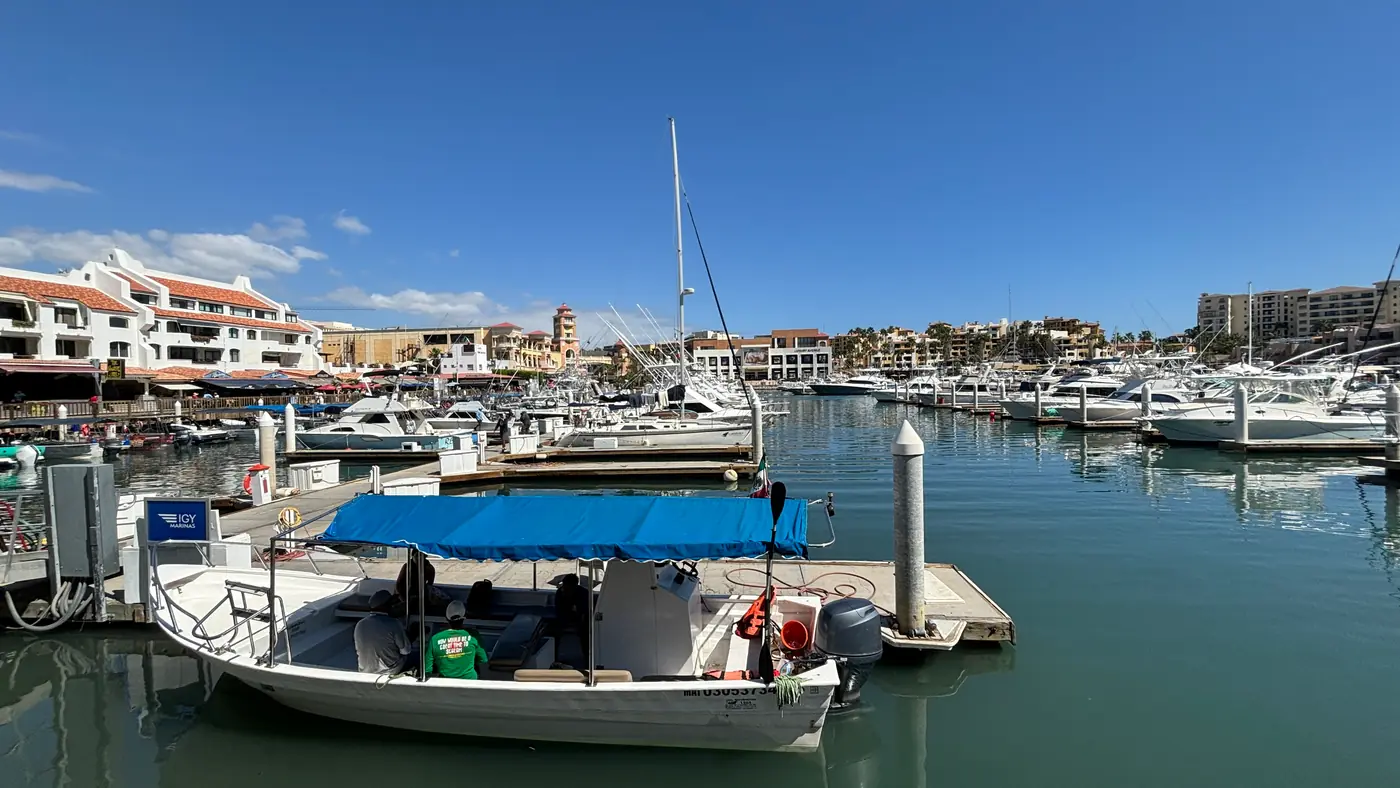
- Cabo San Lucas marina — Alexis Doine, CC0, via Wikimedia Commons.
Change disclaimer. Checked August 29, 2026 against Visit Los Cabos, published 2026 water-taxi pricing, SEMARNAT whale-watching regulation and season dates, Harbor Master landing practice and the US State Department Mexico travel advisory. Water-taxi fares are negotiated rather than posted, so the figures here are the going market rate and not a tariff; peso equivalents move with the exchange rate. Tender procedures, sea conditions, operator capability, landing restrictions, seasonal wildlife, port operations and all-aboard times all change, sometimes on the morning. This article is informational and is not a booking, a quote, or a guarantee of availability, pricing, accessibility or ship schedules. Where the cruise line, the port, the Harbor Master or an operator differ from anything here, theirs governs.