There is no adopted federal design standard for cruise ship accessibility. That single fact explains why your paper trail is not administrative tidiness — it is the protection.
The U.S. Access Board began drafting accessibility guidelines for passenger vessels in 1998. It released proposed guidelines for large vessels for public comment in June 2013. Thirteen years later the Board’s own page still describes them as not yet finalized. Cruise ships remain covered by the ADA and by the Department of Transportation’s rule at 49 CFR part 39, and the Justice Department has enforced against lines including Carnival and Norwegian — but there is no adopted dimension table a ship is measured against.
So when a phone representative says “we should be able to assist”, there is no standard behind the sentence and no record of it. What there can be is a written confirmation naming a cabin number and a feature list, attached to your reservation. That is the difference between a request and an accommodation, and everything below is about producing it.
As of 26 August 2026 Accessibility policies, deadlines, tender conditions, port entry rules and equipment guidelines change frequently and without notice. Re-verify every specification directly with the line and with any third-party vendor before you sail.
1 · The deadlines, by line
These are the dates each line publishes on its own material. Two things to hold in mind before you read them. First, a deadline is the last date a request will be accepted — not a date by which anything is guaranteed. Second, accessible cabins are a small fixed inventory on every ship, and they routinely sell out months before any of these windows open.
| Cruise line | General requests | Sign-language interpreting |
|---|---|---|
| Royal Caribbean | 30 days | 60 days |
| Celebrity | 30 days | 60 days |
| Norwegian | 45 days | 90 days |
| Virgin Voyages | 45 days | 45 days |
| Carnival | At booking | 60 days |
- Royal CaribbeanSubmit at time of booking but no later than 30 days prior to sailing.
- CelebritySame wording as Royal Caribbean — same parent company, same Access Department structure. Interpreting is offered on cruises to and from the U.S. and Canada only.
- NorwegianThe longest interpreter lead time of any line checked. Ninety days is roughly a month before most final payments fall due.
- Virgin VoyagesOne combined window: "make every effort to contact us at least 45 days in advance of your voyage date."
- CarnivalNo universal form deadline published, but three specific ones are: 60 days for interpreters, service-animal documents no later than one week prior, and 14 days for a lift-equipped airport transfer.
Interpreting is the outlier worth circling. Norwegian wants 90 days. That is earlier than most people have finished choosing an itinerary, and roughly a month before final payment falls due. It is also, on every line that offers it, limited to sailings to and from the U.S. and Canada and shared among eligible guests — so being inside the deadline is necessary and not sufficient.
No published number is not the same as no deadline. Holland America Line, Princess Cruises, Disney Cruise Line, MSC Cruises do not state a universal day count on their current public pages. That is a reason to call the access desk and get the lead time in writing for your specific request, not a reason to assume you have time.
2 · Vague requests get vague answers
Operational teams cannot act on adjectives. “Needs an accessible room” tells a cabin allocator nothing they can check against a deck plan. The useful test: could someone who has never met you confirm or refuse this request without calling you back? Here is the same four requests, written both ways.
-
Instead of “Wheelchair user”
Write Permobil M3 power chair · 24.5in wide × 41in long × 38in high · 335 lb with batteries · non-spillable gel batteries · does not fold
Width decides whether it clears the door. Weight decides whether it can go on a tender or a lift-equipped coach. Battery chemistry decides whether it is allowed aboard at all.
-
Instead of “Needs an accessible room”
Write Roll-in shower with fold-down bench · bed clearance 30in on the left side for a single-side transfer · grab bars at toilet and shower · raised toilet seat · shower chair
Accessible cabins are not one product. A cabin with a roll-in shower may still have a bed pushed to a wall, which makes a left-side transfer impossible.
-
Instead of “I have allergies”
Write Coeliac disease — gluten cross-contact protocol required · severe tree-nut allergy · request first-night consultation with the head waiter
An allergy list gets a note on a booking. A named condition with a handling protocol gets a galley process and a named person to find on night one.
-
Instead of “I use oxygen”
Write Inogen One G5 portable concentrator · plus 6 × E-size cylinders delivered to the pier by [vendor] on [date] · two 110v outlets required at the bedside
Most lines do not supply or coordinate oxygen. Virgin states outright that Sailors must make independent arrangements for rental, delivery and return — the ship cannot transfer cylinders for you.
Where the device is stored
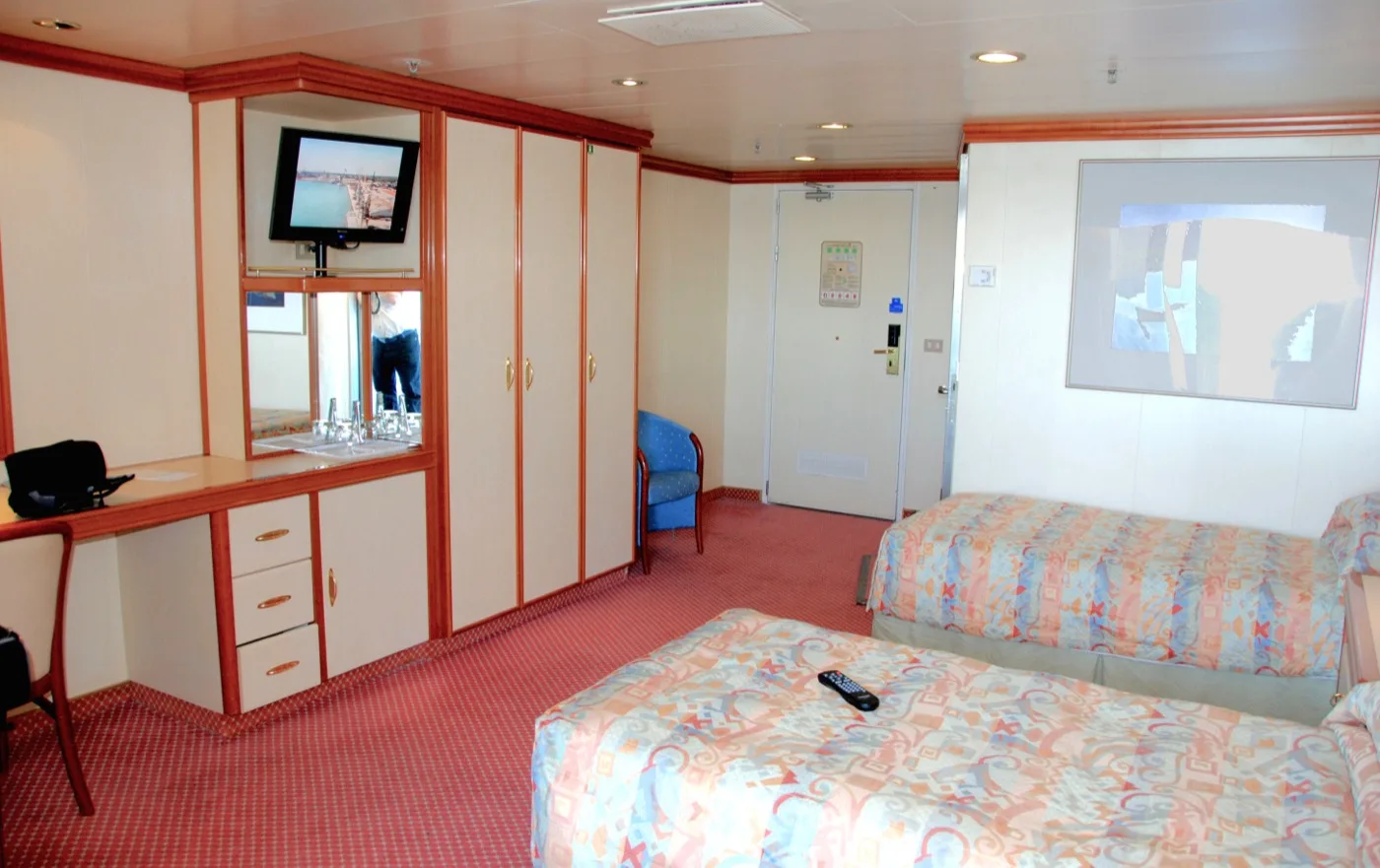
Confirm your device fits through the stateroom door and stows inside the cabin. Corridor storage is not a fallback: Carnival states that mobility devices cannot be stored in corridors or public areas, and Virgin tells Sailors bringing a scooter that it must be stored in the cabin when not in use — which is why it steers them to a Fully Accessible cabin. A device that does not fit inside your room is a problem discovered at 4pm on embarkation day.
Medication that needs cold storage
Do not assume the cabin minibar will do. It is a beverage cooler, not a validated medical refrigerator, and no line publishes a guaranteed holding temperature for it. Request medical-grade storage through the ship’s medical centre explicitly, get the approval in writing, and keep essential medication in your carry-on rather than checked luggage — the bag that follows you to your cabin hours later is the wrong home for anything you need that evening.
Service animals: boarding is not landing
Provide task-training documentation, breed, size, vaccination records and microchip details, and ask about relief-station arrangements. Then treat the ports as a separate problem, because they are. Carnival puts it bluntly: documentation that allows your service dog to board does not guarantee permission to go ashore, and you are responsible for obtaining the permits each port authority requires. Daily care is yours too — Virgin states that care and supervision of the dog is the sole responsibility of the owner and that its ships will not provide food or care for the animal.
The limit staff cannot cross
Cruise line staff do not provide personal care — dressing, bathing, eating, toileting or lifting. This is universal and it is not negotiable at the pier. If you need that support, a capable companion must travel with you, and the booking should say so.
3 · Building the paper trail
Submitting the form is the easy half. The half that protects you is evidence that your guest profile reflects what you asked for. Four habits do almost all of the work.
- Ask for a written receipt. Not “noted on your booking” — an updated reservation summary that itemises every approved accommodation and names the cabin.
- Log the human. Representative’s name, date, time, extension, and every case or ticket number. This is what makes a later complaint specific instead of a story.
- Keep it in two places. PDFs in cloud storage and printed pages in your embarkation folder. Terminal wifi fails at exactly the wrong moment.
- Reconfirm twice. Once at 48 hours out, once with Guest Services within an hour of boarding — while the ship is still alongside and problems can still be fixed ashore.
The email that actually gets a useful reply
The trick is the last sentence. Asking a line to confirm what is approved gets you a cheerful list. Asking it to identify what is not guaranteed is what surfaces the third-party dependency nobody mentioned.
Please confirm in writing that the following accommodations are recorded on reservation [Number] for [Guest Name], sailing on [Ship] on [Date]: [exact list — e.g. roll-in shower cabin #XXXX, medical refrigerator, CPAP extension cord].
Please also identify any request that remains pending, is subject to operational availability, or is managed by a third-party vendor rather than by the cruise line.
4 · The escalation route you are never told about
If something is missing when you board, most advice tells you to find a Guest Services manager. There is a better answer, and it is written into U.S. regulation.
-
Ask for the Complaints Resolution Official
Not "the accessibility officer" and not "a manager". The CRO is a defined role under 49 CFR §39.101, and every passenger vessel operator must make one available on each vessel and at each terminal it serves, at no cost to you. Say the words "Complaints Resolution Official" and the conversation changes.
-
Know that staff must volunteer this
If you raise an accessibility concern and front-line staff do not resolve it or provide the accommodation, they are required to tell you — immediately, and in a format you can use — that you may contact a CRO, and where to find them. Most people are never told.
-
Understand what a CRO can actually do
The CRO must have the authority to overrule any other member of staff. The single exception is that a CRO cannot countermand the master of the vessel on a safety matter. This is why escalating to a CRO is materially different from escalating to a supervisor.
-
Get the written statement you are owed
If a violation has already happened, the CRO must give you a written statement summarising the facts and what the line proposes to do — or, if they disagree, why. It must be handed to you in person where possible, otherwise sent within 10 calendar days. It must also tell you of your right to complain to DOT or DOJ.
-
File in writing inside 45 days
A line is not required to respond to a complaint sent more than 45 days after the incident. Inside that window, it must give a dispositive written response within 30 days that specifically admits or denies that a violation occurred. Say whether you spoke to a CRO, name them, and attach their statement.
Who to go to afterwards
Three bodies, three jobs, and they are routinely confused. The Department of Transportation owns the rule — 49 CFR part 39 — which applies to U.S. and foreign-flag vessels alike. The Department of Justice enforces against Title III private entities, which is what the major cruise lines are. The Federal Maritime Commission does not enforce accessibility law at all; its Office of Consumer Affairs and Dispute Resolution Services offers free ombuds assistance and mediation, limited to passengers who boarded at a U.S. port and bought directly from the line, and it cannot compel a line to do anything. Useful, but it is a negotiator, not a regulator.
5 · What documentation cannot buy
Being honest about the ceiling is part of the advice. A perfect paper trail does not move a gangway angle or calm a swell.
Tender ports are the reliable heartbreak. Where a ship anchors offshore and ferries guests in by small boat, boarding depends on sea state, swell and the angle of the transfer. Power-chair users and travellers with limited mobility are turned away on the morning, at the crew’s discretion, on ports that looked perfectly accessible on paper. Identify every tender port on your itinerary before you sail and decide in advance what a good sea day aboard looks like instead.
Shore excursions carry the same caveat one level down. A generic “accessible” tag on an excursion tells you nothing useful. Ask for the vehicle’s lift capacity, the number of steps at each stop, the terrain, the device weight limit and whether the excursion involves a tender. Excursions are frequently run by third-party operators, which is exactly the category your confirmation email should be forcing the line to disclose.
A working advisor helps here — within limits
An advisor who works in accessible travel is useful for the parts that need cross- referencing: physical cabin dimensions and pillar positions across ship classes, deadline and vendor-delivery tracking, and separating what the line guarantees from what a third party controls. What no advisor can do is override a safety policy or manufacture accessible inventory that does not exist. If someone promises either, that is the tell.
If you are looking at Royal Caribbean specifically, the ship-by-ship cabin dimensions, turning radii and class differences are set out in our complete accessible cruising guide to Royal Caribbean.
6 · The pre-sailing checklist
- Accessibility form submitted to the line’s Access Desk, dated, with a copy saved.
- Device width, length, weight and battery chemistry measured — not estimated — and checked against the stateroom door.
- Written confirmation received naming the specific cabin number and the specific features.
- Medication storage, CPAP power and extension-cord needs approved in writing.
- Port-entry paperwork for a service animal researched per port, not per cruise.
- Tender ports identified, with a backup plan for each.
- Paper trail printed and in your carry-on, not only in the cloud.
- CRO escalation wording saved in your phone.
The goal is not a thicker folder. It is that nothing on embarkation day depends on someone remembering a phone call.
Frequently asked
How far in advance should I submit a cruise accessibility form?
At booking. The published deadlines run from 30 days (Royal Caribbean, Celebrity) to 45 days (Norwegian, Virgin Voyages) before sailing, and sign-language interpreting runs longer still — 60 days on Royal Caribbean, Celebrity and Carnival, and 90 days on Norwegian. Those are the last dates a request will be accepted, not the dates by which anything is guaranteed. Accessible cabins are a small, fixed inventory and are usually gone long before the deadline.
Is a phone call to the cruise line enough to confirm an accommodation?
No. A phone call creates no record you can produce at the pier. Ask for an updated reservation summary by email that itemises each approved accommodation and names the cabin number. Log the representative’s name, the date and time, and any case number. If it is not on your guest profile in writing, treat it as unconfirmed.
What is a Complaints Resolution Official on a cruise ship?
A CRO is a role required by U.S. regulation (49 CFR §39.101). Every passenger vessel operator must make a CRO available on each vessel and at each terminal, free of charge, and the CRO must have authority to overrule other staff — the one exception being the master’s decisions on safety. If a violation has occurred, the CRO must give you a written statement, in person where possible or within 10 calendar days otherwise.
Are cruise ships required to meet ADA accessibility design standards?
Not in the way buildings are. The U.S. Access Board proposed Passenger Vessels Accessibility Guidelines for public comment in June 2013, and its own site still describes them as not yet finalized. No adopted federal design standard for cruise ship accessibility exists. Cruise ships are still covered by the ADA and by 49 CFR part 39, and the Department of Justice has enforced against lines including Carnival and Norwegian — but there is no dimension table a ship must hit. That is why a written confirmation naming your cabin matters more here than in a hotel.
Does permission to bring a service animal aboard mean it can go ashore?
No, and this catches people out. Carnival states plainly that documentation allowing your service dog to board does not guarantee permission to go ashore, and that you are responsible for obtaining the permits each port authority requires. Research entry rules port by port, well before you sail.
What can I do if the cruise line will not fix an accessibility problem?
Escalate to the CRO on board and get their written statement. Afterwards, file a written complaint with the line within 45 days of the incident — it must respond within 30 days, admitting or denying a violation. Beyond that, the Federal Maritime Commission’s Office of Consumer Affairs and Dispute Resolution Services offers free ombuds assistance if you boarded at a U.S. port and bought directly from the line, though participation is voluntary and the FMC cannot compel a line to act. Disability discrimination by a private cruise line is a Department of Justice matter under ADA Title III.
Planning an accessible voyage
Cabin selection is where accessible cruising is won or lost, and the good rooms go early. If you want the deadlines tracked and the confirmations chased in writing before they matter, let’s talk about your sailing.
Start planningSources
- Carnival Cruise Line — Guests with Disabilities
- Royal Caribbean — Guest Special Needs
- Celebrity Cruises — Guest Special Needs Form (PDF)
- Norwegian Cruise Line — Accessibility & Additional Assistance
- Virgin Voyages — Accessibility
- 49 CFR Part 39 — Transportation for Individuals with Disabilities: Passenger Vessels
- U.S. Access Board — (Proposed) Passenger Vessels Accessibility Guidelines
- Federal Maritime Commission — Cruise Passenger Assistance
Photography
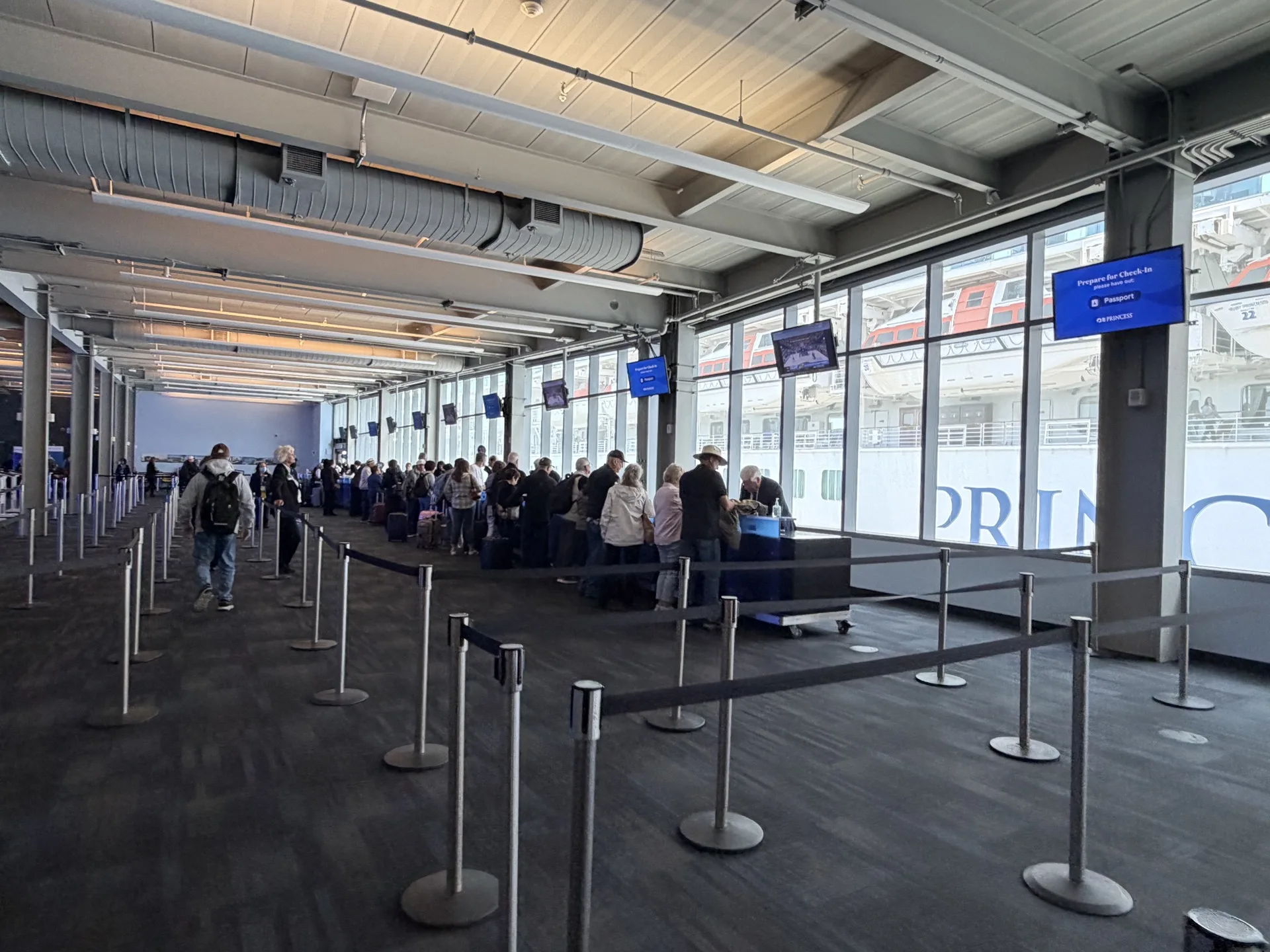
- Embarkation, Pier 27, San Francisco — Sarah Stierch, CC0, via Wikimedia Commons (April 2026).
- Accessible stateroom, Grand Princess — Mike McBey, CC BY 2.0, via Wikimedia Commons (photographed 2009; decor dated, geometry the point).
Change disclaimer. Accessibility policies, submission deadlines, tender conditions, port entry rules and equipment guidelines change frequently. Everything here was verified at source on 26 August 2026. Always re-verify current requirements directly with the cruise line and any vendor before sailing. This article is general information, not legal advice.