Check-in, muster, dining, medical conversations and shore days all depend on fast, clear exchanges with people who have never met you. None of that makes a cruise unsuitable — but each moment needs its own arrangement, made before you sail rather than negotiated in the moment.
Sources and facts checked: September 12, 2026 (America/New_York). Line processes, forms, deadlines and onboard technology change. Nothing here guarantees a line, ship or operator will provide a particular form of communication support — confirm what is available for your sailing, in writing, before payment.
Six moments that need an arrangement
| Moment | What the ship assumes | What to arrange instead |
|---|---|---|
| Terminal check-in | Rapid verbal Q&A with a queue behind you | A written profile handed over, and extra response time requested in advance |
| Muster drill | Spoken instructions in a crowd | Safety information in a format you can use, and a way to confirm receipt without speaking |
| Dining | Ordering, allergies, a new server nightly | A recorded preference that follows you between venues, plus written menus |
| Medical center | High-stakes exchange under time pressure | A prepared summary, a private setting, and instructions given in writing |
| Shore excursions | A guide who has never met you | The preference passed to the operator before the day, not on the coach |
| Emergency | Announcements and shouted direction | An agreed non-verbal way to signal, and a backup if your device is gone |
Build a communication preference profile
Short enough for crew to read in the moment, specific enough to be useful, and no more personal than the line needs to deliver the support. Include:
- Your primary communication method — AAC, speech-generating device, text-to-speech, writing, cards, interpreter.
- Your backup method if the device fails.
- Whether you understand spoken instructions.
- Whether you need written instructions, visual prompts, yes/no questions, or extra response time.
- Whether staff should speak directly to you.
- Whether a companion may assist, and what they may receive.
- Situations needing special planning: muster, tenders, excursions, medical visits, transfers.
- How staff can confirm you received important information without demanding a spoken reply.
A working example. "I have a speech disability and communicate primarily through a speech-generating device. I understand spoken English but may need extra time to respond. Please speak directly to me, allow me to finish using my device, and provide written instructions for important changes or safety information where available. My backup method is a communication card and writing."
Yours should reflect your preferences, not this one. Some travelers want staff to wait silently; others prefer yes/no questions, a communication partner, or a written summary. Do not copy someone else's plan.
Put the request in writing, then chase the confirmation
Start with the line's accessibility process as soon as you book. Royal Caribbean's Guest Special Needs Form includes an "other needs" option; Virgin Voyages directs travelers to its Accessibility and Medical Request Form and Sailor Services team; Holland America uses its Special Requirements Information process; Norwegian runs an Access Desk. Ask each to confirm, in writing:
- Where the communication preference will be recorded.
- Which departments will receive it.
- How muster and emergency communication will be handled.
- Whether written, visual, electronic or other auxiliary support is available.
- Whether a requested interpreter or communication professional can be arranged.
- How the request reaches transfer providers and excursion operators.
- Whether the onboard app or in-cabin tablet can be used for routine communication.
- What happens if the requested support turns out to be unavailable.
A form receipt is not an approval
An automated acknowledgement confirms that a form arrived. It confirms nothing about what was arranged. Save the request, the substantive response, the reservation number, the ship, the sailing date and the name of the representative who confirmed the arrangement — and keep all of it offline, where you can reach it without ship Wi-Fi.
Windows differ by line and do not transfer: Royal Caribbean asks for its form at booking and no later than 30 days before sailing with 60 days for interpreting; Holland America recommends 45 days; Virgin Voyages asks travelers to make every effort to make contact at least 45 days before the voyage; Norwegian publishes 90 days for sign-language interpreters on sailings departing from or returning to a U.S. port, and 45 days for other accessibility needs. Confirm yours, and see the deadlines and paper-trail guide for the full comparison.
Guest Services, muster and emergencies
Guest Services is your onboard coordination point, and it does not replace your own emergency plan. Visit early and ask staff to confirm:
- Your communication method is recorded.
- The muster team has been notified.
- You can receive safety instructions in a format you can use.
- Staff know you may respond through AAC, writing, pointing, cards or another method.
- You have a clear way to request help if your device is unavailable.
- Your preference is shared only with staff who need it.
For muster specifically, ask how safety instructions will reach you, whether you can review them in writing beforehand, how the muster team will know to find you, and what happens if your device is unavailable at the moment it matters. Agree a non-verbal way to signal that you need help and a non-verbal way for staff to confirm you have understood — the second one is the half people forget.
If an accommodation you were promised is missing on board, ask Guest Services for the Complaints Resolution Official. Under 49 CFR §39.101 every passenger vessel operator must make a CRO available on each vessel and at each terminal, at no cost, and the role carries authority ordinary staff do not have.
Dining and shore excursions
Tell the maître d' or dining supervisor before the first meal rather than during it, and ask whether the preference follows you into specialty venues. Ask for written menus, a consistent server or table where that helps, and a way to signal for attention that does not require calling out across a room.
Shore excursions need the preference passed to the operator separately — the cruise line coordinating a tour does not mean it has briefed the guide. Ask whether the guide can communicate in writing or through a speech-to-text tool, whether meeting points and safety instructions can be given in writing, and whether announcements will be repeated one to one. Our shore excursions guide covers the rest of the operator conversation.
Medical conversations, without surrendering your voice
This is about how a conversation is conducted, not what is discussed in it. Prepare a concise summary if you choose to carry one — preferred name and pronouns, communication method, how to get your attention, how to ask yes/no questions, emergency contacts, allergies or critical safety information, and a plain instruction such as "please communicate directly with me and allow time for my response."
Ask for a private setting, and ask that instructions, medication names, appointment times and follow-up directions come in a format you can review afterwards. A companion may help and should not automatically become your spokesperson — decide in advance when they may interpret, repeat or answer. If your device holds sensitive health information, lock it, and carry a backup card with only what an urgent situation actually needs.
Treat the device as essential equipment
- Carry the device in your hand luggage — never checked.
- Pack chargers, adapters, cables, protective cases and any approved backup battery.
- Check the line's current prohibited-items policy before packing a power strip.
- Download required voices, language files and offline content.
- Test text-to-speech with no Wi-Fi and no cellular service.
- Carry a paper or laminated backup method.
- Protect against water, heat, salt spray and drops.
- Ask where you can charge safely during muster, transfers and shore days.
An onboard app or in-cabin tablet can help with routine messages — Virgin Voyages states that guests can message crew through its app or in-cabin tablet for certain needs. Do not assume app messaging is monitored continuously or accepted as a sole emergency channel, and confirm the ship's actual emergency process separately.
Companion and privacy boundaries
A travel companion is not automatically a communication aide or a personal-care provider. Federal rules prohibit a passenger-vessel operator from requiring a disabled passenger to travel with another person, while also stating that crew are not required to perform personal tasks such as eating, dressing or toileting. Both are true at once, which means the companion question is yours to settle. Document:
- Whether the companion may speak for you.
- Whether they may receive medical or booking information.
- Which situations require direct communication with you.
- What they should do if your device fails.
- What support they cannot provide.
Devil's advocate
The honest risk on a ship is not hostility — it is speed. Crew are busy, queues are long, and a system built on fast verbal exchange will default to the fastest available person, which is often your companion. That is how a traveler ends up being talked about rather than talked to, without anyone intending it.
The counter is written, in advance, and repeated: a recorded preference, a profile handed over at check-in, a Guest Services visit on day one, and a companion who has agreed to redirect rather than answer. Nothing about that is confrontational. It just has to exist before the queue does.
Verify before you pay
- Write a short communication preference profile in your own words.
- Submit it through the line's accessibility process as soon as you book.
- Ask in writing where it is recorded and which departments receive it.
- Confirm how muster and emergency information will reach you.
- Ask what happens if the requested support is unavailable.
- Visit Guest Services early and confirm the record exists on board.
- Tell the dining team before the first meal, not during it.
- Pass the preference to excursion operators separately.
- Carry the device in hand luggage with chargers and an offline backup.
- Agree companion boundaries in advance and write them down.
- Keep the confirmation, reservation number, ship, date and representative name offline.
Frequently asked
What should a communication profile actually say?
Short enough for a crew member to read in the moment, specific enough to be useful, and no more personal than the line needs. Something like: "I have a speech disability and communicate primarily through a speech-generating device. I understand spoken English but may need extra time to respond. Please speak directly to me, allow me to finish using my device, and provide written instructions for important changes or safety information where available. My backup method is a communication card and writing." Yours should reflect your preferences — some travelers want staff to wait silently, others prefer yes/no questions or a written summary. Do not copy someone else’s.
Who do I send it to, and when?
The line’s accessibility or special-needs process, as soon as you book. Royal Caribbean’s Guest Special Needs Form includes an "other needs" option; Virgin Voyages directs travelers to its Accessibility and Medical Request Form and Sailor Services; Holland America uses its Special Requirements Information process; Norwegian runs an Access Desk. Windows differ by line — Royal Caribbean asks for its form at booking and no later than 30 days out with 60 days for interpreting, Holland America recommends 45 days, Virgin Voyages asks for contact at least 45 days ahead, and Norwegian publishes 90 days for sign-language interpreters on sailings departing from or returning to a U.S. port and 45 days for other needs. Confirm your own line’s current figure.
Is a form receipt the same as approval?
No, and this is the most common false comfort in the whole process. An automated receipt confirms a form arrived, not that anything was arranged. Ask for written confirmation naming what was agreed, then save it with the reservation number, ship, sailing date and the name of the representative who confirmed it — offline, where you can reach it without ship Wi-Fi.
Can I rely on the ship’s app to communicate?
For routine messages, often yes — Virgin Voyages states that guests can message crew through its app or in-cabin tablet for certain communication needs. For emergencies, no. Do not assume app messaging is monitored continuously or accepted as a sole channel, and confirm the ship’s actual emergency process separately. An app is a convenience layer on top of a plan, not the plan.
How do I handle a medical conversation without losing my voice in it?
Prepare a concise summary if you choose to carry one — preferred name and pronouns, communication method, how to get your attention, how to ask yes/no questions, emergency contacts, allergies or critical safety information, and a line such as "please communicate directly with me and allow time for my response." Ask for a private setting, and ask for instructions, medication names, appointment times and follow-up directions in writing. If your device holds sensitive health information, lock it and carry a backup card with only what an urgent situation needs.
Does a companion become my spokesperson?
Only if you decide they do, and it is worth writing down. Federal rules prohibit a passenger-vessel operator from requiring a disabled passenger to travel with another person, while also stating that crew are not required to perform personal tasks. So the companion question is yours to answer rather than the line’s to impose — decide in advance when they may interpret, repeat or answer, and when staff must address you directly.
Sources and facts checked: September 12, 2026 (America/New_York). Line processes and request windows above are published by each operator individually, are accurate as of the date shown, and are not industry standards — confirm the one that applies to your booking directly with the line, and note that a general accessibility deadline may not cover every communication request. The federal position is stated in both directions because both halves are true: an operator may not require a disabled passenger to travel with another person, and crew are not required to perform personal tasks. Onboard app and tablet messaging capabilities vary by ship and change; confirm the emergency process separately rather than assuming an app covers it.
Sources
- Royal Caribbean — Guest Special Needs ↗
- Virgin Voyages — Accessibility ↗
- Holland America Line — Accessible cruising ↗
- Norwegian Cruise Line — Accessible cruising and the Access Desk ↗
- Electronic CFR — 49 CFR Part 39 (nondiscrimination on passenger vessels) ↗
- U.S. Department of Transportation — Passenger Vessels ↗
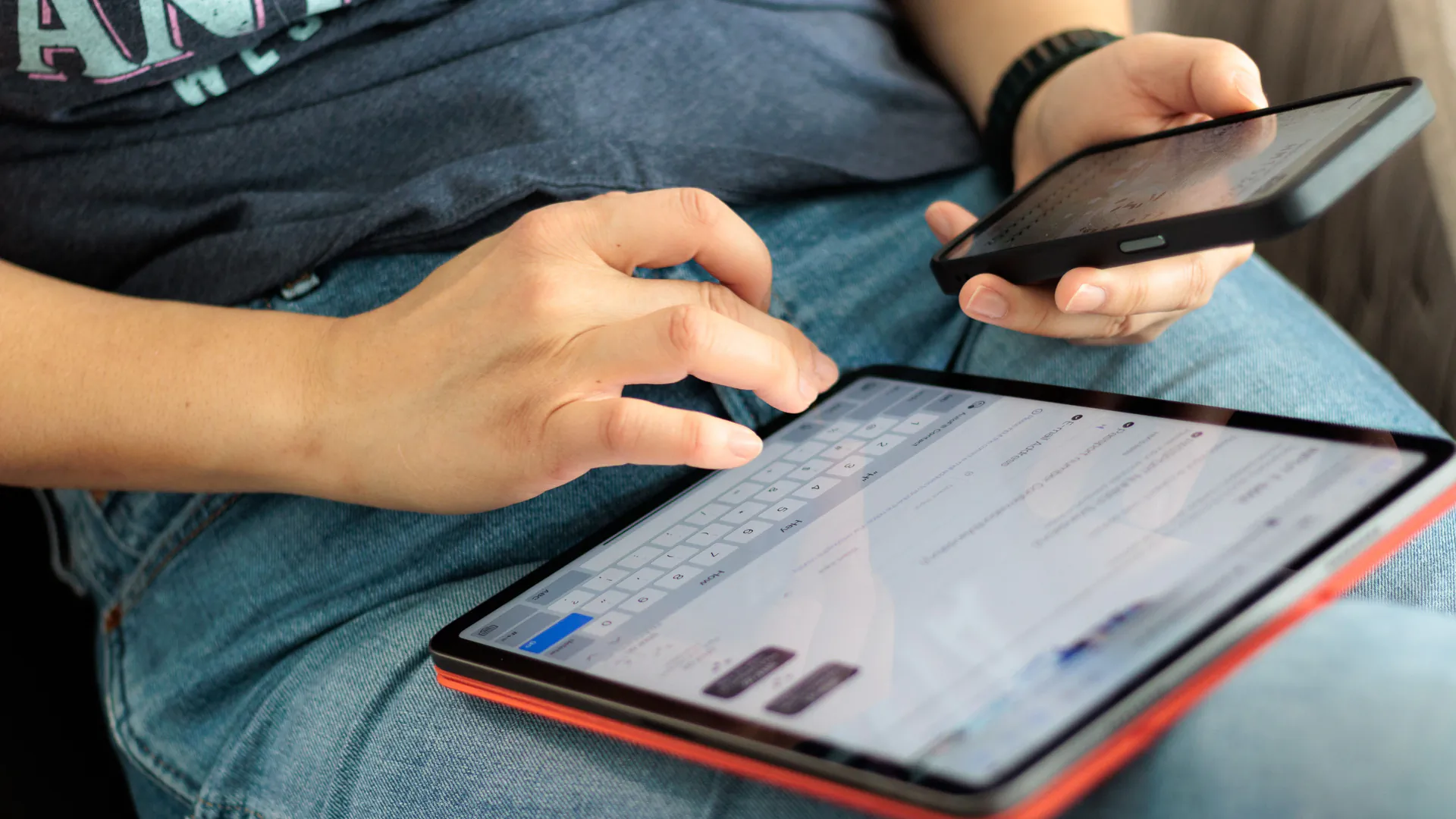
Photographs. Hands using a tablet and phone — IslandHopper X, Pexels Cropped and resized for the web; not otherwise altered. Neither the photographers nor the licensors endorse this article.
This article is planning information, not medical, legal or clinical advice. It addresses how communication is arranged, never what is discussed in a medical conversation. OTGG is an independent travel advisor; this article contains no affiliate or compensated links, and no vendor named in it is a paid placement. Line policies, forms, deadlines, onboard technology and excursion arrangements change — verify with the operator or an accredited travel advisor before payment and again before departure.
Want the preference recorded before you board?
Tell me how you communicate and which sailing you are considering. I will file the profile through the line's own process inside its window, get written confirmation of where it is recorded and which departments hold it, pass it to the transfer and excursion operators separately, and make sure the muster arrangement exists on paper before you need it.
Begin the Journey