A cruise can be perfectly on schedule and still become a very expensive problem before you reach the ship.
Sources and facts checked: September 20, 2026 (America/New_York). Border procedures, exemptions, staffing and cruise-line boarding rules change and vary by airport and port. This is general information, not immigration or legal advice — check and verify with the cruise line, airline and relevant border authority before you pay.
That risk is especially real when you fly into the Schengen Area to join a cruise in Barcelona, Athens, Amsterdam, Frankfurt, Paris, Rome, or another European gateway. The EU Entry/Exit System, commonly called EES, adds biometric border processing for many non-EU visitors. At a busy airport, that may mean more time between your aircraft door and the taxi stand.
Miss the ship’s check-in or final boarding window, and the cruise line may treat you as a no-show. Your flight may not be covered by cruise protection. Your airline may not be required to rebook you for free. That is not a great way to begin a luxury vacation.
The practical answer is simple: treat immigration time as part of your cruise transfer, not as an administrative footnote.
What EES is
EES is a digital border system for non-EU nationals visiting participating European countries for short stays.
It replaces the manual stamping of passports with a digital record containing:
- Travel-document information
- Entry and exit dates and locations
- Fingerprints
- A captured facial image
- Records of refused entry, where applicable
The European Commission’s Migration and Home Affairs site states that the Entry/Exit System “is now fully operational” across external Schengen border crossing points as of April 10, 2026. The rollout was phased: a progressive start on October 12, 2025, followed by six months of phased implementation leading to full operation on April 10, 2026. See the Commission’s full-operation announcement.
The system applies to the external border crossing, not to the type of vacation you booked. A cruise passenger is not automatically excluded simply because the trip is at sea.
You generally do not apply for EES in advance. Registration or verification takes place at the border, using procedures established by the relevant airport, port, and national border authority.
Where EES applies
EES applies when a traveler subject to the system personally crosses an external Schengen border.
That may happen at:
- An international airport
- A ferry terminal
- A cruise port
- A land border
- A rail terminal with external-border controls
The official EES overview explains that the system covers non-EU nationals traveling for short stays in 29 participating European countries. Ireland and Cyprus are EU members but do not participate in EES, while Iceland, Liechtenstein, Norway, and Switzerland are included as non-EU Schengen members.
EES does not apply in the same way to everyone. EU nationals, nationals of Iceland, Liechtenstein, Norway, and Switzerland, and certain travelers with residence permits or long-stay visas may be exempt from EES registration.
Do not guess based on your airline, cruise line, or nationality alone. Confirm which documentation controls your status.
The cruise exemption, and its limits
This is where cruise advice becomes slightly less tidy than a standard airport arrival.
A sailing that starts and finishes outside the Schengen Area, such as a round-trip cruise from a UK port, will generally be exempt from individual EES processing during ordinary Schengen day calls. You may go ashore and return to the ship without completing a separate full EES registration at every port.
However, “generally exempt” is not the same as “guaranteed.”
The UK government’s EES guidance indicates that port authorities may require checks in some circumstances. The same guidance identifies situations in which cruise travelers may need to complete EES processing:
- You fly into Schengen to join the cruise.
- You fly home from a Schengen airport.
- You permanently disembark in Schengen and continue by air, rail, or road.
- You disembark early inside Schengen.
- The port authority determines that individual processing is required.
The rule to remember is this:
A cruise itinerary may receive transit treatment, but your separate flight into or out of Schengen still creates an individual border crossing.
Scenario guide
| Travel pattern | Likely EES exposure | Planning implication |
|---|---|---|
| UK round-trip cruise with Schengen day calls | Usually no individual EES registration for ordinary port calls | Confirm with the cruise line and port authority |
| Fly into Barcelona or Athens to join a cruise | EES at the arrival airport if you are subject to the system | Build in a substantial airport-to-ship transfer buffer |
| Fly home from Amsterdam or Paris after a cruise | EES exit processing may apply | Do not book a tight same-day connection |
| Early disembarkation in Schengen | EES processing may occur at the port | Obtain written instructions before changing the itinerary |
| Cruise begins and ends within Schengen | No external Schengen crossing during the cruise itself | Your arrival flight may still trigger EES |
Who should expect to register
If you are a non-EU national traveling for a short stay, assume EES may apply unless you have confirmed an exemption.
Registration or verification may be required if you:
- Fly into Schengen to join a cruise. Your first external Schengen border is the airport, even if the ship later sails from a different country.
- Fly home from a Schengen airport. You may need an EES exit record before leaving the area.
- Leave the ship early inside Schengen. If you continue by train, road, or air, the port may process you as an individual traveler.
- Use a cruise as one segment of a larger land itinerary. The moment you stop being handled as a ship passenger in transit, the port’s border procedures matter more.
The official Travel Europe EES pages provide the current exemption categories and system information. Check the documentation that supports any exemption, including a residence card, long-stay visa, or qualifying family-member residence document.
The buffer math
As a planning guideline, OTGG suggests arriving at the airport 90 minutes to two hours earlier than usual when EES checks apply. Check and verify current guidance with your airline and airport.
That is planning guidance, not a promise from a border authority. Actual wait times vary.
Use a larger buffer at major hubs such as:
- Paris
- Amsterdam
- Frankfurt
- Barcelona
- Athens
- Rome
The risk increases when several factors stack together:
- Your first EES registration
- A full aircraft arriving at once
- Checked baggage
- A mobility device or medical equipment
- An airport transfer between terminals
- A ship with a firm final boarding time
- A same-day flight-and-cruise connection
For a high-value cruise, arriving the day before remains the cleaner strategy whenever your schedule and budget allow. It separates two different risks: getting through the border and getting to the ship.
Do not calculate your transfer from scheduled landing time. Calculate it from the time you expect to leave the secure arrivals area with your luggage.
Airlines and passenger rights
Airlines may classify EES and immigration queues as outside their operational responsibility. That position matters if the queue causes you to miss a later flight or a cruise connection.
Under the general EU air-passenger framework, rights typically apply when the flight itself is canceled, significantly delayed, or you are denied boarding despite presenting yourself according to the airline’s conditions. A passenger who misses an otherwise on-time flight because they remain in an immigration queue may not receive automatic EU261 compensation, free rerouting, or a refund.
The EU’s Your Europe passenger-rights guidance explains the situations covered by air-passenger protections.
If an EES queue causes you to miss a flight:
- Go to the airline desk immediately.
- Ask what rebooking options apply to your fare.
- Request the airline’s decision in writing.
- Keep boarding passes, queue photos, timestamps, and receipts.
- Ask the airport or border authority how to submit a formal complaint.
Travelers with disabilities or reduced mobility have separate rights to airport assistance under EU rules. Request assistance through the airline or airport in advance, then ask exactly what the service covers at the EES area.
Do not assume assistance automatically means:
- A shorter border queue
- Immediate access to a kiosk
- A companion completing the process for you
- A seated biometric procedure
- Permission to bypass document checks
Confirm the process with the specific airport and border authority.
The partial-suspension allowance has ended
During the EES rollout, national authorities were permitted to partially suspend biometric collection at a border crossing when excessive waiting times created exceptional congestion.
A partial suspension could mean that authorities continued recording non-biometric information while temporarily pausing the collection of fingerprints and facial images. The relevant legal framework is Regulation (EU) 2025/1534, adopted July 18, 2025, and in force since July 26, 2025.
That flexibility was temporary and tied to the transition period. It applied for 90 days after the April 10, 2026 full-operation date, extended automatically by a further 60 days because fewer than 80 percent of the files registered during the progressive start contained biometric data, and expired no later than September 6, 2026. The legal mechanism has now closed, and no successor instrument has been adopted. Reporting in mid-September 2026 indicated that nine member states — among them France, Germany, Italy, the Netherlands and Greece — were nonetheless still not applying full biometric collection, and the European Commission has declined to confirm publicly what, if anything, replaced the expired flexibility. Treat uniform processing as the expectation rather than a certainty, and check and verify current procedures with the airport and the relevant border authority before you travel.
Do not build your travel plan around a biometric pause. You may encounter full collection, partial processing, manual intervention, or a local procedure determined by the border authority. The operational answer can vary by location and by the status of your existing EES record.
Your practical pre-departure plan
Before you pay
- Identify your first external Schengen border.
- Confirm whether your nationality and documentation place you inside or outside EES.
- Ask the cruise line whether your specific embarkation and disembarkation pattern requires individual processing.
- Ask the arrival airport or port authority how EES is handled at that location.
- Obtain written confirmation from the cruise line, airport, port, or border authority. Save the response with your travel documents.
- Avoid a same-day flight-and-cruise connection when the cruise is expensive, nonrefundable, or difficult to replace.
Before you fly
- Use the passport connected to your travel booking.
- Check that the passport is valid for the full itinerary.
- Keep your passport accessible, not buried in checked luggage.
- Allow additional time for baggage and border processing.
- Arrange airport assistance in advance if you need mobility, sensory, communication, or medical support.
- Confirm whether the assistance provider can escort you to or through the EES processing area.
- Ask the border authority whether the kiosk accommodates your wheelchair, scooter, height, reach, vision, hearing, or dexterity needs.
At the airport
- Follow signs and staff instructions.
- Expect to present your passport and possibly provide fingerprints and a facial image.
- Remove hats or eyewear if instructed for facial capture.
- Tell staff immediately if you cannot use the kiosk safely or independently.
- Do not leave the controlled area until the border process is complete.
- Contact the cruise line or transfer provider if processing delays threaten your arrival window.
For more accessibility planning, see OTGG’s guides on Cruise Accessibility: Deadlines and the Paper Trail and The Door-to-Ship Journey.
Devil’s Advocate: EES is not the only variable
The strongest objection to a large buffer is reasonable: not every passenger will experience a long EES delay.
If you already have a valid EES record, your next verification may be faster than your first registration. Some ports may have efficient equipment and staffing. Some cruise itineraries may receive transit treatment without individual processing.
That does not create a guarantee.
Procedures may vary by:
- Nationality
- Passport or residence status
- Airport
- Port
- Cruise itinerary
- Embarkation point
- Disembarkation point
- Border-authority staffing
- Accessibility requirements
- Whether you are joining or leaving the ship by another mode of transportation
The cruise line may know its normal process, but the national border authority controls the border. Get written confirmation from both where possible.
Verify before you pay
Before booking a flight connected to a Schengen cruise, confirm:
- Is the cruise starting or ending outside Schengen?
- Will I fly into Schengen to join the ship?
- Will I fly home from a Schengen airport?
- Could I disembark early inside Schengen?
- Am I subject to EES based on my nationality and documents?
- Do I have an exemption, and can I prove it at the border?
- Where will my first EES registration or verification occur?
- Does the airport or port publish current EES procedures?
- Have I requested accessibility assistance through the airline or airport?
- Has the relevant border authority confirmed kiosk and assistance procedures in writing?
- Has the cruise line confirmed the final boarding time and missed-ship policy in writing?
- Have I allowed enough time for immigration, luggage, transportation, and terminal check-in?
- Is arriving the day before financially smarter than risking a missed sailing?
- Does my travel insurance address missed connections and missed cruises?
Frequently asked
Does every cruise passenger have to register for EES?
No. A round-trip cruise that starts and ends outside Schengen will generally receive transit treatment for ordinary Schengen port calls. However, individual EES processing may still apply depending on the port and your travel pattern.
Do I need EES if I fly into Schengen to join a cruise?
If you are a non-EU short-stay traveler subject to EES, you should expect to register or be verified at the airport where you first enter Schengen.
What if I fly home from Schengen after the cruise?
You may need EES exit processing at the airport. Allow extra time, especially if you have not previously created an EES record.
Can EES make me miss my cruise?
It can contribute to the risk when combined with flight delays, baggage delays, airport transfers, and firm cruise check-in deadlines. EES does not guarantee that a cruise line will hold the ship.
Can I register for EES before traveling?
Generally, no. EES processing takes place at the relevant border. Follow current instructions from the airport, port, and border authority.
Does EES replace ETIAS?
No. EES is a border entry-and-exit record. ETIAS is a separate travel-authorization system. Check the official Travel Europe website for current status and avoid unofficial sites selling applications for systems not yet open to your nationality.
Sources and facts checked: September 20, 2026 (America/New_York). The European Commission’s Migration and Home Affairs EES pages, the official Travel Europe EES site, the UK government’s EES guidance, Regulation (EU) 2025/1534 on EUR-Lex and the EU’s Your Europe air-passenger-rights guidance were reviewed on the date shown. Border authorities control local procedures — get written confirmation from the cruise line and, where possible, the airport or border authority.
Sources
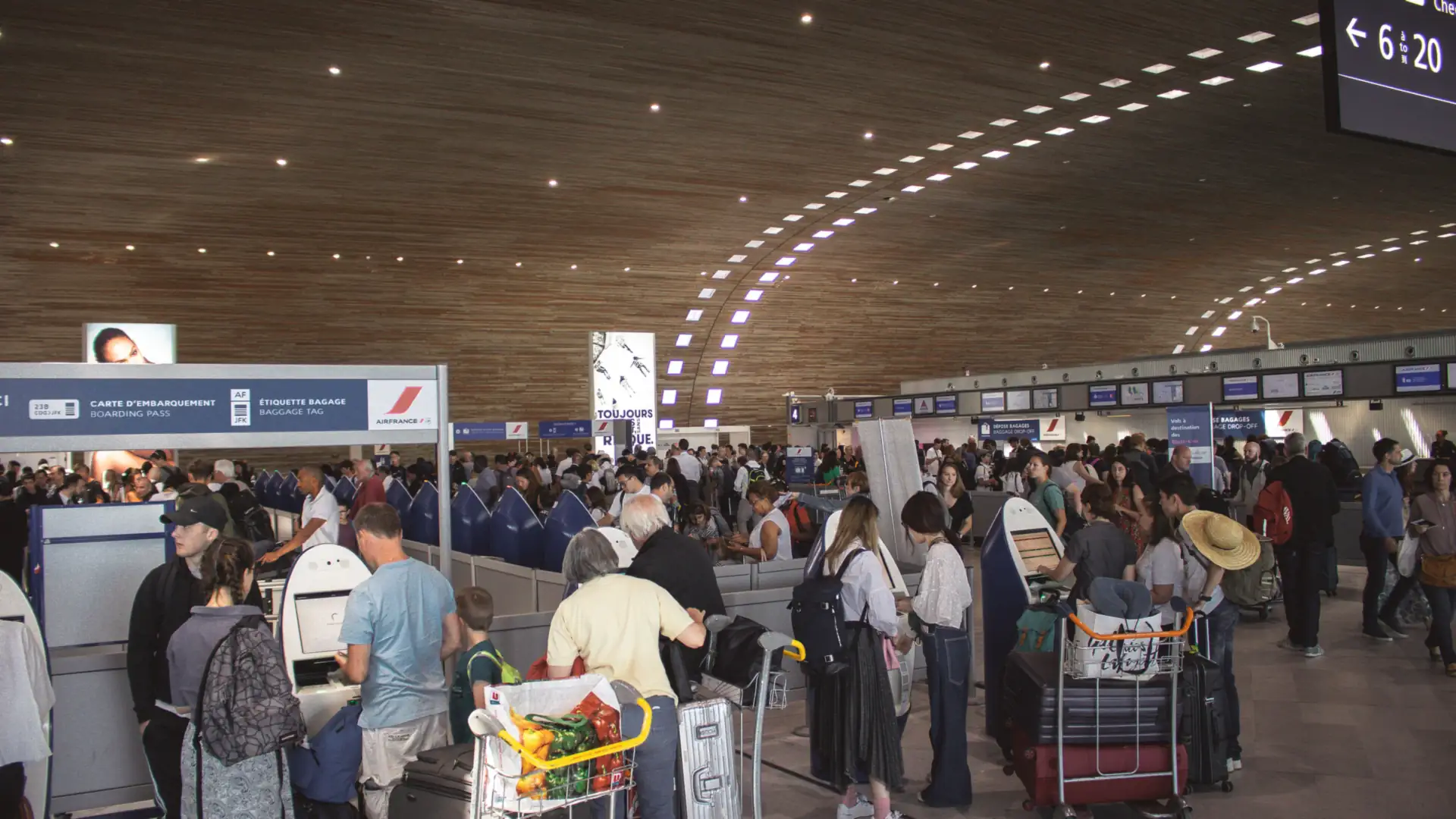
Photographs. Travelers queuing in a busy airport arrivals hall — Connor Danylenko, Pexels Cropped and resized for the web; not otherwise altered. Neither the photographers nor the licensors endorse this article.
This article is general information, not immigration, legal or insurance advice. OTGG is an independent travel advisor; this article contains no affiliate links. Cruise line and supplier policies, rates, promotions, inclusions, accessibility procedures and deposit schedules change — verify all details with the operator or an accredited travel advisor before booking or payment.
Flying into Europe to meet a ship?
Send me the flights and the sailing. I will map your first external Schengen border, build a realistic arrival buffer, confirm the final boarding time in writing and flag any tight same-day connection before you pay.
Begin the Journey