A cruise ship can accommodate many allergies and dietary needs. It cannot promise an allergen-free environment.
Sources and facts checked: September 15, 2026 (America/New_York). Dietary deadlines, venue policies and medication-storage rules change and differ by line and itinerary. This is general planning information, not medical advice — check and verify with the cruise line and your treating clinician before you sail.
Ships prepare food in shared galleys. Ingredients move through common storage areas, equipment, preparation surfaces, and service routes. Even when a meal is made carefully, the cruise line may not be able to eliminate every possibility of cross-contact.
That distinction matters.
“Gluten-free,” “dairy-free,” or “nut-free” may describe an ingredient choice or a planned meal. They do not automatically mean that the entire kitchen, buffet, restaurant, or ship is free from that allergen.
Treat cruise dining as a managed-risk process:
- Notify the cruise line before sailing.
- Obtain the line’s response in writing.
- Meet the dining team immediately after boarding.
- Ask specific questions before every meal.
- Carry your emergency medication on your person.
This approach works for solo travelers, LGBTQ+ groups, and multi-generational families alike. Everyone can participate in the dining plan without making one guest’s medical needs a group spectacle.
What Cruise Lines Can, and Cannot, Guarantee
Cruise lines generally state that they will make reasonable efforts to accommodate food allergies, intolerances, and medical diets. They also state that accommodations are not guaranteed.
For example:
- Virgin Voyages says it does not have allergen-free kitchens and cannot guarantee accommodation for requests submitted with less notice.
- Holland America Line notes that cross-contact is possible despite precautions; confirm with the current HAL page.
- Carnival Cruise Line states that allergies can be addressed in the main dining room, while its published guidance notes that buffet, lido, and room-service items cannot be guaranteed against cross-contact; confirm with the current Carnival page.
- Norwegian Cruise Line asks guests to disclose food allergies and dietary requirements to a reservations or travel professional before sailing.
- Disney Cruise Line describes allergy-friendly and special-diet options, particularly in table-service restaurants, while directing guests to submit requests before embarkation.
Use the word accommodate carefully. It means the line may plan, source, prepare, and communicate around your needs. It does not mean the line has created a medically sterile dining environment.
If a cruise line cannot clearly explain its process for your specific allergy, treat that uncertainty as meaningful information, not an invitation to improvise.
Use the Published Notification Window
Submit food allergy and dietary information through the cruise line’s accessibility, special services, guest access, or special needs department.
Use the line-specific published deadline and confirm current deadlines with the line. Some lines or itineraries require more notice for specialty products, religious meals, or region-specific provisioning.
Examples from current official pages include:
- Virgin Voyages requests special dietary submissions at least 45 days before sailing; confirm current deadlines with the line.
- Norwegian Cruise Line publishes two different figures on two different official pages. Its dietary-needs FAQ states that many special products (such as gluten-free items and kosher meals) require 30 days’ notice. Its separate accessibility and dietary-requirements page states that special dietary requests should be submitted at least 45 days before sailing and that requests made inside 45 days “cannot be guaranteed.” Both figures come from NCL’s own materials, so the discrepancy is worth knowing about: ask NCL to confirm in writing which deadline applies to your request type and sailing.
- NCL also specifies that kosher-meal requests require 90 days’ notice for certain international itineraries, including Africa/Madagascar, Antarctica, Asia, Europe/UK, and South Pacific departures from Fiji or French Polynesia; confirm the current list with NCL.
- Disney Cruise Line’s current page lists different timing by request type and need, so verify the exact requirement for your sailing and confirm current deadlines with the line.
- Holland America uses different processes for non-life-threatening and life-threatening allergies.
Do not rely on a note added casually by a call-center representative. Submit the appropriate form, save the confirmation, and ask the cruise line to confirm:
- The exact allergens.
- Whether the allergy is life-threatening.
- The risk of cross-contact.
- Whether the request is recorded on the reservation.
- Which venues can accommodate the request.
- Whether special food must be sourced before sailing.
- How medication refrigeration will be handled.
The OTGG cruise accessibility guide explains why the paper trail matters. A phone call can be helpful. Written confirmation is better.
Follow a Day-One Dining Protocol
Do not wait until the first formal dinner and hope the reservation note has traveled perfectly through the ship’s systems.
After boarding, go directly to the main dining room or the location identified by the cruise line. Ask for the:
- Head server.
- Maître d’.
- Dining room manager.
- Restaurant manager.
- Chef or culinary representative, when available.
Explain your allergy plainly. State the ingredient, the severity of the reaction, and whether trace exposure or cross-contact creates a risk.
Ask how the team will handle:
- Menu review.
- Ingredient verification.
- Sauces, dressings, marinades, and garnishes.
- Separate utensils and preparation surfaces.
- Dessert and bread service.
- Meals in other restaurants.
- Advance ordering for the following day.
For a group, let the affected guest speak for themselves whenever possible. Offer support without turning the conversation into a group interrogation. A child, adult, disabled traveler, or LGBTQ+ guest should be treated as a knowledgeable participant in their own care.
Why the Main Dining Room Usually Has the Advantage
The main dining room is usually the best-equipped venue for managing complex food allergies because the team can coordinate with the chef, review ingredients, and prepare a meal to order or in advance.
Carnival explicitly centers allergy accommodations in the main dining room with the chef. Holland America instructs guests with severe allergies to meet the Dining Room Manager after boarding. Other lines, including Celebrity and Princess, direct guests toward senior dining staff or restaurant management.
The main dining room offers several practical advantages:
- A consistent service team may learn your needs over several nights.
- The chef can review the menu before preparation.
- You can pre-order the next day’s meal.
- Ingredients can be checked more deliberately.
- Staff can explain which sauces or prepared components cannot be modified.
This does not remove risk. It gives you more control and better communication.
Ask for a written or app-based note if the line uses one. Then repeat the allergy at every meal. A notation is a tool, not a substitute for communication.
Treat Quick-Service, Buffets, and Room Service Differently
Buffets and quick-service venues move quickly. Shared serving utensils, open pans, topping stations, fryer oil, and crowded preparation areas can increase cross-contact risk.
Room service may have another limitation: the person taking the order may not be the person preparing the meal, and the kitchen may not be equipped to make allergy-specific guarantees.
That does not mean every casual venue is automatically unsafe. It means you need a direct answer before eating.
Ask:
- Who prepared this item?
- Does it contain the allergen?
- Was it prepared on a shared surface?
- Are the fryer, grill, or utensils shared?
- Can the chef prepare a separate meal?
- Can the venue guarantee the requested protocol?
If the answer is unclear, choose a venue with stronger chef oversight. Carnival’s published guidance notes that buffet, lido, and room-service items cannot be guaranteed against cross-contact; confirm with the current Carnival page.
For a multi-generational group, build flexibility into the day. One person may eat at the main dining room while others choose a casual venue. That is a logistics decision, not a failure of the vacation.
Plan Medication Storage Before You Sail
Do not assume the refrigerator in your stateroom is approved for medication storage. Cabin refrigerators vary in temperature and function, and they may not be suitable for temperature-sensitive medication.
On many ships, crew members are generally prohibited from storing guest medication in stateroom refrigeration. The medical center may be able to refrigerate medication during operating hours, subject to the cruise line’s policy and the medicine’s requirements.
Ask the cruise line in writing:
- Whether your medication may remain in your stateroom.
- Whether the cabin refrigerator is suitable.
- Whether the medical center can refrigerate it.
- During which hours you can access it.
- What happens while the medical center is closed.
- Whether you may bring a personal cooler and ice packs.
- Whether the cooler must be approved in advance.
Include the medication and storage requirement on the relevant accessibility or medical request form. Keep the response with your travel documents.
Never place essential medication in checked luggage. If a personal cooler is permitted, carry it according to the cruise line’s written instructions. Do not expect crew to store, prepare, or administer medication unless the line has specifically confirmed that service. This is general planning information, not medical advice. Confirm medication storage, refrigeration, and administration arrangements with the line and your treating clinician.
Carry EpiPens and Emergency Medication on Your Person
Carry EpiPens or other prescribed emergency medication with you, not only in your cabin, luggage, or a group member’s bag.
A practical setup includes:
- Your prescribed epinephrine auto-injectors.
- Any additional emergency medication prescribed by your clinician.
- A copy of your emergency action plan.
- Medication in its original labeled packaging.
- A written list of allergies and current medications.
- A backup supply stored according to medical and cruise-line instructions.
Tell your travel companions what to do in an emergency. If you are traveling solo, keep the medication visible and accessible, and make sure the ship’s medical team knows about your allergy.
The ship’s medical center may have medication and equipment to treat allergic reactions, but it is not a substitute for carrying your own prescribed rescue medication. In an emergency, follow your clinician’s emergency plan and contact onboard medical services immediately.
Read OTGG’s cruise medical and medication logistics guide before departure.
Use Bilingual Allergy Cards as a Communication Tool
A bilingual allergy card can help bridge language gaps between you and dining staff, particularly on international itineraries or when communicating with port restaurants.
Equal Eats is one third-party resource that offers translated food allergy cards. It is mentioned for information only; OTGG has no affiliate relationship with Equal Eats.
Use a card that states:
- The exact allergen.
- Whether trace exposure is dangerous.
- Foods and ingredients to avoid.
- The need to prevent cross-contact.
- The action required if exposure occurs.
Carry the card with your medication. Show it to the dining manager, chef, and restaurant staff when needed.
A card supports communication. It does not replace the cruise line’s written confirmation or your direct conversation with the chef.
Devil’s Advocate: The Limits of “We Will Try”
Cruise lines use careful language because kitchens are complex environments. “Every reasonable effort” may be the most accurate promise they can make.
The difficult questions are straightforward:
- What happens when the ship changes ports and its ingredients change?
- What happens when a prepared sauce cannot be modified?
- What happens when a crew member changes during the voyage?
- What happens when a restaurant is unexpectedly closed?
- What happens when a buffet item is labeled incorrectly?
- What happens when a shore excursion meal is supplied by a separate operator?
Crew turnover also matters. The server who understood your allergy on night one may not be serving you on night five.
Build a backup plan:
- Know which venue has the strongest chef oversight.
- Carry safe snacks if your clinician approves them and the cruise line permits them.
- Avoid relying on one restaurant or one food item.
- Reconfirm your allergy after itinerary or venue changes.
- Ask before eating, even when the dish appears familiar.
- Keep emergency medication accessible.
If the cruise line will not provide a clear written answer, reconsider the sailing, the itinerary, or the level of risk you are prepared to accept.
Verify before you pay
Before paying a deposit, complete this checklist:
- Ask the cruise line whether it can accommodate your specific allergy or medical diet.
- Ask whether the ship has shared kitchens and how it manages cross-contact.
- Confirm which dining venues can provide chef-led allergy accommodations.
- Ask whether buffet, quick-service, specialty restaurant, and room-service meals can be guaranteed.
- Submit the required accessibility or dietary form within the published window.
- Obtain written confirmation from the relevant cruise line.
- Confirm medication storage, refrigeration access, and cooler rules in writing.
- Pack EpiPens and emergency medication in your carry-on and on your person.
- Bring a written allergy card and emergency action plan.
- Identify the main dining room and dining manager’s location for embarkation day.
- If dining ashore, obtain written confirmation from the relevant restaurant, excursion operator, hotel, transfer provider, or other supplier.
- Reconfirm the plan before departure and after any itinerary or venue change.
Frequently asked
Can a cruise line guarantee an allergen-free meal?
Usually, no. Cruise lines can plan accommodations and reduce cross-contact risk, but shared kitchens mean they generally cannot guarantee an allergen-free environment.
When should I report a food allergy?
Use the line-specific published deadline and confirm current deadlines with the line. Virgin Voyages currently states 45 days, Norwegian Cruise Line publishes 30 days on one page and 45 days on another, and Disney timing varies by need.
Is the main dining room safer than the buffet?
It is usually better equipped for chef consultation, ingredient review, and advance preparation. It is not risk-free. Ask the dining manager what the ship can specifically do for your allergy.
Can I leave my EpiPen in the cabin?
Do not rely on the cabin. Carry prescribed emergency medication on your person and follow your clinician’s emergency plan.
Can the medical center refrigerate my medication?
Possibly, depending on the cruise line, medication, medical-center hours, and storage requirements. Obtain written confirmation before sailing and ask about access when the medical center is closed.
Sources and facts checked: September 15, 2026 (America/New_York). Dietary and allergy pages from Virgin Voyages, Holland America Line, Carnival Cruise Line, Norwegian Cruise Line and Disney Cruise Line, and Equal Eats’ allergy-card resource, were reviewed on the date shown. Published deadlines and venue policies change — submit the line’s form and get written confirmation before sailing.
Sources
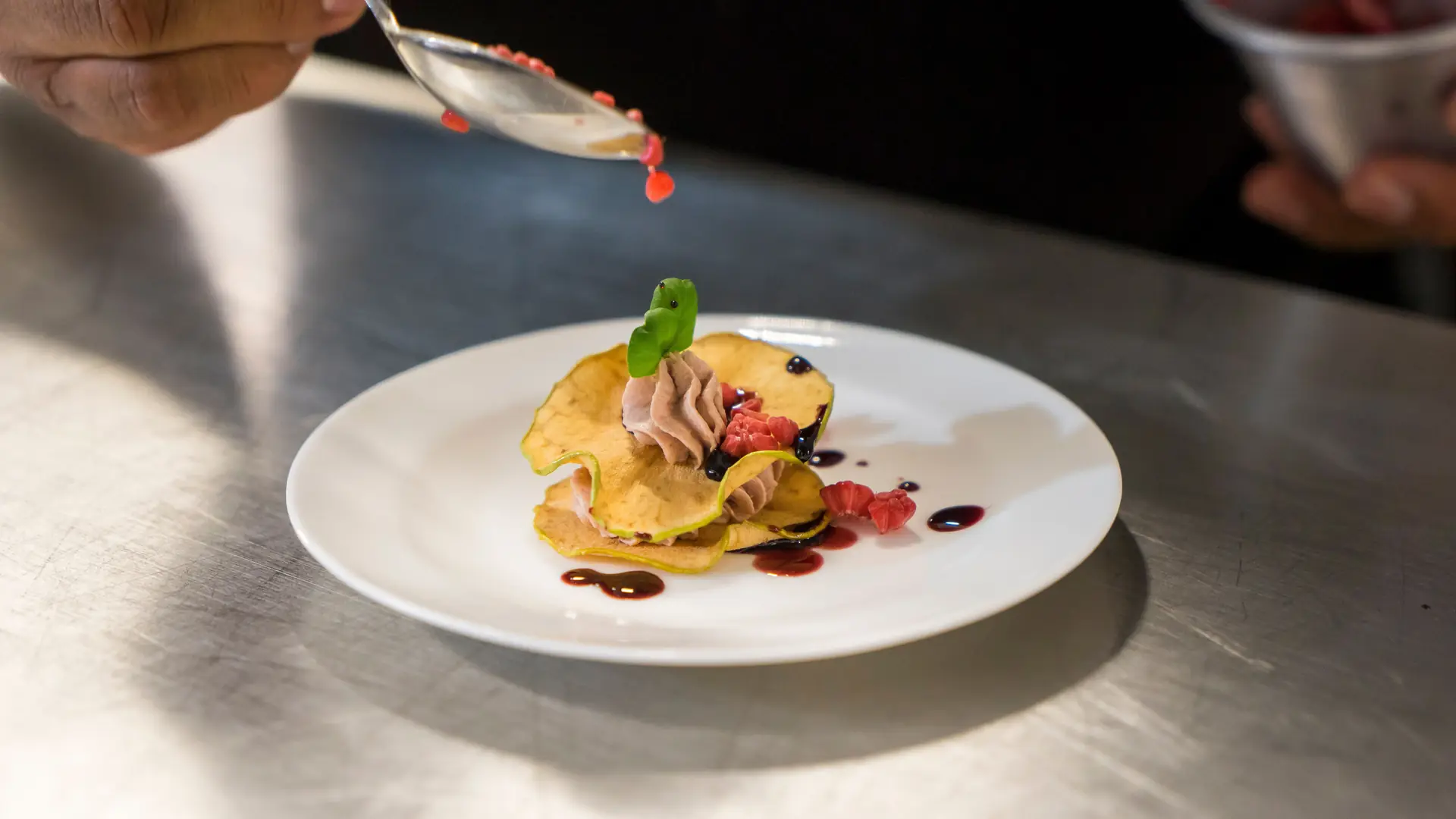
Photographs. A chef finishing a plated dish — Luis Becerra Fotógrafo, Pexels Cropped and resized for the web; not otherwise altered. Neither the photographers nor the licensors endorse this article.
This article is general information, not medical or dietary advice. It does not assess whether a specific sailing is safe for a specific allergy — follow your clinician’s emergency plan. OTGG is an independent travel advisor; this article contains no affiliate links, and third-party resources are named for information only. Cruise line dining and medical policies change — verify directly with the operator or an accredited travel advisor before booking or paying.
Sailing with a serious food allergy or medical diet?
Tell me the allergy, how severe it is and the lines you are considering. I will compare their published processes, submit the request with you, and get the dining and medication answers in writing before you pay. Start with our <a href="/journal/cruise-dining-allergies-ask-before-sailing">questions to ask before sailing</a>.
Begin the Journey