Most cruise-weather advice stops at "the ship might skip a port". The more disruptive thing is quieter and almost nobody watches for it: the port itself can be closed by order, and when that happens your ship cannot dock no matter what your boarding pass says.
As of August 22, 2026 Port conditions, schedules and cruise line policies change constantly and are decided island by island. Confirm current status with the Coast Guard, Hawaii DOT Harbors and your cruise line before traveling or making non-refundable arrangements.
1 · The four-letter ladder that decides everything
The U.S. Coast Guard sets a heavy-weather port condition for each Hawaii county, and it escalates on a fixed clock measured against the arrival of sustained tropical-storm-force winds — 39 mph. These are the four rungs, in the Coast Guard's own terms.
- Whiskey 72 hours out Port open, business as usual. The clock has started.
- X-ray 48 hours out Still open, but vessels are told to finish up and plan to leave within 36 hours.
- Yankee 24 hours out Inbound traffic prohibited without approval. Cargo work must stop within 12 hours.
- Zulu 12 hours out The port is closed. No terminal, facility or vessel operations at all without the Captain of the Port saying so.
Zulu is the one that matters to a cruise passenger, and it is worth reading literally: the port is closed, and no terminal, facility or vessel operations are permitted within it unless the Captain of the Port specifically approves them. Not "delayed". Not "subject to congestion". Closed, by order, to everyone.
A cruise line can move a ship. It cannot open a port.
2 · How the Lala closure actually unfolded
The sequence matters more than the headline, because it shows that "Hawaii closed" was never one decision. It was four counties on four different clocks.
- Fri 14 Aug · 08:00Hawaiʻi County (Big Island) → Zulu. Honolulu only → Yankee. The Big Island closes first because Lala passes closest to it.
- Sat 15 AugCondition Zulu statewide. Every commercial port in Hawaii is shut.
- Sun 16 Aug · 10:00Hawaiʻi and Maui county harbors reopen — Hilo, Kawaihae, Kahului, Kaumalapau.
- Sun 16 Aug · 16:00The Captain of the Port reopens all remaining commercial ports after assessment.
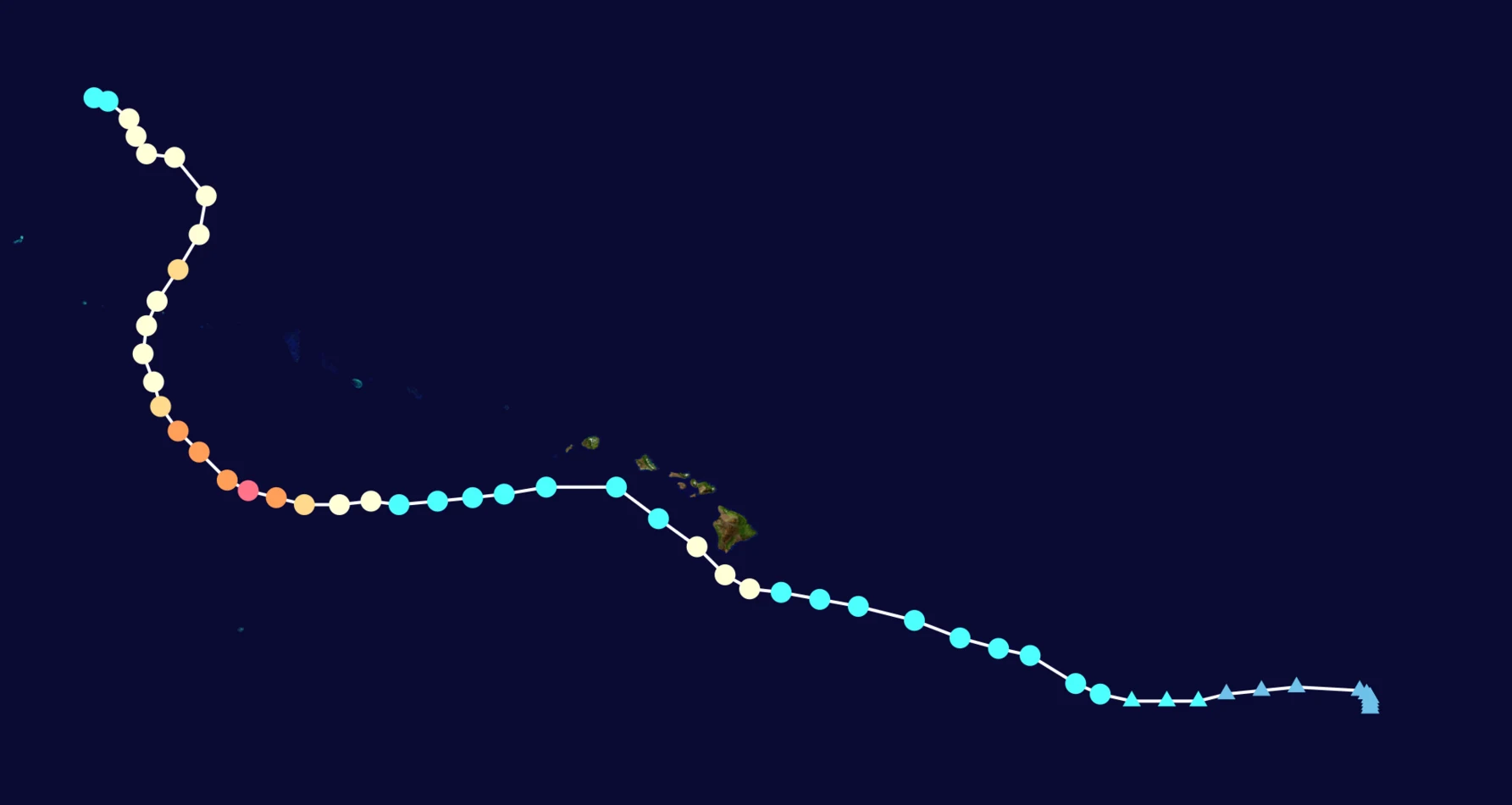
Note where the warm colors sit on that track. Lala was at its most intense well past the islands, which is exactly the shape of storm that catches travelers out: the forecast looks survivable, the ports still close, and the disruption lands on the schedule rather than on the weather app.
It matters to say plainly that this was not only a logistics story. Ashore, Lala killed at least one person, damaged or destroyed more than 100 homes on the Big Island, and cut power to roughly 100,000 customers. Two ships changing plans is the smallest thing that happened that weekend.
3 · What a closed port does to a sailing
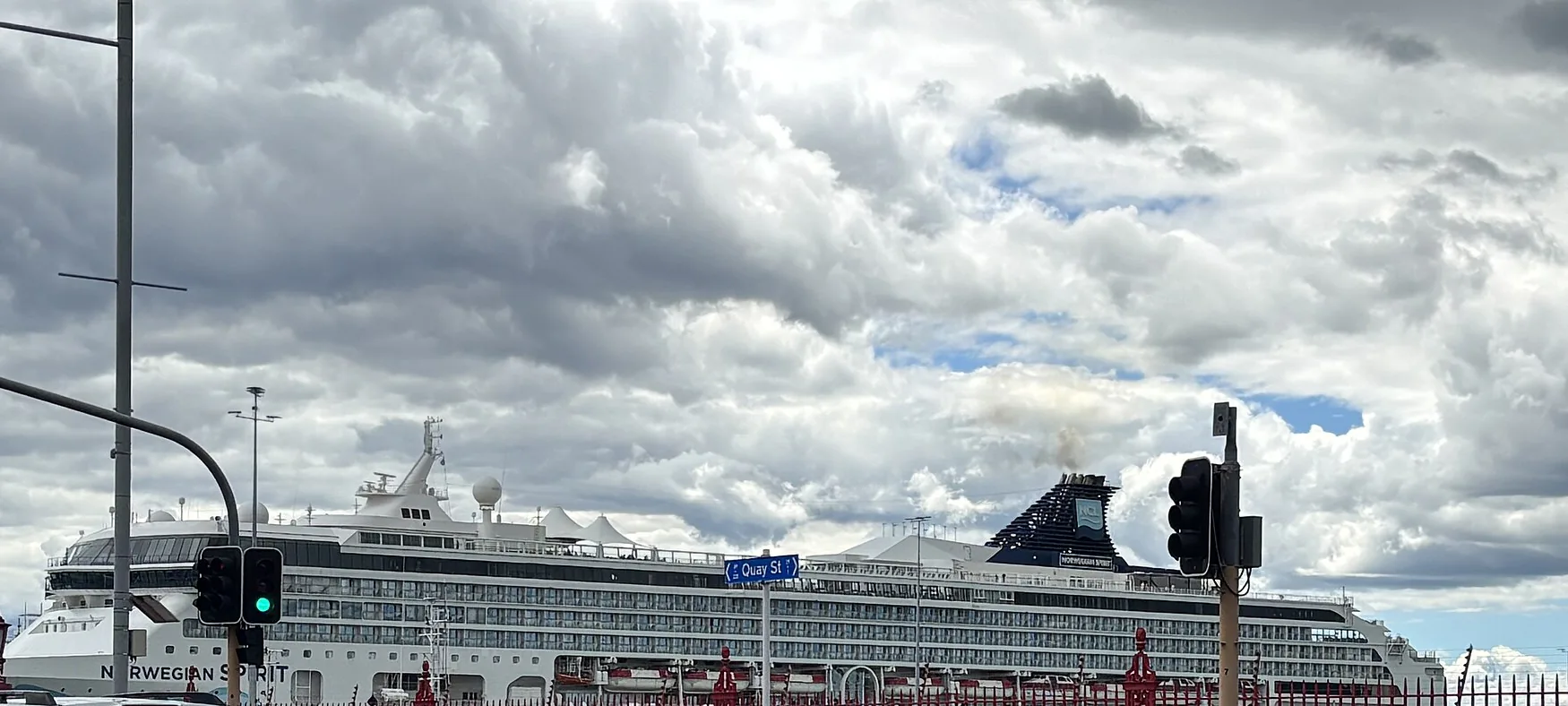
Two Norwegian ships were caught on opposite sides of the same closure — one trying to finish a voyage, one trying to start the next.
Norwegian Spirit
Inbound · 16-night Vancouver → Honolulu
- Reaches Honolulu early on Thursday 13 August, ahead of the voyage’s scheduled end.
- Drops its last two calls — Hilo on the 14th, Kona on the 15th — and stands out to open water, away from the islands.
- Debarkation, and the embarkation behind it, slip to Monday 17 August.
Pride of America
Inter-island · the ship that lives in Hawaii
- Cuts its Nawiliwili, Kauai call short on Wednesday 13 August and runs for Honolulu ahead of the closure.
- Guests choose: step off early, or ride it out at sea. Hundreds took the early exit.
- The Saturday 15 August turnaround slips to Sunday the 16th — and the next voyage sails as a six-night cruise instead of seven, with a shortened Kahului call.
The Pride of America line is the one to sit with. A closed port does not just delay the people trying to get off — it delays the people trying to get on, and then it eats their holiday. That sailing lost a night off the front of the cruise and length off its Maui call, and the guests affected had done nothing but book a cruise for the following week.
A useful correction to a common assumption: Norwegian Spirit did not run for port when it dropped Hilo and Kona. It stood out into open water, away from the islands. Sea room is the safe place in a storm. The harbor is the hazard, which is precisely why it closes.
4 · Who pays — the short version
Cruise contracts reserve broad rights to change itineraries, ports and arrival times for weather. Norwegian's terms are typical of the industry, not an outlier. What appeared during Lala — a prorated refund of about two days' fare for guests who left early, onboard credit for those who stayed, a future cruise credit — was a goodwill response to a badly broken voyage, not a published entitlement you can plan around.
The costs that actually hurt in a port closure are the ones the cruise line was never going to cover: the extra hotel night, the rebooked flight, the missed connection. Those belong to your insurance policy, and whether they are covered depends on wording you have to buy before the storm is named.
That is a whole subject of its own, and we have written it up separately — which lines actually refund port taxes, what insurance pays for a missed port, and the timing rule that decides every hurricane-season claim. This piece stays on the operational side.
5 · Planning for a port that might be shut
Leave a night. Treat it as part of the fare.
Hawaii's ports reopened at 16:00 on a Sunday. Any guest holding a same-day afternoon flight had already lost it. One flexible night is the difference between an inconvenience and a scramble, and it is far cheaper bought in advance than bought at 10pm from a ship where two thousand people are booking the same seats on the same wifi.
Know whether you are the exposed kind of traveler
- Solo travelersYou are your own rebooking desk, at 11pm, on ship wifi, competing with 2,000 people for the same seats.
- Multi-generational groupsFour bookings on three airlines rebooked separately is not one problem, it is four — and they will not all move to the same day.
- Anyone using mobility equipmentAccessible transfers and adapted rooms are the first inventory to vanish and the last to be re-secured. A same-day flight is not a plan here.
- Non-refundable anythingA restricted fare or a prepaid hotel converts a delay into a loss. That is the whole mechanism.
Watch the source that actually decides it
Most travelers watch the forecast. The forecast is not the decision — the port condition is. These are the five feeds worth having, in the order they will affect you.
- Central Pacific Hurricane CenterThe forecast itself. Hawaii is the central Pacific basin, not the Atlantic and not the eastern Pacific.
- Coast Guard COTP HonoluluPort conditions. This is the one that decides whether your ship can dock — and almost nobody watches it.
- Hawaii DOT HarborsHarbor-side operations and berth availability.
- Your cruise line’s appWhere the actual itinerary change arrives. Turn the notifications on before you sail.
- Your airlineWeather waivers are often published before your flight is formally canceled — that window is when seats are still available.
Keep the record as it happens
Screenshot every notice and app alert as it arrives; they are rarely retrievable afterwards. Keep receipts for every unplanned hotel, meal and transfer. Keep any cruise line claim separate from your insurance claim unless the insurer tells you to combine them. And carry medication, chargers, documents and any mobility aids in hand luggage — extra sea days are survivable, being separated from your prescriptions is not.
6 · The counter-argument: buffers cost money
Everything above costs something. An extra hotel night is money spent on a delay that may never happen. A changeable fare costs more than a restricted one. Insurance may exclude the very storm you are worried about, if it was already named when you bought.
So make the flexibility targeted rather than automatic. Price the risk against the trip: the season, the number of travelers, how many connections have to work, whether anyone has a fixed medical appointment or an accessible transfer that cannot simply be rebooked. A solo traveler with a flexible week can carry risk that a family of six with four separate flight bookings cannot.
Buy the buffer where the failure would hurt most. Skip it where it would not. That is a different instruction from "always buy everything", and it is the one that survives contact with a budget.
Frequently asked questions
What does Port Condition Zulu mean for a cruise ship?
Why did Hilo close before Honolulu during Tropical Storm Lala?
Will my cruise line pay for a hotel if the ship cannot dock?
How much buffer should I leave after a Hawaii cruise?
Was Lala a hurricane or a tropical storm?
Sources
- U.S. Coast Guard / Big Island Now — Port conditions increased as Tropical Storm Lala approaches (14 August 2026)
- Maui Now — Coast Guard scheduled to increase port conditions across the State of Hawaiʻi
- Hawaii News Now — Coast Guard reopens commercial ports across Hawaii after Lala passes
- Cruise Hive — Port of Honolulu reopens and cruise ships resume adjusted schedules
- Cruise Hive — Norwegian Spirit cuts ports in Hawaii as tropical storm closes in
- Seatrade Cruise News — Hawaii braced for Lala as two NCL ships steer clear
- CNN — At least one dead and over 100 homes damaged in the wake of Hurricane Lala
- NOAA — About the Central Pacific Hurricane Center
- Norwegian Cruise Line — Terms and Conditions, "Itinerary Changes"
Photography
- Norwegian Spirit — Paora, CC0, via Wikimedia Commons (photographed in Auckland, not Hawaii).
- Lala best-track map — OreoStar-fait, public domain, via Wikimedia Commons (derived from NHC/CPHC advisories).
Subject to change. Port conditions, harbor status, cruise line policies, insurance terms and itineraries can all change without notice and are set island by island. Verify current status directly with the Coast Guard, Hawaii DOT Harbors, your cruise line and your insurer before traveling or making non-refundable arrangements.
Informational only. This article is general information and is not legal, insurance, financial or medical advice. Consult an appropriately licensed professional about your own policy, rights or circumstances.