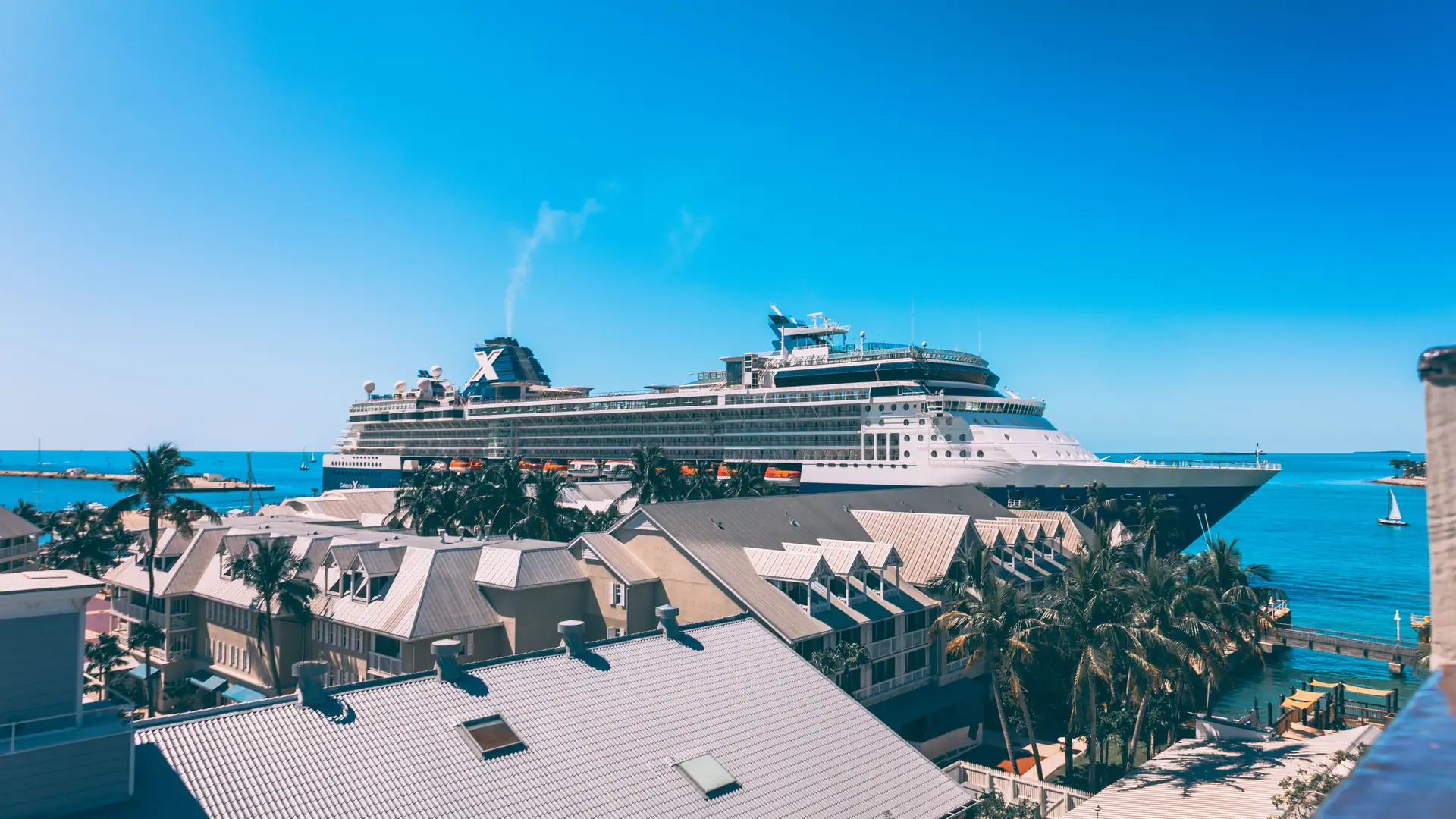
A cruise ship can create a welcoming, affirming environment at sea. That matters. For many LGBTQ+ travelers, the ability to relax, meet people, enjoy entertainment, and move through the ship without constantly calculating how visible to be is a major part of the vacation.
Sources and facts checked: September 27, 2026 (America/New_York). Port decisions, travel advisories, fare terms and charter policies change, sometimes within days. This is general information, not legal advice — check and verify with the cruise line, charter operator and official government sources before you pay.
But the ship is only one part of the journey.
The moment you step into a port, you enter another legal system, another administrative structure, and another social environment. The cruise line may support an LGBTQ+ charter. The destination may still restrict, question, delay, or deny the ship’s arrival.
That distinction became impossible to ignore in July 2026.
The ship is not the whole journey
Evaluate three separate layers before you book:
- The ship or charter: How does the operator handle LGBTQ+ guests, onboard programming, privacy, security, and communication?
- The port: What do the local port authority, terminal, immigration officials, and excursion providers control?
- The country: What laws, travel advisories, social conditions, and government policies may affect LGBTQ+ travelers?
A strong result in one layer does not guarantee a strong result in the other two.
A welcoming ship cannot override a port authority. A friendly local guide cannot change national law. A published itinerary cannot guarantee that a ship will be allowed to dock.

What the July 2026 Atlantis reports show
The July 2026 Atlantis Events charter aboard Virgin Voyages’ Scarlet Lady was widely reported by The Guardian on July 9, USA TODAY on July 9, and Cruise Hive.
The reported sequence was:
- In late June or early July 2026, Turkish authorities denied the charter access to Kuşadası and Istanbul.
- Authorities in Aydın Province cited language about social structure and moral values.
- Atlantis then revised the itinerary to include Alexandria, Egypt, along with changes involving Crete.
- On July 9, 2026, just hours before the scheduled arrival, Egyptian authorities denied Scarlet Lady entry to Egyptian waters for the Alexandria call.
- The voyage continued with an adjusted itinerary that included Chania (Crete) and Kotor (Montenegro), with other Adriatic calls such as Dubrovnik and Zadar retained.
The two-country denial was described as the first time in Atlantis's history that the same charter voyage had been denied by two countries — an unusual detail, but one that still does not predict how every future charter or regular sailing will be treated.
The reports do not establish that every port in Turkey or Egypt denies access to LGBTQ+ travelers. They document a specific charter, a specific ship, specific dates, and specific government decisions.
That distinction matters. Do not turn one incident into a blanket statement about every resident, business, city, or future sailing in either country.
The reporting also distinguished between the two decisions. Turkish authorities publicly cited moral and social concerns. Egyptian authorities did not provide a public explanation in the cited coverage. Treat those facts differently rather than filling gaps with speculation.
Law and social climate are not the same thing
A country’s legal position and its social climate can point in different directions.
A destination may have:
- Laws that do not criminalize consensual same-sex relationships but limited protections against discrimination.
- Legal protections in major cities but a more conservative environment outside them.
- Welcoming tourism businesses alongside restrictive government policies.
- A relatively open local community but strict rules involving public conduct, gender expression, photography, or public events.
- Laws that appear manageable on paper but uneven enforcement in practice.
Cruise travelers also face a special complication: you may spend only several hours ashore, but immigration, customs, policing, and port security still apply.
Do not assume that a ship’s LGBTQ+ branding, an excursion provider’s “welcoming” description, or a city’s reputation answers the legal question. Ask for current, destination-specific information.
This section describes publicly reported events and general legal context; it is not legal advice. Port-entry decisions are made by national and port authorities and can change at any time.
Use a ship-port-country evaluation framework
| Layer | What to evaluate | What it cannot guarantee |
|---|---|---|
| Ship or charter | LGBTQ+ policies, onboard conduct rules, privacy, security, communication, group support | Permission to enter another country |
| Port | Port authority practices, terminal procedures, immigration requirements, tender arrangements, local operating conditions | A stable national policy |
| Country | Laws, advisory level, local customs, social climate, enforcement patterns, entry rules | That every city or resident shares the government’s position |
Before paying, write down the countries and ports on the itinerary. Then assess each one separately.
For a regular sailing, check the ship’s current itinerary and the cruise line’s ticket contract.
For a full-ship charter, also check the charter operator’s terms. The charter may control programming, guest communication, and certain cancellation rules, while the cruise line controls the vessel and navigation.
You need both sets of information.
Read State Department advisories as information, not bans
The U.S. Department of State’s LGBTQI+ traveler guidance directs travelers to review the advisory and local laws information for each destination.
Use the country travel advisories to check:
- The current advisory level.
- Safety and security concerns.
- Local laws and customs.
- Entry and exit requirements.
- Special circumstances affecting travelers.
- Any specific discussion of discrimination, harassment, or violence.
An advisory is information for decision-making. It is not automatically a legal ban on travel, and it is not a guarantee that a destination is safe or unsafe for every traveler.
For cruise planning, check every country rather than only the headline destination. A sailing marketed as “Greek Isles and Turkey,” for example, may also involve Greece, Turkey, Montenegro, Croatia, Italy, and a different embarkation or disembarkation country.
Advisories can change. Recheck them before final payment and again before departure. Check and verify any final-payment deadline with the cruise line or vendor.
OTGG’s related guide, STEP, Embassy Alerts, and Medicare Abroad, explains how to build a broader travel-safety information trail.
Understand what itinerary-change protection really means
Virgin Voyages’ published Additional Terms and Conditions and Ticket Contract give the carrier broad authority to change, omit, substitute, or reorder ports.
The standard contract also states that government action, port restrictions, civil unrest, weather, and other circumstances may require itinerary changes. A missed port does not automatically create a right to a full cruise refund.
That is the uncomfortable part of cruise pricing: you are buying a voyage, not a guaranteed collection of port calls.
Fare and protection snapshot
| Booking category | General published position | Verify before paying |
|---|---|---|
| Essential or Premium | May offer more flexibility for changes, credits, or future sailing options, depending on timing and current terms. Check and verify against current Virgin Voyages fare terms. | Exact cancellation window, credit rules, transfer terms, and charter-specific conditions |
| Lock It In or Base | Generally more restrictive and may be non-refundable. Check and verify against current Virgin Voyages fare terms. | Whether a port change creates any special protection |
| Full-ship charter | May have separate operator rules layered over the cruise line’s contract. Check and verify against current charter and cruise-line terms. | Who handles refunds, credits, replacement ports, and guest communication |
Fare-protection features change; verify the current terms for your exact sailing before paying any deposit.
Do not rely on a salesperson’s verbal promise that a port denial will trigger a refund or credit. Ask for the policy in writing.
For a charter, request written confirmation from:
- The charter operator.
- The cruise line or its authorized charter representative.
- The relevant port or destination authority where a specific concern exists.
- Any excursion or transfer provider affected by the change.
Written confirmation is not a guarantee that circumstances cannot change. It gives you a record of what was represented and which party is responsible for the answer.
Questions to ask before booking
Ask these questions directly:
- Which countries and ports are currently confirmed?
- Which calls are overnight, tendered, or dependent on local approval?
- Has the operator received written confirmation for each planned port call?
- What happens if a port denies entry because of the charter’s identity, programming, or guest profile?
- Will the operator offer a refund, future voyage credit, onboard credit, or only a replacement port?
- Does the protection apply to a regular sailing and a full-ship charter in the same way?
- Who decides whether a replacement port is acceptable to the charter group?
- What happens to prepaid excursions, transfers, hotels, flights, and visas?
- How quickly will guests receive an official update?
- If I am traveling solo, how will I receive changes if I do not participate in group chats?
- If I am traveling with a group, who is responsible for communicating the revised plan?
- If I have mobility, sensory, medical, or communication needs, will the replacement port still work?
Get answers before final payment. If the answer is “the itinerary is never guaranteed,” ask the next question: “What protections are available if the itinerary changes for this specific reason?”
Plan realistically for a removed port
A replacement day may become:
- A sea day with additional onboard programming.
- A new port with limited notice.
- A different port with tendering or reduced accessibility.
- A shorter call that makes long excursions impractical.
- A port where your original excursion cannot operate.
Do not automatically book an independent tour for a replacement call. Confirm the arrival time, departure time, transportation, cancellation rules, and return-to-ship plan first.
If you have accessibility requirements, ask whether the new port has a pier or tender, whether adapted transportation is available, and whether the excursion operator can accommodate your exact equipment. A ship that is accessible at sea may not deliver an accessible day ashore.
Sometimes the most practical alternative is to stay onboard. That is not a failed vacation. It may be the safer and more comfortable choice when the replacement port does not meet your needs.
Solo, group, and multigenerational considerations
Solo travelers need a personal contingency plan. Keep copies of itinerary updates, know how to contact the ship or charter operator, and do not assume that a group organizer will handle every individual question.
Groups should agree in advance on:
- How itinerary changes will be communicated.
- Whether members can opt out of a replacement port.
- How canceled excursions will be handled.
- How accessibility needs will be reassessed.
- Who will document requests and responses.
- Whether the group has a shared emergency contact process.
For multigenerational groups, a removed port may affect travelers differently. Younger guests may welcome an active replacement day while older relatives may prefer a slower onboard schedule. Build flexibility into the plan rather than promising that everyone will follow the same response.
For LGBTQ+ travelers, community remains valuable. So does informed consent. A group can be joyful and affirming while still acknowledging that each traveler has a different comfort level with legal exposure, public visibility, and local conditions.

Devil’s Advocate: one case does not predict every sailing
The July 2026 Atlantis incident deserves careful attention, but it is still one case involving one charter, one ship, and one period of rapidly changing port decisions. It was also reportedly the first time in Atlantis's history that two countries denied the same charter voyage, which explains why the event drew unusual attention without proving that every future charter will face the same response.
It does not prove that:
- Every LGBTQ+ charter will face the same response.
- Every sailing on Scarlet Lady will be treated the same way.
- All ports in Turkey or Egypt will deny LGBTQ+ groups.
- A regular sailing will receive the same treatment as a full-ship charter.
- A replacement port will be unsafe or unwelcoming.
- A cruise line can guarantee entry into a sovereign country.
It also does not mean that an advertised port is worthless. Ports change for weather, congestion, security, mechanical issues, government decisions, and operational reasons every year.
The practical conclusion is narrower: if a port matters deeply to you, do not treat it as guaranteed merely because it appears in the brochure.
Verify before you pay
Before booking an LGBTQ+ cruise or charter:
- List every country and port on the current itinerary.
- Check the current State Department advisory for each country.
- Read the local laws and customs section.
- Separate the ship’s inclusion policies from the port’s entry authority.
- Read both the cruise line and charter operator terms.
- Confirm what happens if a port denies entry.
- Ask whether the protection is a refund, credit, onboard credit, or replacement port only.
- Obtain material answers in writing.
- Confirm cancellation rules for excursions, transfers, hotels, and flights.
- Recheck the itinerary, advisory levels, and policies before final payment. Check and verify any deadline with the cruise line or vendor.
- Reconfirm accessibility and communication needs if the itinerary changes.
- Keep a personal contingency plan if traveling solo.
- Make sure group travelers know who will communicate changes.
- Purchase travel insurance only after reviewing exclusions for itinerary changes, government action, and missed ports.
Frequently asked
Does a welcoming cruise ship guarantee a welcoming port?
No. The ship, port authority, and country operate under different rules. A cruise line may support LGBTQ+ travelers while a port or government makes a different decision.
Can I get a refund if a port rejects the ship?
Not automatically. The cruise line’s ticket contract, fare type, charter agreement, and circumstances of the change control the answer. Prepaid excursions for a canceled port may be refunded, but the cruise fare may not be.
Should LGBTQ+ travelers avoid every country with a higher advisory level?
Not automatically. Review the current advisory, local laws, customs, and your own risk tolerance. The State Department’s system provides information; it is not a universal LGBTQ+ cruise-port ban list.
Are charter cruises riskier than regular sailings?
A charter can create a more visible guest profile and may have different communications and cancellation terms. That does not make every charter riskier, but it makes the charter agreement and port-confirmation process especially important.
Sources and facts checked: September 27, 2026 (America/New_York). Reporting by The Guardian, USA TODAY and Cruise Hive on the July 2026 Atlantis charter, the U.S. Department of State’s LGBTQI+ traveler guidance and country advisories, and Virgin Voyages’ Additional Terms and Conditions and Ticket Contract were reviewed on the date shown. Port-entry decisions are made by national and port authorities and can change at any time — confirm current terms in writing before booking.
Sources
Photographs. A cruise ship docked beside a waterfront town — PeopleByOwen, Pexels Cropped and resized for the web; not otherwise altered. Neither the photographers nor the licensors endorse this article.
This article is general information, not legal, immigration or safety advice. It describes publicly reported events and does not predict how any government will treat a future sailing. OTGG is an independent travel advisor; this article contains no affiliate links. Cruise line, charter and fare terms change — verify directly with the operator or an accredited travel advisor before booking or paying.
Weighing an LGBTQ+ charter or a sailing with ports you’re unsure about?
Send me the itinerary. I will check each country’s current advisory, put the itinerary-change and refund questions to the line and the charter operator in writing, and tell you plainly which calls I would treat as uncertain. See more on our LGBTQ+ travel page.
Begin the Journey






















