A cruise port fee only reaches your invoice if it survives the lawmaking process. The ones that die quietly never reach you, but the difference between a live charge and a dead bill tells you what to expect, and when.
Sources and facts checked: October 7, 2026 (America/New_York). Fares, fees, promotions and cabin terms change without notice. Check and verify with the cruise line before you pay.
The live fees are the ones with a collection mechanism
The clearest 2026 example is Mexico’s non-resident duty, or DNR. It survived negotiation, received a phased implementation schedule, and is now being collected.
Hawaii’s proposed fee followed a different path. Senate Bill 2698, with companion House Bill 2195, passed both chambers but stalled in conference committee in April. The Senate did not appoint its negotiators. No enacted fee followed.
That is the practical distinction: approval is not collection. A fee needs a legal mechanism, an effective date, and someone responsible for charging it.
| Jurisdiction | Fee per passenger | Status | Effective date | Who collects it | Source |
|---|---|---|---|---|---|
| Mexico DNR | $10 now; $15 from July 1, 2027; $21 from August 1, 2028 | Survived; live phased schedule | $10 effective August 1, 2026; $21 scheduled through September 2030 | Cruise lines or shipping agents, generally within taxes and fees | Riviera Maya News, Fox News, Cruise Hive |
| Hawaii SB 2698 | $10 proposed at each port entry | Died in conference | None; no passenger fee created by this bill | Nobody; the proposal did not become collectible | Honolulu Civil Beat, Hawaii Legislature status page, bill text |
| Boston | $3 in 2026, rising $3 per year to $15 by 2030 | Survived; staged schedule | Begins 2026, stepping annually to 2030 | Cruise lines, as a pass-through charge funding the $105 million Flynn Cruiseport modernization including shore power | Massport public board materials; corroborated by GoCruiseTravel |
| Santorini, Greece | €20 peak-season levy (€12 in April, May and October; €4 in winter) | Survived; live | June–September at the €20 rate | Collected with cruise passenger charges | TNT Magazine |
The table is the numeric spine. It also shows why the label "port fee" is not enough. One charge is federal and itinerary-based. Another was a state proposal assessed at every port entry. Boston's schedule is a port-authority capital plan. Santorini's levy operates alongside an 8,000-passenger daily cap.
Mexico passed, and your fare can reflect the ladder
Mexico's non-resident duty ran at $5 per cruise passenger through July 2026. From August 1, 2026 it is $10, holding at that level through June 30, 2027. It then steps to $15 from July 1, 2027 through July 2028, and to $21 from August 1, 2028, holding through September 30, 2030.
Cruise lines generally collect the amount inside the taxes, fees, and port expenses already included in the fare. You may not see a neat line labeled “Mexico DNR.” That does not mean it is absent.
The charge applies once per itinerary on a passenger's first entry into a Mexican port, and it is assessed on cruise passengers including those who do not step ashore. A sailing calling at Cozumel and Costa Maya should not automatically create two DNR charges if both calls form part of the same itinerary.
That structure matters. A once-per-itinerary fee is predictable: count the qualifying itinerary, not every port call. A per-passenger-per-port-entry fee is different. On a multi-island itinerary, the same passenger can generate a new charge each time the ship enters a qualifying port.
One source discrepancy is worth flagging. The Independent reports a $20 amount beginning in August 2028, while the Mexican government decree and the bulk of trade coverage report $21. Use $21 for planning: it matches the decree, which is the controlling document, and is cited by Cruise Hive. Recheck before booking a 2028 or later sailing.
Hawaii passed both chambers, and still produced no fee
SB 2698 was designed to replace the contested application of Hawaii’s transient accommodations tax to cruise ships with a $10 passenger fee assessed at each port entry. The money would have gone into a Cruise Ship Special Fund for harbor and port infrastructure.
The bill cleared both the House and Senate. It still died.
That can happen because bicameral passage is not the same as enactment. The chambers must agree on final language, conference negotiators must be appointed, deadlines must be met, and the measure must complete the remaining legislative steps.
Here, the measure stalled in conference after the Senate did not appoint its negotiators, despite Senator Lorraine Inouye asking Senate President Ron Kouchi to do so. The result for travelers is simple: SB 2698 did not create a $10 Hawaii cruise fee for 2026.
Watch the following legislative session, not the old bill as though it were still active. A new proposal may reuse the same concept with a new number, revised amount, or different collection mechanism. Search for the new measure and read its status page.
Boston and Santorini show two different kinds of survival
Boston's schedule starts at $3 per passenger in 2026 and rises by $3 a year to $15 by 2030. It is not a levy imposed on the port — it is a capital plan. The revenue funds a $105 million modernization of Flynn Cruiseport, including shore power. That makes it the most documented of the four cases, not the weakest: the schedule appears in Massport's own public board materials rather than only in trade reporting.
Santorini's €20 peak-season levy is already live, operating alongside the island's 8,000-passenger daily cap. The 70/30 split between the Old Port of Fira and Athinios governs where passengers physically disembark, not how levy revenue is divided — worth stating plainly, because the two are easy to conflate. We cover that regime in full in Santorini’s 8,000 Cap and Greece’s 2026 Cruise Levies; the relevant point here is only that a live per-passenger levy in a capped port is what a sustained fee regime looks like in practice.
The policy question is no longer only, “What will I pay?” It is also, “Will the port still deliver the day I booked?”
The pass-through clause is the part to watch
Most cruise lines reserve the right to pass on changes in taxes, fees, and fuel charges. That is why a fee introduced after you have paid in full is the one to watch.
A modest new charge can still appear on your invoice if your booking terms allow the line to collect it. The timing may be awkward: after final payment, after flights are purchased, or shortly before embarkation.
Your workaround is straightforward. Build a separate fee line in your travel budget. Then ask your advisor or the cruise line, in writing:
- Which taxes, fees, and port expenses are already included?
- Which charges remain subject to adjustment?
- Can a new government or port fee be added after final payment?
- Is the charge assessed once per itinerary, per passenger, or per port entry?
- What happens if the itinerary changes and a qualifying port is removed?
Keep the answer with your booking documents.
Devil’s advocate: the fee may not be the real cost
The honest case against fee anxiety is that these charges are usually small against the total fare. A $10 Mexico DNR or €20 Santorini levy may be annoying without being trip-changing.
For families and multigenerational groups, the arithmetic matters more because the amount multiplies by traveler. For a solo guest, the absolute charge is smaller, but a late adjustment still matters when the booking was built to a strict budget.
The larger cost of an overtourism levy may not be the euros. It may be the itinerary change it helps produce: a missed call, a shifted berth, a tender restriction, or a port day redesigned around crowd management. A fee can be visible while the operational consequence arrives somewhere else.
Verify before you pay
- Check the cruise line’s current taxes-and-fees breakdown.
- Ask whether each charge is included or adjustable.
- Confirm whether the fee is per itinerary or per port entry.
- For Mexico, budget $10 now and monitor the scheduled $15 and $21 steps.
- For Hawaii, do not budget SB 2698 as a current charge; check for any new bill in the next session.
- For Boston, budget the $3-to-$15 schedule and note it funds Flynn Cruiseport improvements rather than a municipal levy.
- For Santorini, verify the season, ship call, passenger-routing rules, and current levy treatment.
- Request written confirmation from the cruise line, port authority, or government body when the charge affects your booking.
- Recheck the invoice after final payment and before online check-in.
Your booking deserves a fee audit
Before you pay, separate the fare from the charges that can move. Then identify whether each fee survived into law, remains only a proposal, or is a documented capital plan rather than a levy at all.
That small audit will not eliminate every surprise. It will tell you which surprises are real, which are possible, and which died before they ever reached your invoice.
Frequently asked
Can Mexico charge the DNR at every Mexican port?
The reported arrangement treats it as a once-per-itinerary charge on the first entry into a Mexican port, not a new DNR at every Mexican call.
Did Hawaii’s $10 fee take effect?
No. SB 2698 died in conference committee. It did not create a collectible passenger fee.
Can a port fee be added after final payment?
It can be, depending on the cruise line’s booking terms and the nature of the charge. Ask specifically about pass-through taxes, fees, and fuel adjustments.
Is Santorini’s levy €20 all year?
No. Santorini’s levy follows seasonal tiers; see Santorini’s 8,000 Cap and Greece’s 2026 Cruise Levies for the current breakdown and verify the amount for your sailing month.
Should I trust the Boston schedule?
Yes, as a budget line. The $3 current fee and the $15-by-2030 step-up appear in Massport's own public board materials, so it is the best-documented of the four cases here. Confirm the amount applied to your booking with the cruise line, as with any pass-through charge.
Sources and facts checked: October 7, 2026 (America/New_York). Cruise line published terms and trade reporting were reviewed on the date shown.
Sources
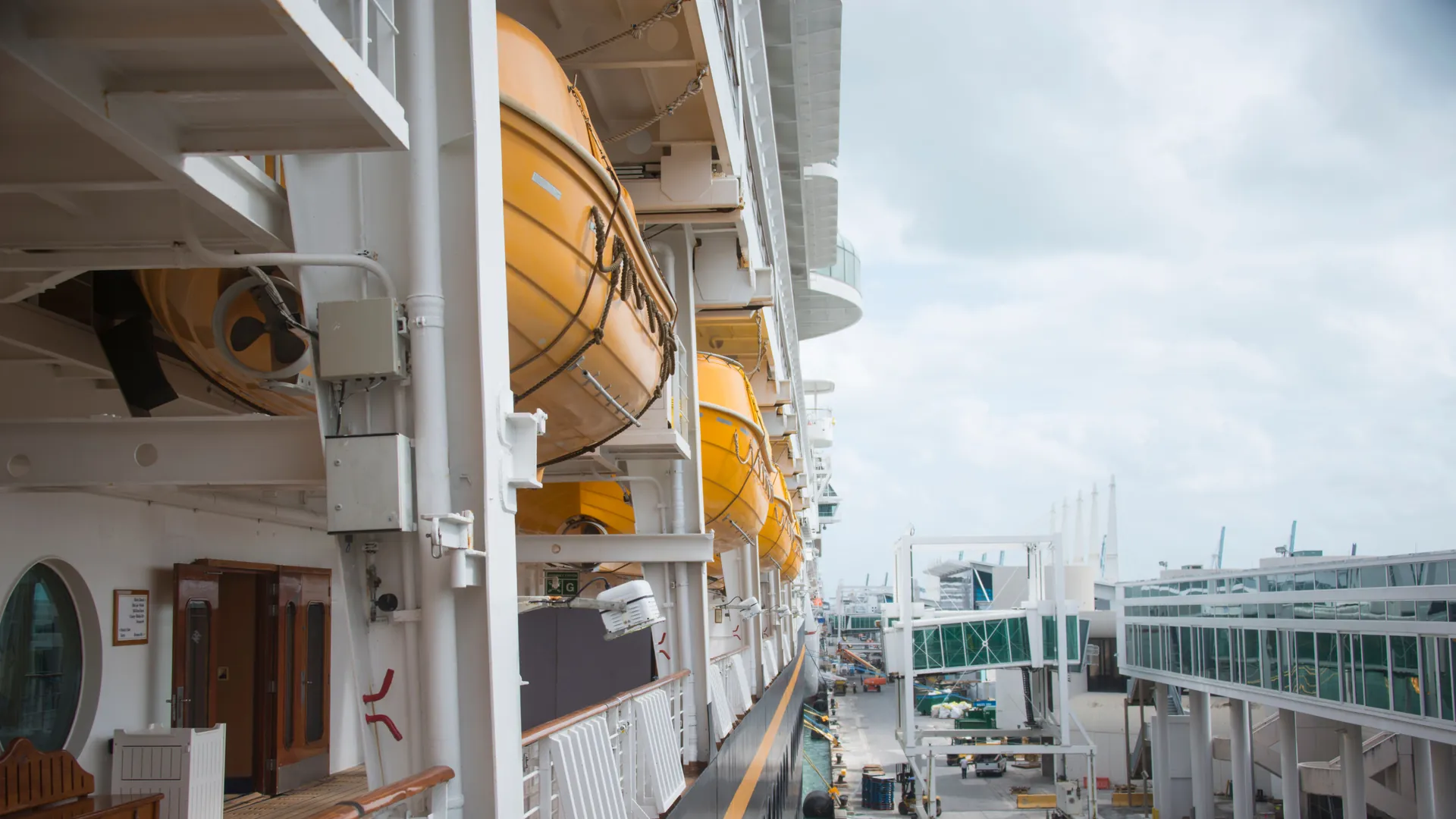
Photographs. Lifeboats on a docked cruise ship — Diego F. Parra, Pexels Cropped and resized for the web; not otherwise altered. Neither the photographers nor the licensors endorse this article.
This article is general information, not medical, legal, financial or safety advice. OTGG is an independent travel advisor; this article contains no affiliate links. Cruise line and supplier policies, rates, promotions, inclusions, accessibility procedures and deposit schedules change — verify all details with the operator or an accredited travel advisor before booking or payment.
Wondering what fees could still land on your booking?
Send me the booking. I will separate the fare from the charges that can move and check which of them apply to your ports.
Begin the Journey






















