Greece is managing cruise volume with two separate tools, and they are frequently confused: a capacity cap that applies only to Santorini, and a passenger levy that applies across the country. One can move your port call before you sail. The other just costs you money.
There is also a third thing, newer than either and absent from most coverage: a rule about where your tender lands, which changed twice this summer after a wall fell onto a staircase.
The cap, and the arithmetic that tightened it
Santorini's daily ceiling is 8,000 cruise passengers. The number did not change for 2026 — the way it is calculated did, and that is the whole story.
2025 assumed ships would sail 80% full. 2026 counts them at 100% of stated
capacity. A 3,000-berth ship therefore consumes 3,000 of the day's
8,000 slots rather than 2,400 — a 25% increase in what a single ship counts
against the cap, which leaves 5,000 slots for everyone else instead of 5,600.
The effect is measurable rather than theoretical: Santorini's berth allocation system shows
scheduled 2026 arrivals down 18.27% — 595 ships against 728 in 2025.
Enforcement happens in advance, not at the pier. Calls are evaluated through a ranked berth allocation system, and when a day's projected total would breach the ceiling, lower-ranked requests are shifted to other dates. A shifted call can become impractical and be dropped — though cancellation is not the automatic result of every adjustment.
The consequence for you is simple: a Santorini call printed in an early brochure is a request, not yet an operational fact.
Mykonos has the levy, not the cap
The two islands are named in the same breath so often that the difference gets lost. Mykonos shares Santorini's higher levy tier. It has no equivalent published numeric daily cruise-passenger cap.
A Mykonos call can still be affected by berth availability, congestion, tender capacity, weather or a wider itinerary change. It is simply not governed by the 8,000 formula, and planning as though it were will lead you to worry about the wrong risk.
The levy, in full
Greece's sustainable tourism fee — the government's own term — has been in force since 21 July 2025, so it is not a 2026 rule. It is charged per person, per Greek port call, each time you disembark, collected through the cruise line — bundled into the fare, into port charges, or posted to your onboard account rather than paid in cash ashore. Two exemptions: passengers disembarking for emergency medical reasons, and crew.
| Season | Santorini & Mykonos | All other Greek ports | Two people, one call at each island | Note |
|---|---|---|---|---|
| Peak 1 June – 30 September | €20 | €5 | €80 — those two calls only, not a trip total | The rate almost every summer Aegean itinerary pays |
| Shoulder April–May, October | €12 | €3 | €48 for the same two calls — a €32 saving | Plus thinner crowds and easier private guides |
| Low November – March | €4 | €1 | €16 for the same two calls | Few Aegean itineraries run then, but repositionings do |
Most coverage stops at the €20 and never mentions the €5. On a seven-night Aegean itinerary calling at four or five Greek ports, those other-port charges are the larger part of the bill — a couple visiting Santorini, Mykonos and three other Greek ports in peak season pays €110, not €80. The levy is also separate from accommodation taxes, so ask any pre- or post-cruise hotel what it adds.
Where you actually come ashore — and why it moved twice
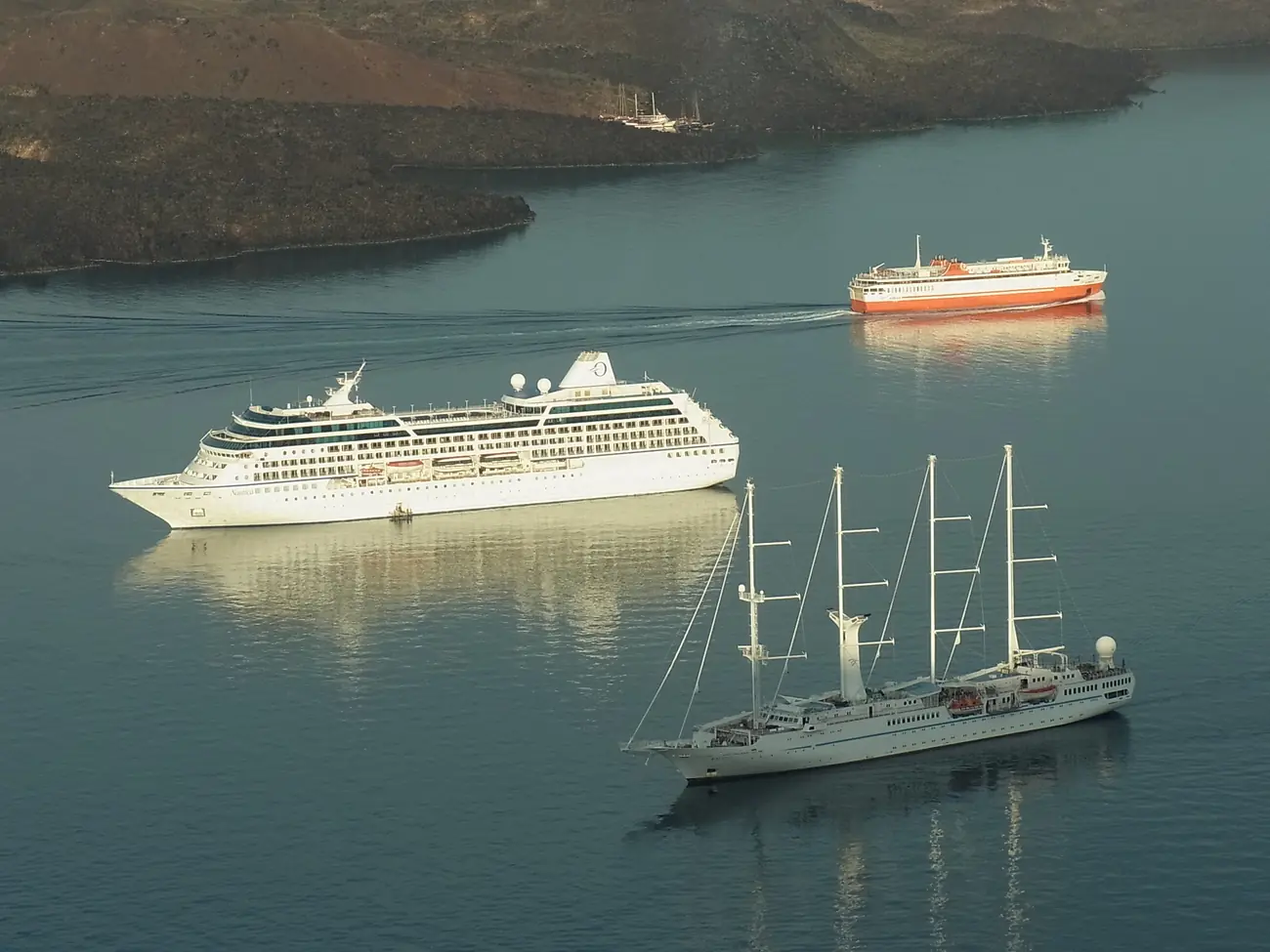
This is the part most reporting treats as a footnote, and it is the part most likely to shape your actual day.
| Landing point | What it is | Share of passengers | How you reach Fira | What happened in 2026 |
|---|---|---|---|---|
| Ormos Firon The Old Port, below Fira | Tender landing beneath the caldera cliff | At least 70% of each ship’s passengers | The Karavolades Stairs (~560 steps), or the cable car. That is the entire list | The stairs closed for ~a week in late July. Cable car queues ran to hours |
| Athinios The commercial port, south | The island’s ferry and cargo port — road access, better infrastructure | No more than 30% — a civil-protection cap | Road transfer to Fira and Oia | Cap suspended during the stairs closure, then reinstated on 3 August |
The timeline
- June 2026 — the 70/30 rule. Up to 70% of each ship's passengers must land at Ormos Firon, the Old Port; no more than 30% via Athinios. This replaced an earlier allowance of 40% at Athinios. The 30% ceiling is a civil-protection measure, intended to keep the island's roads clear for emergency access following the early-2025 seismic crisis.
- 27 July 2026 — the staircase falls. A private wall collapsed onto the Karavolades Stairs, the pedestrian link between the Old Port and Fira. (Published step counts vary between 558 and 588 depending on the source.) Foot and donkey traffic were banned. Cable car queues ran to multiple hours. All organized excursion movements were rerouted through Athinios and the 30% cap was suspended.
- Early August 2026 — reopening, and the cap returns. The stairway reopened and the 30% Athinios limit was reinstated. That is the rule in force as this is published.
The episode exposed the actual fragility, and it is not the cap. With 70% of arrivals required to land at the Old Port, and that port connected to Fira by exactly two things — one staircase and one cable car — the entire Santorini shore operation rests on two links, one of which failed this summer. Ask your line which landing point applies to your ship, because Ormos Firon and Athinios produce completely different days: a cable car queue under a cliff, or a road transfer.
Planning around it rather than away from it
- Choose a smaller ship. Fewer calculated slots means more flexibility in the allocation ranking — and a calmer ship-to-shore transition when the only way up is a cable car.
- Sail May or October. The strongest single move: the levy drops from €20 to €12 at both islands, demand is less concentrated so your call is less likely to be reallocated, and private guides and vehicles are easier to secure. The trade is weather.
- Book the earliest tender slot your ship offers. It buys margin against cable-car queues, traffic, heat and the return-to-ship buffer — and on a day when 70% of a full ship is funnelling through one lift, margin is the whole game.
- Count the calls on your actual date, not the generic port calendar. Ask whether the listed vessels are confirmed, provisional, or subject to slot adjustment.
- Confirm the excursion's starting point. Docked, tender landing, or a separate transfer — "Santorini" on an itinerary does not describe the logistics.
Solo, group and accessibility planning
Solo travelers should favor a longer Santorini or Mykonos call over a short port window — a compressed call plus a cable car queue is how a marquee port becomes an hour in Fira. Look for low to no single supplement, and shore excursions that do not penalize a one-person booking.
Group organizers should confirm a hosted group is attached to the exact sailing rather than the same itinerary family, and pin down excursion minimums, rooming deadlines and cancellation terms in writing.
For anyone with mobility needs, Santorini is the hardest call in the Aegean, and the 70/30 rule is why. A landing at Ormos Firon means a tender transfer followed by a cable car or roughly 560 steps. Ask specifically: can every traveler board a tender independently; is mobility-device storage available; are shore transfers step-free; does the excursion involve stairs, uneven paving or prolonged standing; and is there a return-to-ship guarantee if local transport is delayed. Athinios is materially easier — which is precisely the landing point restricted to 30%. Get the answer attached to the reservation in writing before final payment.
Do the rules actually fix overtourism?
Only partly, and it is worth being honest about it. The cap limits cruise passengers. It does nothing about arrivals by air, ferry or private yacht — so Fira and Oia can stay crowded on days when cruise numbers are well down.
The levy has the same limitation from the other direction. €20 is a real cost to a budget-conscious traveler and a rounding error to someone already committed to a several-thousand-euro holiday, which is not obviously the demand signal it was designed to be.
And there is a fairness question the policy does not answer. When lower-ranked calls are moved, the passengers on those sailings lose the destination they chose, with no say in the replacement. The system may well improve crowd management on the island while making itinerary certainty worse for the people paying for it. Both of those can be true.
Verify before you pay
- Santorini and Mykonos call status — confirmed, provisional, or subject to slot adjustment.
- The port date and the arrival/departure window.
- Ormos Firon or Athinios — which landing point, and what the current split is.
- Tender booking procedure and the earliest slot available to you.
- How the 2026 levy is collected on your booking, and your total across all Greek calls.
- Substitution terms if Santorini is moved or dropped.
- Accessibility arrangements, transfer details and equipment limits — in writing, attached to the reservation.
- Deposit, final payment, cancellation and itinerary-change rules.
Language to send 48 hours before departure:
“Please reconfirm in writing that our sailing's Santorini and Mykonos calls remain
operational, identify whether each call is docked or tendered and which landing point
applies, confirm the 2026 levy treatment on our booking, and note any current changes to
landing points, tender procedures, accessibility arrangements or shore-excursion return
times.”
Common questions
What exactly is Santorini’s 8,000-passenger cap?
A daily ceiling on cruise passengers — not on all visitors. The important 2026 change is arithmetic rather than the number itself: the port now counts each ship at 100% of stated capacity, where 2025 assumed 80% occupancy. A 3,000-berth ship therefore consumes 3,000 of the 8,000 daily slots instead of 2,400, which materially tightens popular summer dates. The effect is measurable: Santorini’s berth allocation system shows scheduled 2026 arrivals down 18.27%, at 595 ships against 728 in 2025.
Can my Santorini call be moved or canceled after I book?
Yes, and the mechanism is worth understanding because it operates well before your sailing date. Calls are evaluated in advance through a ranked berth allocation system, and when a day’s projected total would breach the 8,000 ceiling, lower-ranked requests are shifted to other dates. A shifted call can become impractical and be dropped, though cancellation is not the automatic outcome of every adjustment. The practical consequence: a Santorini call printed in an early brochure is a request, not yet an operational fact.
How much is the Greek cruise levy, and when do I pay it?
It depends on the port and the season. At Santorini and Mykonos it is €20 per person in peak season (1 June to 30 September), €12 in April, May and October, and €4 from November to March. Every other Greek cruise port charges €5, €3 and €1 across those same three bands. It applies each time you step ashore, is charged through the cruise line — typically bundled into the fare, port charges or your onboard account — and is separate from any accommodation tax on a pre- or post-cruise hotel stay. Two categories are exempt: passengers disembarking for emergency medical reasons, and crew members.
Does Mykonos have the same 8,000-passenger cap?
No — and this is a distinction worth holding onto, because the two islands are usually named in the same breath. Mykonos shares Santorini’s higher levy tier at €20 in peak season, but no equivalent published numeric daily cruise-passenger cap has been identified for it. A Mykonos call can still be affected by berth availability, local congestion, tender capacity, weather or a wider itinerary change. It is simply not governed by the Santorini 8,000 formula, and you should not plan as though it were.
Where will my ship actually land me on Santorini?
One of two places, and the split is regulated. Under the rule in force at the time of writing, at least 70% of each ship’s passengers must come ashore at Ormos Firon — the Old Port beneath Fira — and no more than 30% may use Athinios, the commercial port to the south. The 30% ceiling is a civil-protection measure intended to keep roads clear for emergency access after the early-2025 seismic crisis. Ask your line which applies to your ship, because the two produce completely different days.
What happened to the Karavolades Stairs, and does it still matter?
On 27 July 2026 a private wall collapsed onto the Karavolades Stairs — the roughly 560-step pedestrian link between the Old Port and Fira, and authorities banned foot and donkey traffic. Cable car queues stretched to hours, and all organized excursion movements were rerouted through Athinios with the 30% cap suspended. The Mayor of Thira reopened the stairway on 3 August 2026 and the cap was reinstated — a closure of about a week. It matters because it exposed the structure of the problem: with 70% of arrivals required to land at the Old Port, and that port connected to Fira by exactly two links, the whole thing rests on a staircase and one cable car.
Does the cap actually fix overtourism on Santorini?
Only partly, and it is worth being honest about that. The cap limits cruise passengers; it does nothing about arrivals by air, ferry or private yacht, so Fira and Oia can stay crowded on days when cruise numbers are well down. The levy has a similar limitation — €20 is a real cost for a budget-conscious traveler and a rounding error for someone already committed to a several-thousand-euro holiday. What the measures do reliably achieve is spreading the cruise-side load across more dates, which is a genuine crowd-management win even if it is not the same as solving overtourism.
Should I sail in May or October instead?
It is the strongest single planning move available. The levy drops from €20 to €12 at both Santorini and Mykonos, cruise demand is less concentrated than in July and August so slot allocation is less likely to move your call, and private guides, vehicles and flexible excursions are easier to secure. The trade is weather, which is never guaranteed in the shoulder season. But on an itinerary where the headline risk is your marquee port being reallocated to another date, traveling when the system is under less pressure is worth more than the fare difference.
What should I ask my cruise line before final payment?
Get four things in writing. First, whether the Santorini and Mykonos calls are confirmed or provisional and subject to slot adjustment. Second, whether the ship expects to land passengers at Ormos Firon or Athinios, since that decides whether your day starts with a cable car queue or a road transfer. Third, how the 2026 levy is being collected on your booking — bundled into the fare, added to port charges, or posted to your onboard account. Fourth, the substitution terms if Santorini is moved or dropped. Then reconfirm the lot 48 hours before departure.
More on Mediterranean crowding and itinerary risk: Santorini, Corfu and Mediterranean cruise crowds in 2026, the European summer island hot list, and what you are owed when a port is dropped. For access at sea, start with accessibility requests and the deadlines that catch people out.
Aegean itinerary you want to actually happen?
Santorini calls are allocated, not guaranteed, and the shoulder season is genuinely the better buy this year — cheaper levy, looser slots, easier guides. Send me your dates and I will tell you which sailings are exposed to reallocation, which landing point you are likely to get, and what the levy adds across the whole itinerary.
Ask PaoloSources
- Municipal Port Fund of Thira — official 2025–2026 berthing policy (the cap and the 100% occupancy rule in the authority’s own language)
- Greek City Times — Santorini cruise passenger cap 2026 (100% capacity calculation, berth allocation)
- TNT Magazine — Greece clamps down on Santorini crowds: visitor caps and overtourism 2026
- CruiseMapper — Greece imposes levy on cruise passengers (full seasonal rate schedule)
- GreekReporter — how geopolitics and new fees are reshaping cruise tourism on Santorini and Mykonos
- Cruise Industry News — Santorini implements new cruise tender limits, the 70/30 rule (13 June 2026)
- Cruise Industry News — Santorini staircase closes, impacting cruise operations (July 2026)
- Cruise Industry News — Santorini old port pathway reopens, 30% cap reinstated (August 2026)
- Greek City Times — landslide forces emergency closure of the Karavolades Stairs (1 August 2026)
- Cruise Hive — Santorini lifts ban on iconic cruise path after wall collapse (8 August 2026)
- GreekReporter — Santorini accuses cruise lines of creating port chaos (12 June 2026)
- To Vima — cruise passenger levy takes effect at Greek ports (21 July 2025)
Images
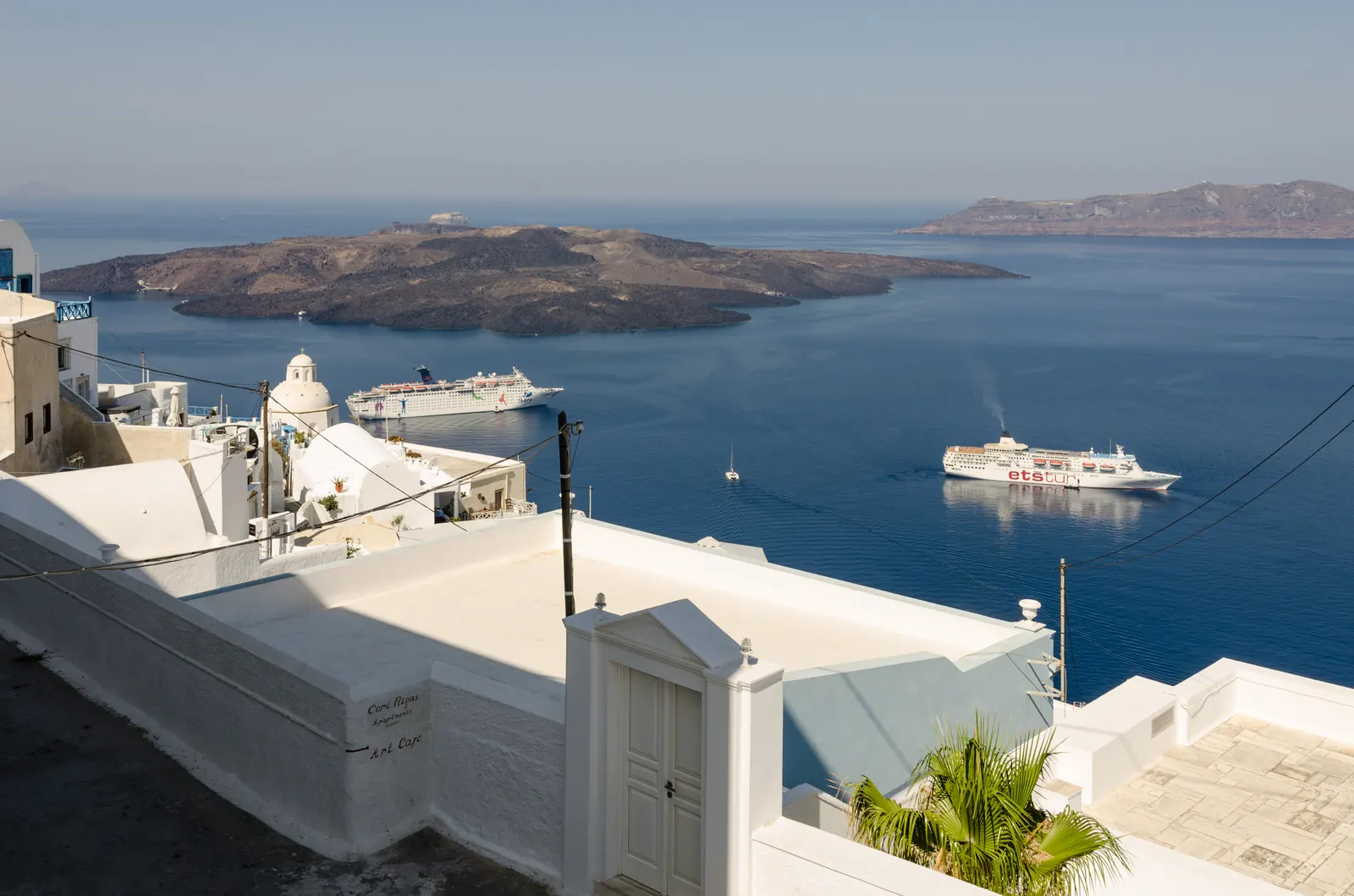
- Fira and the caldera with a cruise ship at anchor — Norbert Nagel, CC BY-SA 3.0, via Wikimedia Commons.
- Cruise ships anchored in the Santorini caldera — Iantomferry, CC BY 3.0, via Wikimedia Commons.
Change disclaimer. Checked August 30, 2026. Santorini's landing rules changed twice during summer 2026 — the 70/30 split, its suspension during the Karavolades Stairs closure, and its reinstatement on 3 August — so the position described here is current as at the check date and is unusually likely to move. Cruise schedules, port slot allocation, tender operations, levy rates and collection methods, deposit terms and itinerary-change policies all change. This article is informational and is not a booking, a quote, or a guarantee of availability. Treat every port call as provisional until reconfirmed in writing by the cruise line or an accredited travel advisor. Where the port authority, local civil-protection decisions or your cruise line differ from anything here, theirs govern.