The solo fare is only half the decision. On an expedition, the way the landing groups form can shape your days ashore, too.
Sources and facts checked: November 3, 2026 (America/New_York). Solo offers, supplements and cabin inventory change by sailing and can disappear as berths sell. Check and verify with the expedition operator before you pay.
Some operators offer dedicated single cabins or sell a cabin to one guest; others price a double-occupancy cabin with a single supplement. Select departures may reduce or remove that supplement to fill berths. There is no universal rule, and the same operator can behave differently across ships and sailings.
There is a second solo question nobody posts about: who decides which group you go ashore with? In Antarctica that can matter more to your day than whether you found a dinner companion.
Compare the one-person total, not the headline fare
A “per person” fare often assumes two guests sharing a cabin. Ask for the total for one traveler, including taxes and fees, and never compare your solo quote with a per-person double-occupancy figure.
Expedition operators may offer several different arrangements:
- A dedicated solo cabin: designed and priced for one person, limited to certain categories.
- A standard cabin sold to one guest: private, but potentially priced with a supplement.
- A reduced or removed supplement: often tied to a particular sailing, cabin category, or promotion.
- A twin-share gender-match program: you pay the twin-share rate and the operator pairs you with another solo traveler of the same gender. If no match is found, no supplement applies. Distinct from both the dedicated solo cabin and the surcharge path, and worth asking about by name.
- A cabin-share option: the operator may match solo guests; confirm the rules and what happens if no match is found.
One current example, confirmed against the operator's own page: Aurora Expeditions advertises up to 10 dedicated solo cabins per sailing across its 2026 Arctic and Beyond and 2026-27 Antarctica seasons, with low to no single supplement, and describes a 50% surcharge on the twin-occupancy rate for a solo guest booking any other available stateroom. The line also runs a twin-share gender-matching program: you pay the twin-share rate, the operator pairs you with another solo traveler of the same gender, and if no match is found no supplement applies. Check and verify with the expedition operator.
That is one operator's published pattern, not a market-wide rule, and a general page is not proof that a particular cabin or offer applies to your sailing. Read Aurora's solo-traveler options and the equivalent terms for any operator you are weighing.
For how supplements are calculated across cruise types, see The Solo Cruise Supplement Playbook and Low to No Single Supplement Cruises; this article stays with expedition-specific patterns and the landing-group question.
Shorter voyages make a smaller first bet
A 10- to 12-day expedition is a materially smaller solo commitment than a 20-day voyage. That does not make the shorter trip automatically better; it lets you weigh your appetite for remote travel and variable plans before committing to a longer itinerary.
Compare the whole trip, not only the ship fare: flights, hotels before and after, transfers, insurance, and optional activities. Fixed travel costs can make a shorter voyage less of a saving than the itinerary length suggests.
Expedition ships also tend to offer fewer cabin categories than large ships, so there is less room to move down a category and find a dramatically different price. Compare the actual solo options on your departure rather than assuming a long ladder of cabins.
Budget the gateway days too: the pre- and post-voyage days are yours to plan. Price those days as deliberately as the fare, because they are the one part of the trip nobody is pricing for you.
Refundability matters more when the itinerary can change
Itinerary changes are normal in weather- and ice-dependent regions, and that fact alone tells you nothing about what happens to your fare if you cancel or the operator changes the route.
Ask whether your specific fare is refundable in your circumstances, and get the deposit schedule, final-payment deadline, cancellation terms, and change or credit provisions in writing. Do not treat “flexible expedition itinerary” as an answer about your right to a refund.
For context on the wider operating realities, read Expedition Cruising: What the Brochure Skips.
The landing group can become your expedition circle
On a large ship, the ship supplies the social settings. On an expedition, the group that shares a Zodiac or goes ashore together becomes the social unit of the day.
Three IAATO rules govern every Antarctic landing, and they are settled rather than indicative. No more than 100 passengers may be ashore at a site at one time, and that figure excludes expedition staff. One tour guide must be ashore for every 20 passengers ashore. And only one ship may be at a landing site at a time.
There is a fourth rule that matters more than most travelers realize: vessels carrying more than 500 passengers are barred from making landings at all. That is why larger ships in these waters offer scenic cruising rather than shore landings, and it is a useful filter when you compare itineraries.
These are operational rules. They are not a promise about how your particular operator will organize its guests.
Zodiac capacity and landing procedures vary by ship and operator. The expedition leader’s plan depends on the site, conditions, available boats, safety procedures, and the order guests go ashore. IAATO’s rules do not prescribe a universal passenger-group rotation or say that a guest keeps the same group throughout a voyage.
Before you pay, ask how guests are assigned to landing groups, whether groups rotate and how often, whether you can request a different pace or change groups mid-voyage, and what your options are if you want a quieter outing or would rather stay aboard.
Do not assume you can land independently or change groups whenever you like. Ask what the operator can accommodate, and get the answer in writing. That is the expedition version of checking whether the hosted solo dinner is actually on the schedule: find out who is making the plan.
On who runs what: the landing program is run by the operator's own expedition team, not an outside host. Any solo gathering an advisor arranges around a sailing is a separate, advisor-hosted add-on, and should be described as exactly that.
The season’s scale makes clear why plans are coordinated
IAATO’s preliminary 2026–27 estimate projects 105,902 passengers across 581 voyages. For the Antarctic Peninsula alone: traditional seaborne travel 65,055 passengers on 45 vessels over 408 voyages; air-cruise travel 13,498 on 19 vessels over 124 voyages; cruise-only travel 26,238 on 7 vessels over 14 voyages; yacht travel 235 on 9 vessels over 28 voyages. The rest of the projected season sits in other Antarctic regions.
IAATO says these preliminary figures were based on information available on April 10, 2026 and are subject to revision. Check and verify with the expedition operator. They describe the planned season, not a promise of sailings, landings, or passenger experience.
Fleet growth sharpens the point: IAATO records growth from 48 ships in 2015-16 to 68 in 2025-26. Check and verify with the expedition operator. More ships running more voyages compete for the same capped landing sites, which is one more reason the rotation schedule, not any guest's preferences, sets the rhythm of the day.
The scale explains why landing parties are coordinated rather than shaped around one guest’s preferred timetable. Whether the group suits you is a different question, and it is worth asking about assignment, rotation, and opting out.
Devil's advocate: shared adventure helps, but it does not fix the economics
A solo traveler is often better served on an expedition ship than on a mainstream cruise. Shared Zodiac rides and landings create repeated contact around a shared experience, and expedition guests skew self-directed, so conversation grows from curiosity rather than a scheduled icebreaker.
But shared experience does not erase the pricing asymmetry: two or four travelers can share a cabin, one traveler cannot, and a dedicated solo category or sailing-specific offer may not exist in the cabin type you want.
The landing schedule also limits your control: a pair can decide together how to spend its time, but a solo guest still follows the operator’s safety and activity plan. Ask what flexibility exists, and do not mistake a request for a confirmed arrangement.
Verify before you pay
What is the total price for one person?
Request the one-person total, including taxes and fees, not a double-occupancy per-person figure.
Which cabin and occupancy basis is the rate for?
Confirm the exact cabin category, occupancy basis, and whether the rate is capacity-controlled or restricted to certain categories.
Does any reduction or waiver apply to you?
Ask whether any reduction or waiver applies to your ship, sailing, and cabin, and get the terms in writing.
What are the deposit and cancellation terms?
Confirm the deposit, final-payment, cancellation, and refund terms for the fare you are considering.
How are Zodiac and landing groups assigned?
Ask how Zodiac and landing groups are assigned, whether they rotate, and whether a change request is possible.
What if you would rather not land?
Confirm what alternatives exist if you would rather not land or prefer a different pace.
Are the answers in writing before you pay?
Ask the operator to put any cabin, pricing, or group-arrangement answer in writing before payment.
Choose the expedition that fits your version of solo
If you value a private cabin, start with the solo inventory and the one-person total. If you value shared time ashore, ask how your landing group forms and what choices you will have. A good solo expedition plan needs both answers, not just a tidy cabin fare.
I am an independent travel advisor and intermediary; the operator controls its fares, cabin inventory, booking terms, and expedition decisions.
Frequently asked
Do expedition ships have solo cabins?
Some operators offer dedicated single cabins; others sell standard cabins to one guest with a supplement. Terms depend on the operator, ship, cabin, and sailing.
Can a solo traveler avoid a single supplement on an expedition?
Sometimes. A dedicated solo cabin, a cabin-share program, or a promotion may reduce or remove it on a particular departure. Confirm the exact cabin and terms in writing.
Are expedition solo offers restricted to certain cabins?
Often, yes. A solo category or reduced supplement can be limited to specific cabin types or a set number of berths, and it can disappear as those berths sell. Ask which categories the offer applies to on your sailing.
Is a shorter expedition better for a first solo trip?
A shorter voyage is a smaller commitment, but compare the total trip cost and itinerary. The right length depends on your budget, travel time, and comfort with expedition conditions.
Will I stay with the same landing group throughout the voyage?
Do not assume so. IAATO guidance sets operational limits, but it does not set a universal passenger-group rotation. Ask the operator how that sailing organizes its groups.
Can I change my landing group if I do not click with it?
That depends on the operator’s procedures and conditions on the day. Ask whether a request is possible and get the answer in writing.
Can I choose not to go ashore?
Ask the operator what alternatives are available on your ship and itinerary. Do not assume that a separate landing or Zodiac arrangement will be offered.
What should I ask about the fare before paying?
Ask for the total for one traveler, including taxes and fees, plus the exact cabin category, promotion restrictions, deposit schedule, cancellation terms, and refund rules for your circumstances.
Sources and facts checked: November 3, 2026 (America/New_York). Operator solo-traveler pages and IAATO papers were reviewed on the date shown.
Sources
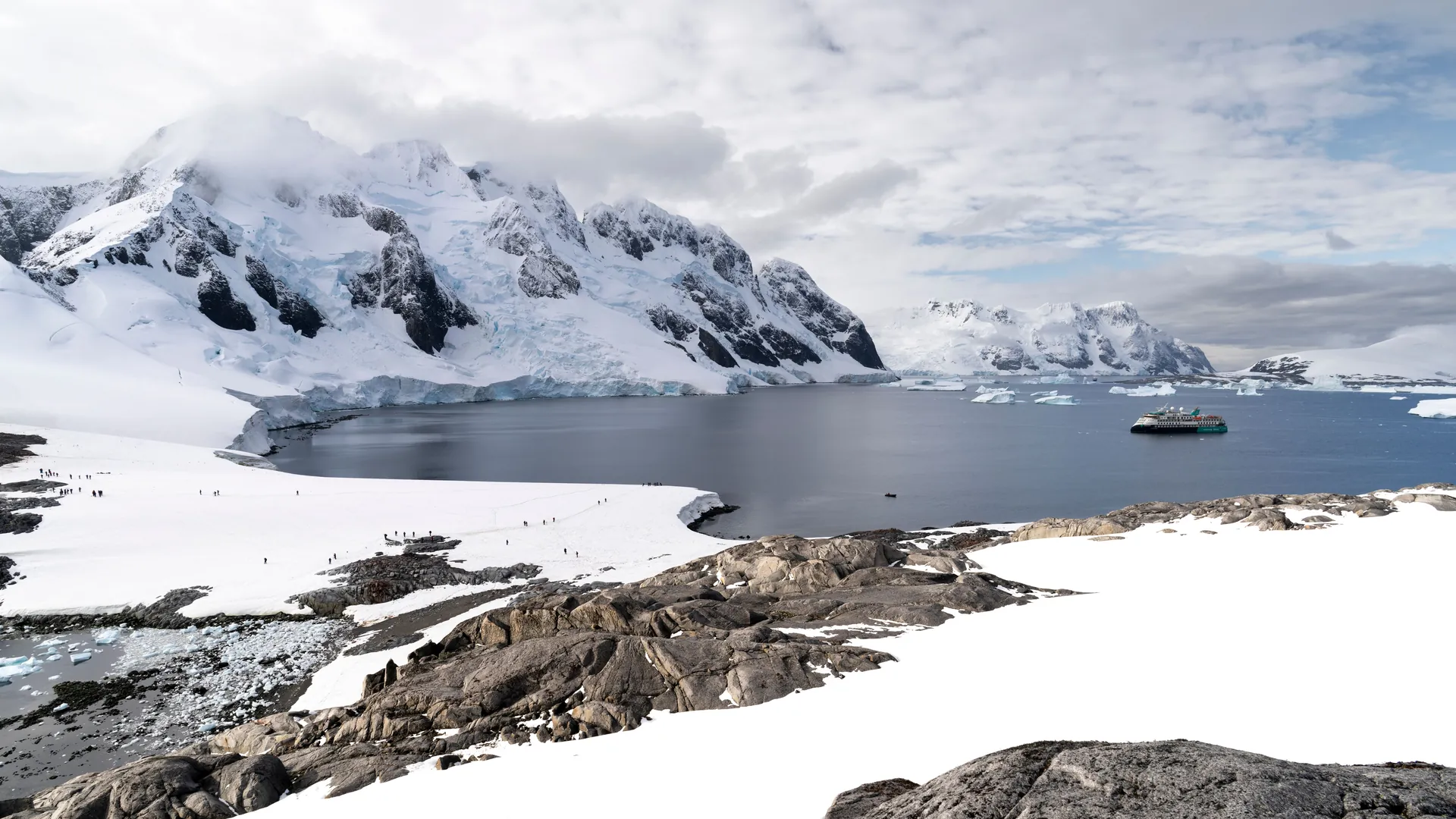
Photographs. A small expedition ship in an Antarctic bay beneath snow-covered mountains — Hugo Sykes, Pexels Cropped and resized for the web; not otherwise altered. Neither the photographers nor the licensors endorse this article.
This article is general information, not financial or travel-insurance advice. OTGG is an independent travel advisor; this article contains no affiliate links. Cruise line and supplier policies, rates, promotions, inclusions, accessibility procedures and deposit schedules change — verify all details with the operator or an accredited travel advisor before booking or payment.
Pricing a solo expedition voyage?
Tell me the operators and sailings you are weighing. I will get the one-person total, the cabin categories and the landing-group answers in writing.
Begin the Journey