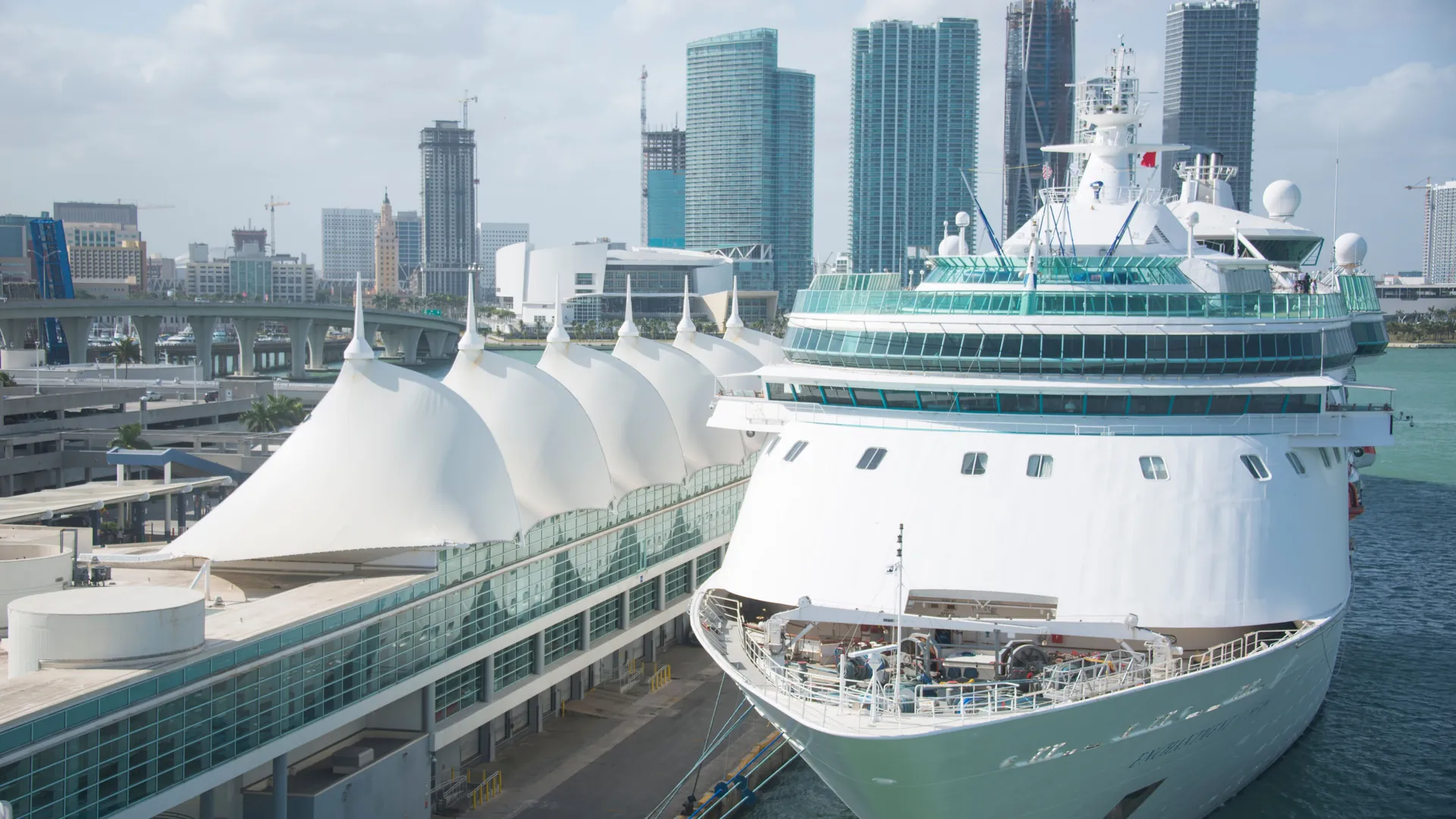
Cruise-day planning now starts on land: follow the right approach, arrive in your assigned window and confirm which pier or terminal your ship is using.
Sources and facts checked: October 18, 2026 (America/New_York). Terminal assignments, road work and berth schedules change. Check and verify with the cruise line or port before you travel.
For a smoother departure, plan your homeport access, not just how early to leave. Miami, Galveston and San Diego illustrate three different pressure points: congested approaches, road work and changing berth priorities.
Miami’s terminal assignment now determines your approach
PortMiami welcomed its 10-millionth cruise passenger on September 14, 2026, surpassing its previous fiscal-year record of 8,564,225 with two weeks remaining in the fiscal year, according to Miami-Dade County. Check and verify with the cruise line or port. That milestone is a signal of sustained volume, not a prediction that every sailing day will be gridlocked.
Access to Dodge Island is split by terminal, and Miami-Dade says following that split helps maintain steady traffic flow. The instructions are specific: Terminals AA, A, B, C and D use the PortMiami Tunnel; Terminals E, F, J and V use the PortMiami Bridge. Miami-Dade’s 2026–2027 season announcement says to use the garage or surface lot designated for your ship and arrive only at your scheduled embarkation time.
That means “PortMiami” is not a complete navigation plan. Check your current terminal, route and assigned parking before setting off. The official parking guidance maps terminals to facilities; do not choose a garage just because it looks convenient on a map.
Construction adds a longer horizon. A Royal Caribbean terminal project valued at $345 million is under way, with completion reported for late 2027. Check and verify with the cruise line or port. Treat a terminal under construction as a future change, not as an improvement to count on for your sailing.
For the basic distinction between port, terminal and berth, see The Port Is Not the Terminal. Here, the practical issue is what access route the terminal assignment sends you to.
Galveston’s road work is part of the arrival picture
Galveston’s challenge is a growing passenger flow meeting a changing road network. Through August 2026, the port recorded about 2.55 million passenger turns, up 8.3% from the same period in 2025. Cruise ship calls increased from 273 to 292, according to The Daily News. Check and verify with the cruise line or port.
The port is also negotiating with Royal Caribbean Group over a proposed fifth cruise terminal at Pier 14. The Wharves Board deferred a non-binding memorandum of understanding on August 25, then voted unanimously at its September 22 meeting to continue negotiations, according to the port’s October update. No final agreement is in place. A proposed terminal is not an operating terminal, and it is not a reason to assume your ship’s current instructions have changed.
The financial and construction estimates help explain why road access is on the agenda: The Daily News reported roughly $150 million in cruise-line investment, about $120 million in port-funded berth work and estimated annual port revenue of $10 million to $12 million once a terminal is fully operating. Check and verify with the cruise line or port. These are project figures, not a schedule for a completed terminal.
Separately, the port has invested about $18.4 million in its internal road system, including $9.3 million in state grants. Work on the section between 33rd and 41st streets is intended to keep port traffic off Harborside Drive; about $8.5 million in mobility projects are also under way. Check and verify with the cruise line or port. Check the Port of Galveston’s project updates and current travel instructions before departure. Internal road improvements do not tell you whether a public approach road is clear that morning.
San Diego’s berth assignment is a scheduling question
San Diego’s access story is less about major road construction and more about where ships are scheduled to berth. The port describes the 2026–2027 season as its biggest in more than 15 years, with more than 700,000 passengers and 183 voyages; the season opened on September 14, 2026. Check and verify with the cruise line or port.
The port operates at two downtown locations: B Street Pier has two berths and Broadway Pier has one, according to its cruise operations page. Do not assume that a past San Diego departure tells you where your next ship will be.
In April 2026, the port announced a new agreement with Disney Cruise Line, running through at least 2031, that gives Disney non-exclusive priority access to the North and South berths at the B Street cruise terminal. Check and verify with the cruise line or port. “Priority access” favors Disney’s schedule at those berths; it is not a permanent assignment for every other ship. Your ship’s pier remains a sailing-specific detail; priority may affect berth availability or scheduling.
Confirm the assigned pier in your cruise documents and check again with the cruise line close to departure. The port’s season announcement and its Disney agreement announcement explain the larger schedule context.
The right arrival window beats an extra hour at the curb
These ports differ, but the useful rule is the same: match your arrival plan to the instructions for your sailing. At Miami, that means the correct route and assigned parking as well as your embarkation window. In Galveston, check for road and mobility updates rather than assuming a port project clears the city approach. In San Diego, verify the pier rather than relying on last year’s habit.
At PortMiami, arriving before your assigned time does not move you ahead if the terminal is processing an earlier group. It can add curbside congestion. The embarkation window in your travel documents is an operational instruction, not a suggestion. Read your cruise line’s passenger ticket contract, too: it reserves the right to change or substitute ports and adjust timing for operational reasons. An itinerary is a plan, not a promise that every detail stays fixed.
A same-morning flight leaves fewer recovery options
Flying in on embarkation day adds another moving part before you reach the terminal. A delayed flight, a slow baggage handoff or ground traffic can eat into the time needed to reach your assigned window.
When possible, fly into the departure city the day before. That is different from arriving early at the terminal: it gives you a recovery window without asking you to queue outside the ship before your assigned time.
If you must fly in the same morning, check the airline itinerary, arrival airport, terminal location, transfer plan and cruise check-in cutoff together. Ask the cruise line in writing what its process is if a flight delay makes you miss the assigned window. Keep a backup plan for reaching the homeport, but do not mistake an early terminal arrival for flight-delay protection.
For more on flight disruptions and missed departures, see When the Airport Closes and the Ship Sails.
Devil’s advocate: most people board without noticing
Most cruise departures run as planned. Many passengers follow their documents, reach the right terminal and never experience a serious delay. Headlines about record volumes or construction can make every trip sound like a traffic emergency.
That is a fair counterpoint. A high annual passenger count does not mean your departure will be difficult, and a proposed terminal is not proof that today’s roads are blocked. Still, congestion matters when several ships share limited access, a road project affects your approach or you rely on a precise flight-to-pier connection. The sensible response is not panic or unnecessary early arrival. It is checking the details that actually apply to your sailing.
Verify before you pay
- Confirm your ship’s current terminal or pier with the cruise line.
- At Miami, verify whether your terminal uses the tunnel or bridge route and use the designated garage or surface lot.
- Check port and local road updates for your departure date, particularly in Galveston.
- Confirm your assigned embarkation window and the cruise line’s check-in cutoff.
- If flying in the same morning, ask the cruise line in writing how a flight delay affects your arrival plan.
- Get written confirmation from relevant providers when an arrangement depends on a particular transfer, terminal or pier.
Plan around your own departure
Start with the ship, not the city name: confirm the terminal or pier, follow the assigned arrival window and check current road guidance.
Frequently asked
Should I get to the terminal hours before my assigned window?
No. Follow the arrival time in your travel documents. At PortMiami, the port says arriving only at the scheduled time helps manage traffic and terminal processing.
Does the Miami tunnel serve every cruise terminal?
No. Miami-Dade’s published guidance directs Terminals AA, A, B, C and D through the tunnel, and Terminals E, F, J and V through the bridge.
Is the proposed fifth terminal in Galveston already approved?
No final agreement was in place as of the verification date. The Wharves Board voted unanimously on September 22 to continue negotiations, and the port says a final agreement would go back to the board for approval.
Will Disney’s San Diego agreement change my ship’s pier?
It may affect berth scheduling, but it does not establish a fixed pier for other ships. Check the assignment for your specific sailing.
Is flying in the morning of embarkation a good idea?
It is a higher-risk plan because a flight delay can leave little recovery time. Arriving in the departure city the day before gives you more flexibility.
Can my ship change its ports or timing?
Your passenger ticket contract sets out the cruise line’s rights to adjust ports and timing for operational reasons. Review the terms for your sailing and confirm current arrangements with the operator.
Sources and facts checked: October 18, 2026 (America/New_York). Port, county and trade announcements were reviewed on the date shown.
Sources
- miamidade.gov — 2026–2027 season announcement ↗
- miamidade.gov — Official parking guidance ↗
- portofgalveston.com — Port of Galveston’s project updates ↗
- portofgalveston.com — Fifth cruise terminal negotiations update ↗
- portofsandiego.org — Cruise operations page ↗
- portofsandiego.org — Season announcement ↗
- portofsandiego.org — Disney agreement announcement ↗
- miamidade.gov — 10-million passenger milestone ↗
- galvnews.com — Cruise growth and infrastructure ↗
Photographs. Cruise ship moored beside a Miami terminal with downtown towers beyond — Diego F. Parra, Pexels Cropped and resized for the web; not otherwise altered. Neither the photographers nor the licensors endorse this article.
This article is general information, not travel-insurance or safety advice. OTGG is an independent travel advisor; this article contains no affiliate links. Cruise line and supplier policies, rates, promotions, inclusions, accessibility procedures and deposit schedules change — verify all details with the operator or an accredited travel advisor before booking or payment.
Not sure which terminal or window you have?
Tell me your ship, your homeport and how you are getting there. I will work out which approach, window and parking apply and what to confirm in writing.
Begin the Journey