Low water on the Rhine and Danube is now a recurring late-summer risk, not a fluke. In 2026 it was something more: the Rhine recorded its lowest water level since records began, and Viking told investors on its Q2 2026 earnings call that low water, which intensified in mid-July, affected more than half of its river capacity for the third quarter — and that roughly 10 to 12 per cent of the affected cruises were cancelled outright. The rest sailed in some altered form. That is the scale of the problem this article addresses. The real question is not whether disruption can happen, but how your operator handles it and what that costs you in actual trip quality.
Sources and facts checked: September 18, 2026 (America/New_York). Gauge readings, operator policies, insurance triggers and itineraries change constantly. Nothing here guarantees how a specific sailing will be handled — check and verify with the cruise line or operator in writing before you pay.
Viking, AmaWaterways, Riviera Travel, Tauck, Uniworld, and Avalon all appeared in 2026 reporting about altered, rerouted, or cancelled sailings. Most lines try to keep guests moving. That is practical, but it does not guarantee the same trip you booked.
Why low water reroutes cruises instead of stopping them
River ships need adequate depth beneath the hull, particularly at bottleneck sections. Operators monitor gauge readings at locations such as Kaub on the Rhine and Pfelling on the Danube. Conditions can change daily, and one gauge does not describe an entire river.
The 2026 season was not a routine dip. The Kaub gauge on the Rhine — whose live readings the German waterways administration publishes at PEGELONLINE — fell to 5 centimetres on 17 August 2026 — the lowest reading since records began in 1880, and far below the previous record of 25 centimetres set on 22 October 2018. The gauge fell through the teens in the first half of August on its way to single digits. Pfelling on the Danube reached approximately 194 centimetres on the same day, below the previous benchmark low of 221 centimetres recorded on 17 August 2022; the regulated low-water reference there is 290 centimetres. ESA captured the Danube’s record lows from orbit. The regulated low-water reference (GlW) at Kaub is 77 centimetres, so the August reading sat far below the level at which normal navigation is assured. Kaub recovered only partially in September: the official gauge read 24 centimetres on 18 September 2026, still classed as low water and far below the roughly 200 centimetres normal for that time of year. Check the live Kaub reading before you travel. Check and verify with the cruise line or operator.
When a ship cannot safely pass a shallow section, the line may split the itinerary, move guests overland, or replace sailing with a hotel-and-coach plan.
That preserves logistics. It may not preserve the classic “new town every morning” rhythm.
The five standard low-water mitigations
Ship swaps
A ship swap moves you to a sister ship beyond the shallow section, usually via disembarkation, luggage transfer, coach ride, and re-boarding. AmaWaterways describes this model, and Forbes documented Uniworld using separate ships on opposite ends of a Rhine itinerary in 2026.
What it costs you: time and possible cabin mismatch. Similar branding does not guarantee the same size, layout, balcony, bathroom, bed setup, or accessibility features.
Ask for the replacement ship name, deck plan, cabin category, cabin number, square footage, bed setup, and accessibility details in writing.
The disruption was widespread rather than isolated: Viking reported that more than half of its European river operating days between mid-July and mid-August 2026 were affected, and Riviera Travel cancelled approximately 10 sailings while halting new Rhine and Danube sales during the low-water period. AmaWaterways, by contrast, stated publicly that it cancelled no 2026 departures.
Motorcoach transfers between ports
The line may keep the ship on one navigable section and bus guests around the shallow stretch.
What it costs you: sailing time and downtime. A coach day is not the same as a river day. Pack medication, water, chargers, snacks, and any mobility essentials with you.
Travel Extra reported a Viking Rhine sailing that required a ship change in Cochem and a motorcoach transfer to Strasbourg because of low water near Maxau.
Revised embarkation or disembarkation points
Your start or end port may move to avoid a shallow section.
What it costs you: transfer complexity, airport timing, and sometimes hotel plans. Confirm the new port, luggage process, included transfers, and final disembarkation time before booking independent air.
Substituted ports and excursions
Ports may be dropped, reordered, or replaced. Cruise Critic reported 2026 Danube sailings where ports changed and buses replaced parts of the cruise.
What it costs you: the specific place you booked to see. If Budapest, the Rhine Gorge, Regensburg, or a family activity is non-negotiable, ask what happens if that stop is lost.
Using the ship as a floating hotel
The ship may stay docked while coaches handle touring.
What it costs you: scenic cruising and flexible riverside time. Riviera Travel says it aims to avoid turning a river cruise into a pure coach vacation, but that is still an operating plan, not a guarantee that every advertised port survives.
How to plan around low-water risk
Choose the route, not just the brand
Ask which Rhine or Danube sections create the most exposure. A route with fewer bottlenecks may be less vulnerable. Riviera’s 2026 response showed this approach by shifting some alternatives toward the Netherlands and Belgium, the Moselle, the Main, and the western Danube.
Build a buffer at both ends
Avoid same-day flights after disembarkation. Add a hotel night before embarkation and, if possible, after the cruise.
Treat the coach day as a real travel day
Do not stack a major dinner, show, or accessibility-dependent activity right after a possible transfer. Ask whether the coach has a restroom, step-free boarding, luggage help, and space for mobility devices.
For a broader look at the shore gap, read OTGG’s River Cruising With a Disability: The Shore Gap.
Confirm the insurance trigger
Ask your insurer in writing whether low water is covered, whether bus-substituted itineraries still count as interruption, whether independent flights and hotels are covered, what documentation is required, and whether any payment is cash, reimbursement, or credit.
A policy that covers supplier cancellation may not cover a cruise that still operates in altered form.
Questions to send before paying
Request written confirmation from the operator or accredited travel advisor covering:
- Which river sections and gauges are critical for this itinerary, and what mitigation is most likely: ship swap, coach transfer, revised port, hotel stay, or cancellation?
- If operations change, will the replacement ship and cabin match your booked category, size, deck, bed setup, balcony, and accessibility features?
- Who covers transfers, hotels, meals, independent travel changes, and any compensation, refund, rebooking, or future cruise credit if the itinerary is materially changed?
- When will the line make final decisions, what happens if conditions worsen after embarkation, and will you receive the revised itinerary and cabin details in writing before travel?
Keep the reply with your booking documents. A phone reassurance is not written confirmation.
Devil’s Advocate: “Kept moving” is not “same trip”
Operators are generally not obliged to compensate you just because low water changes the experience. Contracts commonly treat river conditions as an act-of-God or force-majeure-style event.
“Kept moving” means the transport problem was solved. It does not mean you received itinerary parity.
A ship swap may mean a different cabin. A coach transfer may replace a scenic sailing day. A floating hotel preserves your bed while removing the river from the day. A substitute port may still be the port you did not choose.
Riviera has published clearer options for significant changes, including revised itineraries, cancellation options, and refunds in specified cases. Other operators may not. Scenic is the clearest current example of a formalised trigger: it has offered an automatic, no-charge River Cruise Travel Guarantee, backed by Chubb Insurance, since 2016–17, and it responds specifically to highand low-water disruption — including a three-hour-plus coach transfer or a ship-swap delay of 24 hours or more. Name-level policies like this are what to look for, and to ask for in writing, rather than assuming every operator offers equivalent protection. Read the contract and sailing notice, not just the marketing promise.
Verify before you pay
- Identify the river sections and bottlenecks most exposed to low water, including Kaub, Pfelling, the Rhine Gorge, or any route-specific pinch points.
- Confirm the operator’s written low-water policy, likely mitigation, and whether coach transfers may replace sailing.
- Confirm replacement ship and cabin parity, including accessibility details, and check revised embarkation or disembarkation procedures.
- Build hotel and flight buffers, then confirm travel-insurance triggers for cancellation, interruption, and altered itineraries.
- Ask what compensation applies for substituted ports, hotel nights, or major itinerary changes, and save every alert, revised itinerary, and written reply.
Frequently asked
Will low water automatically cancel my river cruise?
No. Operators usually try ship swaps, coach transfers, revised ports, or hotel-based touring first. Some departures are still cancelled if no workable alternative remains.
Is a ship swap a cancellation?
Usually not. It is an operational substitution. What matters is whether the replacement ship and cabin are actually comparable.
Which is more vulnerable, the Rhine or Danube?
Neither by default. Risk depends on route, weather, gauges, and bottlenecks. The Rhine Gorge and parts of the upper Danube featured heavily in 2026 reports.
Can I refuse a revised itinerary?
It depends on the operator’s terms and how significant the change is. Some lines offer refunds or alternatives for major changes; others reserve broad rights to alter routes.
Will travel insurance cover a missed port?
Not automatically. Coverage may require a named benefit or formal supplier documentation. Confirm the trigger before purchase.
Should I avoid late-summer river cruises?
Not necessarily. Just book knowing low water is a recurring risk and avoid tight, nonrefundable onward plans.
How does low water affect accessible travelers?
Every mitigation adds another handoff: gangways, coaches, luggage transfers, unfamiliar cabins, and changed ports. Confirm access, storage, assistance, and replacement-ship details in writing. For related planning context, see Introduction to River Cruising.
Sources and facts checked: September 18, 2026 (America/New_York). Reuters gauge reporting, Viking’s Q2 2026 earnings call, and 2026 low-water coverage from Forbes, Travel Extra and Cruise Critic, plus operator statements, were reviewed on the date shown.
Sources
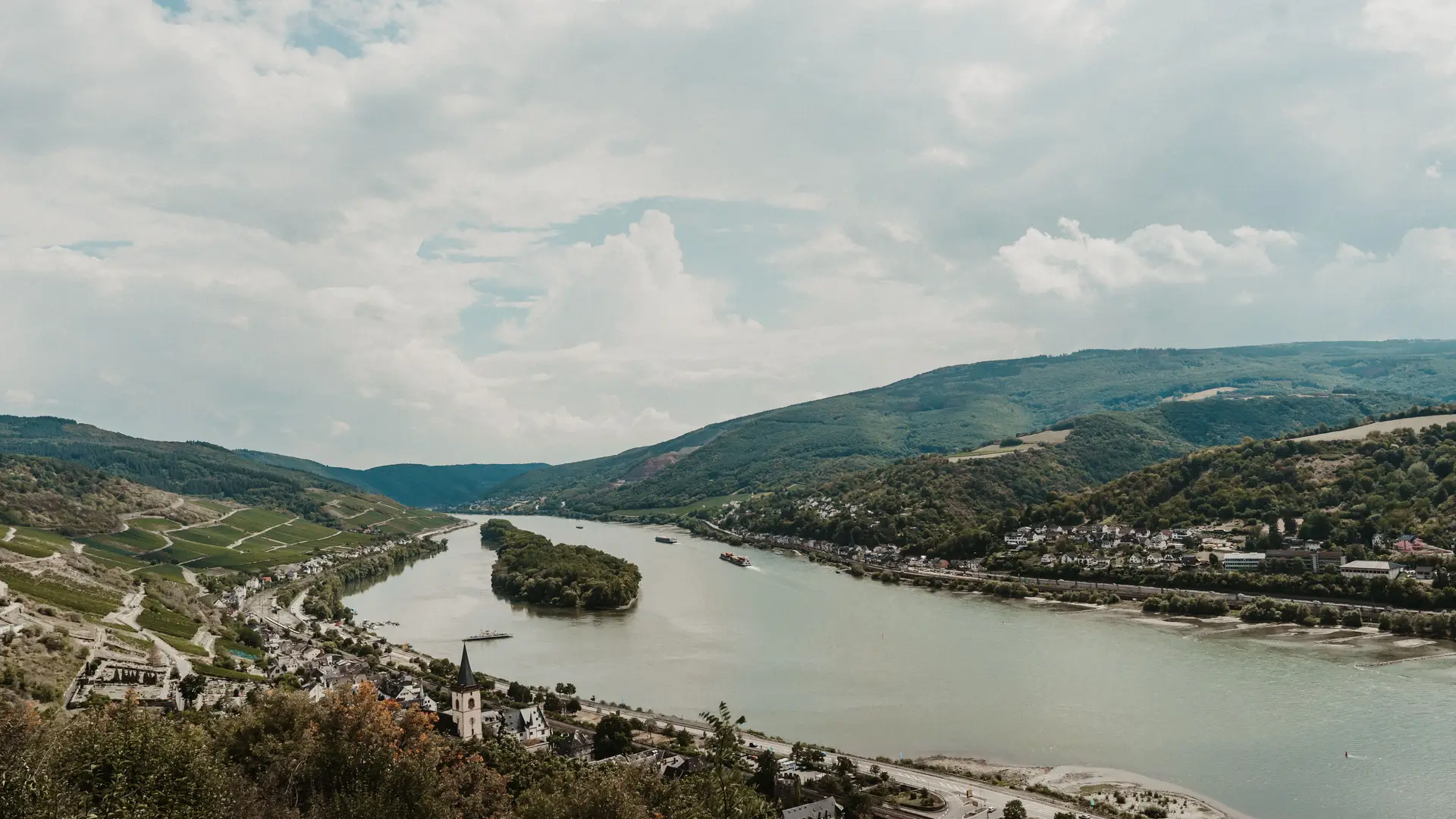
Photographs. The Rhine winding past Rüdesheim — Masood Aslami, Pexels Cropped and resized for the web; not otherwise altered. Neither the photographers nor the licensors endorse this article.
This article is general information, not insurance or legal advice. OTGG is the travel-planning platform of Paolo Melendez, an independent travel advisor with Nexion, LLC, a Travel Leaders Network Affiliate Agency. This article contains no affiliate links. Operator policies and insurance terms differ by product and jurisdiction — verify with the operator, your insurer or an accredited travel advisor before booking or paying.
Booking a Rhine or Danube sailing and worried about the water?
Tell me the month and the route. I will compare how each line handles low water, what its insurance actually triggers on, and get the disruption terms in writing before you pay a deposit.
Begin the Journey