Deck plans are genuinely useful for the questions they can answer: where a cabin sits, which lift bank serves it, how far the theater is. They are silent on thresholds, clear opening widths, turning space, transfer sides and whether the route to your muster station includes a step — which is to say, silent on almost everything that determines whether you can actually use the cabin.
Sources and facts checked: September 12, 2026 (America/New_York). Ship layouts change with refits, cabin conversions and venue changes, and published dimensions differ by line, by class and by individual vessel. Treat every measurement as ship-specific and confirm it in writing against your assigned cabin before payment.
What a deck plan shows, and what it hides
| Element | What the plan shows | What it does not show |
|---|---|---|
| Cabin position | Where the cabin sits on the deck, and its category | Whether a threshold interrupts the route to it |
| Lifts and stairs | Where the banks are | Whether every bank reaches every deck, or has audible announcements |
| Venues | Dining rooms, lounges, theaters, pools | The usable route around a staircase, or a step up into a venue |
| Cabin shape | A rough footprint and bed position | Door clear width, turning space, bathroom entry, transfer side |
| Distance | That two things are far apart | How far the cabin is from dining, the medical center or muster |
| Nothing at all | — | Temporary construction, a broken lift, or furniture that moved last refit |
Start with cabin geometry
Doorways first, because a door you cannot get through makes the rest academic:
- What is the clear opening width of the cabin door — not the frame width?
- Is there a threshold at the cabin entrance, and how high?
- What is the clear width of the bathroom door?
- Does the bathroom door swing in, swing out, or slide?
- Is there a threshold or lip at the shower?
- Is the balcony door step-free, and what is the threshold height?
Ask for clear opening width, not frame width. They are different numbers and only one of them matters. Then measure your own device at its widest point with batteries, footplates, controls and accessories fitted — several lines publish device or cabin width limits, and they differ between lines and between standard and accessible cabins, so ask for the current figure for your ship rather than working from a number in a general article.
Then the bathroom and the space to move:
- Turning space beside the bed, in the cabin, and in the bathroom.
- Shower type — roll-in, step-in, or tub — with its dimensions.
- Shower seat type, and which side it transfers from.
- Grab-bar placement, and toilet height with side-transfer space.
- Sink clearance and reach range.
- Bed height and whether there is clearance beneath it for a hoist.
Royal Caribbean, Princess and Seabourn all publish device or cabin-width information in their accessibility materials, and Royal Caribbean's form asks guests to supply equipment dimensions. Use those as a prompt for what to ask, then get the figures for your own vessel.
Trace the routes you will use every day
A deck plan flattens distance and hides interruptions. Trace each of these and ask which cross a step, a raised sill or an outdoor deck:
- Cabin door to the nearest lift bank.
- That lift bank to the main dining room.
- Lift to the buffet, theater, and the venues you will actually use.
- Lift to the medical center.
- Cabin to your muster or assembly location.
- Cabin to the accessible gangway or tender platform.
- Any route that crosses an outdoor deck, a step, or a raised door sill.
Then be honest about the arithmetic. Two venues that look adjacent on paper can be a long corridor, a lift wait and a crowded atrium apart — and you will make that trip several times a day for a week. Weigh the daily distance against your stamina rather than against the diagram.
Muster, gangway and tender need their own answers
These are the routes you cannot opt out of. Ask where you report for muster, whether the route includes stairs, what happens if lifts are unavailable, and how the plan changes in a real emergency rather than a drill. Then ask separately about embarkation, disembarkation, the gangway and any tender platform — a ship can be entirely navigable inside and still present a gangway angle you cannot use. Our door-to-ship guide covers the land side, and the shore-gap guide covers what happens once you are off it.
Sister ships are different ships
Vessels in the same class can differ through refit history, build yard, cabin conversions, later class variations and venue changes. A cabin carrying the same number on a sister ship may have a different bathroom arrangement, balcony threshold, storage layout or emergency process.
If someone tells you a cabin worked well on the sister ship, treat that as a reason to ask the same questions again — not as an answer.
Get the assignment documented
Before you pay, request written confirmation of:
- The exact cabin number, not a category.
- Door and bathroom clear widths, and threshold heights.
- Shower configuration, seat and grab-bar placement.
- Turning space dimensions.
- Bed height and clearance.
- Confirmation your device fits, stores and charges inside that cabin.
- The muster location and the accessible route to it.
- What happens to that plan if lifts are unavailable.
Ask for recent photographs of the specific cabin where the line can supply them. A photograph shows you a threshold, a grab-bar position or a furniture arrangement that no plan and no category description will. It is not a substitute for measurements — it catches the things nobody thought to measure.
Devil's advocate: is the deck plan worth using at all?
It is, but only for what it is good at: position, lift banks, rough distance, and building a list of routes to ask about. Used that way it saves you a great deal of time.
The failure comes from treating it as a specification. A plan will happily show you an accessible cabin two corridors from a dining room, and tell you nothing about the step at the venue door, the lift bank that stops one deck short, or the threshold at your own bathroom. If a line will not put the measurements in writing against a cabin number, that reluctance is itself the answer.
Verify before you pay
- Get the exact cabin number before paying, never just an accessible category.
- Ask for clear opening widths in inches or centimetres, not "wide enough".
- Ask about thresholds at the cabin door, bathroom, shower and balcony.
- Confirm the shower type, seat side and grab-bar placement.
- Confirm turning space in the cabin and in the bathroom.
- Send your device dimensions, weight, battery type and charging needs.
- Ask the line to confirm the device against that cabin, not the ship.
- Trace every daily route and ask which cross a step or an outdoor deck.
- Confirm the muster location and its accessible route separately.
- Confirm embarkation, disembarkation, gangway and tender routes separately again.
- Treat a sister ship as a different ship and re-ask everything.
- Get all of it in writing, tied to the sailing and cabin number.
Frequently asked
Can I choose an accessible cabin from the deck plan alone?
No. A deck plan shows position, rough footprint and where the lifts are. It does not show door clear widths, threshold heights, turning space, transfer sides, shower configuration, or whether the route to your muster station includes a step. Those are the things that decide whether the cabin works, and every one of them has to come from the line in writing against a specific cabin number.
How wide does my cabin door need to be?
That depends on your device, and the answer has two halves. Get the clear opening width of the door — the actual gap, not the frame — and the full width of your device at its widest point with everything fitted. Several lines publish device or cabin width limits and they differ between lines and between standard and accessible cabins, so ask for the current figure for your ship rather than working from a general number. Royal Caribbean, Princess and Seabourn all publish device or cabin-width information in their accessibility materials; treat every dimension as ship-specific.
Are sister ships laid out the same?
Do not assume it. Ships in the same class can differ through refit history, build yard, cabin conversions, later class variations and venue changes. A cabin with the same number on a sister ship may have a different bathroom arrangement, balcony threshold, storage layout or emergency process. Re-ask everything for the actual vessel you are booking.
Why does distance from the cabin matter so much?
Because a deck plan flattens it. Two venues that look adjacent on paper can be a long corridor, a lift wait and a crowded atrium apart, and you will make that trip several times a day for a week. Calculate the daily distances honestly — cabin to dining, cabin to theater, cabin to muster — and weigh them against your stamina rather than against the diagram.
What about muster and the gangway?
Those need their own questions, because they are the routes you cannot opt out of. Ask where you report for muster, whether the route includes stairs, what happens if lifts are unavailable, and how the plan changes in a real emergency. Then ask separately about the embarkation, disembarkation, gangway and tender routes — a ship can be perfectly navigable inside and still present a gangway you cannot use. Our door-to-ship guide covers the land side.
Should I ask for photographs?
Yes, and ask for recent ones of the specific cabin where the line can supply them. A photograph will show you a threshold, a grab-bar position or a furniture arrangement that no plan and no category description will. It is not a substitute for measurements, but it catches the things nobody thought to measure.
Sources and facts checked: September 12, 2026 (America/New_York). No device or doorway width figure is quoted in this article. Several lines publish limits, they differ between operators and between standard and accessible cabins, and the clearest published sets trace to documents that carry their own dates — a stale width limit is the damaging kind of wrong here, because it can convince a traveler their device will not fit when it would. Ask your own line for the current figure for your ship, and send it your device dimensions with batteries and accessories fitted. Every dimension in cruise accessibility is ship-specific rather than class-specific: confirm all of them in writing against your assigned cabin number before payment.
Sources
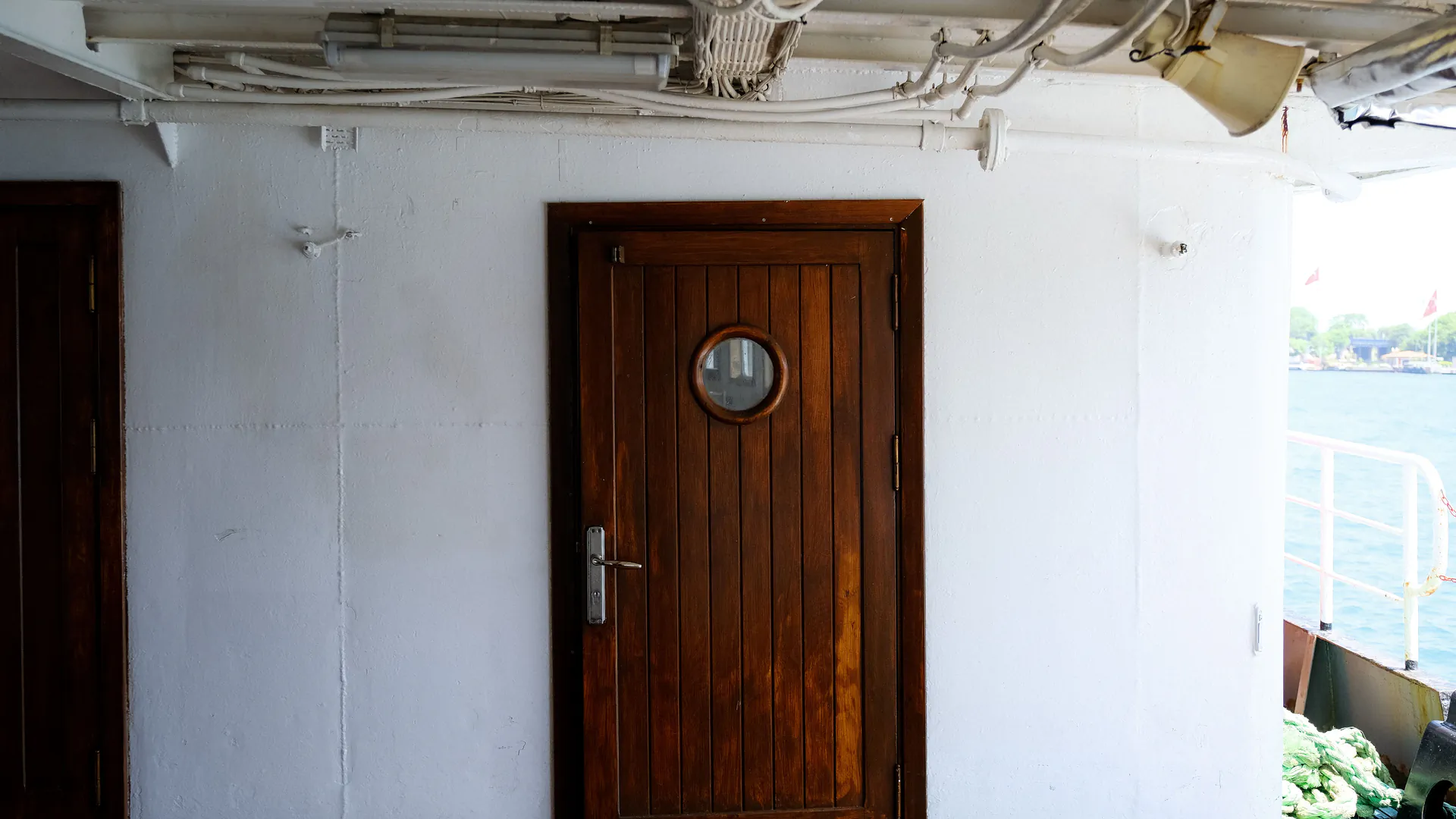
Photographs. A wooden door with a porthole on a vessel deck — Mathias Reding, Pexels Cropped and resized for the web; not otherwise altered. Neither the photographers nor the licensors endorse this article.
This article is planning information, not an accessibility certification. No cabin, ship, route or venue described here is certified as accessible, and no dimension in it should be relied on for your own booking. Ship layouts, cabin inventory, published dimensions and emergency procedures change without notice — verify every measurement with the operator against your assigned cabin, in writing, before payment and again before departure.
Want the measurements before you commit to a cabin?
Send me the ship you are looking at and your device dimensions. I will get the clear widths, threshold heights, shower configuration and transfer side in writing against a specific cabin number, trace the muster and gangway routes, and tell you plainly when the cabin the line is offering is the wrong one.
Begin the Journey