Embarkation day is not a lounge experience with a ship-shaped backdrop. It is a logistics sequence involving arrival windows, security, luggage handoffs, safety requirements, cabin access, and a fair amount of walking.
Sources and facts checked: September 23, 2026 (America/New_York). Check-in windows, arrival appointments, boarding cutoffs, muster procedures and disembarkation timing vary by line, ship and port. Check and verify with the cruise line or vendor before you book flights.
Plan the sequence correctly and the day feels easy. Ignore it and you may spend the first afternoon sitting beside a suitcase, waiting for medication, or wondering whether your flight home is optimistic or genuinely reckless.
This guide fills the gap between packing and the actual travel-day timeline.
Online check-in: complete the moving parts
Online check-in timing varies by cruise line. Some systems open well before departure, while the final operational steps — documents, health questions, arrival appointments and app prompts — may matter most during the last 24–48 hours. Check and verify the timing with your cruise line.
Complete check-in as soon as your line permits. Then verify it again before leaving for the port.
Your checklist should include:
- Passport or other required travel identification.
- Guest names and birth dates.
- Emergency contact details.
- Payment method for onboard charges.
- Health or travel questionnaires.
- Digital boarding pass or eDocs.
- Terminal arrival appointment.
- Accessibility or medical requests.
- Service-animal documentation, where applicable.
Do not assume that a completed profile means you have a valid boarding pass. Open the app or cruise documents and confirm that every traveler shows as ready to sail.
Royal Caribbean directs guests to use its app for check-in, arrival times, health questions, and the safety briefing. It also states that guests must arrive within their selected time slot and be fully checked in before the published cutoff — check and verify it with Royal Caribbean. Read the Royal Caribbean check-in guidance and arrival-time guidance.

Arrive in your window, not dramatically early
Your terminal arrival time is not a suggestion to arrive whenever your rideshare driver feels inspired.
Cruise terminals process large groups in stages. Arriving significantly before your assigned window can create curbside congestion, long outdoor waits, and terminal backups. It may not get you on board sooner.
Follow the time printed in your app, boarding pass, or cruise documents. Build your transportation plan around that time rather than the ship’s advertised departure.
Norwegian Cruise Line asks guests with a reserved check-in time to follow the time listed in their eDocs and not arrive more than one hour before that appointment (check and verify with NCL). NCL also states that guests who have not completed online check-in should arrive at least two hours before the scheduled departure, and that guests arriving no later than one hour before departure may still be permitted to sail, while those who miss that window may require NCL approval to join the ship at a later port, with associated fees. Holland America Line similarly assigns check-in times and asks guests not to arrive more than 20 minutes early — check and verify the current window with Holland America. Policies vary by port, so review the line’s current instructions:
If you are flying to the embarkation city, arrive the day before whenever practical. A delayed flight is inconvenient before a hotel night. It is considerably more expensive when the ship has already sailed.
Build a carry-on that can survive the first day
Assume you will not have access to your checked luggage for several hours.
Your carry-on should hold:
- Passport, identification, visas, and cruise documents.
- All medications, including prescription and emergency medication.
- Medical equipment that cannot be safely separated from you.
- Chargers, cables, battery packs, and essential electronics.
- Wallet, travel documents, and valuables.
- Swimsuit and cover-up.
- A change of clothes.
- Toiletries you need before dinner.
- Sunglasses and sunscreen.
- Snacks or permitted dietary essentials.
- A small amount of accessible clothing or comfort equipment needed immediately.
- Copies or digital backups of important medical information.
Keep medications in their original labeled containers when possible. Do not put critical medication in checked luggage because a bag delayed at the terminal is still a delayed medication supply.
For solo travelers, use one compact personal item rather than creating a portable luggage ecosystem. You need one hand free for documents, railings, elevators, and the occasional unexpected queue.
For multigenerational groups, assign one adult to carry the shared document folder and one person to carry each traveler’s personal medication and essential items. Do not place the entire family’s critical supplies in one checked suitcase.
Checked bags: the curbside handoff
Porters generally accept large checked bags at the curb or terminal entrance. Attach the cruise line’s luggage tags before you arrive, and confirm the stateroom number is correct.
Once you hand over a bag, you may not see it again until the afternoon or evening.
Norwegian’s departure-day guidance specifically recommends a small bag with medication, valuables, important documents, and items needed while luggage is delivered. Its guidance also notes that bags are collected before the end of the voyage, making the small bag useful again on disembarkation morning.
A practical division looks like this:
| Bag | Keep inside |
|---|---|
| Checked luggage | Most clothing, shoes, toiletries, and nonessential items |
| Carry-on | Documents, medication, valuables, chargers, swimsuit, change of clothes, first-day essentials |
| Personal item | Phone, wallet, passport, medication, mobility or sensory essentials |
Do not place your passport in a checked bag. Do not place your only swimsuit in a checked bag unless you enjoy watching other people use the pool while wearing travel clothes.
Muster: complete both parts
Many lines now use a digital or electronic muster process. That does not mean you can watch a video and consider yourself finished.
The usual sequence is:
- Open the cruise line’s app or onboard safety system.
- Watch or acknowledge the required safety briefing.
- Locate your assigned muster or assembly station.
- Physically check in or scan your key card, app, or wearable device.
- Listen for any ship-specific instructions.
The process varies by line and ship. Royal Caribbean describes a digital safety briefing followed by a visit to the assigned assembly station. Norwegian directs guests to visit the muster station printed on their key card. Virgin Voyages uses an electronic muster process with a physical station check-in.
Complete the process as soon as the app and crew permit. You do not want your first vacation task to be a last-minute sprint to a muster station while announcements call your name.
Read the current Virgin Voyages embarkation guide and confirm the process for your specific sailing.
Your stateroom may not be ready when you board
Boarding does not always equal room access.
Staterooms generally open in the early afternoon, but the exact timing depends on the line, ship, port operation, and turnaround. Norwegian advises guests to explore the ship or have lunch if the stateroom is not ready.
Use the waiting period intelligently:
- Keep your carry-on with you.
- Eat before the busiest lunch rush if possible.
- Locate elevators and accessible routes.
- Complete muster requirements.
- Check the app for dining, entertainment, and port information.
- Confirm that any mobility device or medical equipment delivery is moving as planned.
- Avoid carrying more than you can comfortably manage.
If you require an accessible stateroom, do not rely on requesting one after boarding. Accessible cabins are limited and must be confirmed before travel. Your cabin assignment should match your actual needs, including door width, bathroom layout, turning space, bed access, and storage for a wheelchair or scooter.
Accessibility planning starts at the curb
Accessibility is not just a cabin category. It is a chain of handoffs:
- Arrival vehicle to terminal curb.
- Curb to luggage or porter area.
- Security screening.
- Check-in desk.
- Waiting area.
- Gangway or boarding bridge.
- Stateroom.
- Disembarkation route.
- Terminal exit.
- Transfer vehicle.
Request wheelchair assistance at the terminal in advance. Assistance may be available from the terminal entrance through boarding and again during disembarkation, but staffing, procedures, and waiting times vary by line and port.
A mobility device you need during travel should remain with you unless the cruise line, port, and transfer provider have confirmed the handoff in writing. If a rental scooter, wheelchair, CPAP, oxygen device, or other equipment is being delivered, obtain written confirmation of:
- Delivery date and time.
- Delivery location.
- Guest or crew recipient.
- Stateroom access procedure.
- Retrieval or return instructions.
- What happens if the ship arrives late or the cabin is not yet accessible.
Service-animal procedures also vary by itinerary. Confirm advance notification requirements, terminal access, relief arrangements, documentation, and port-entry rules directly with the cruise line and relevant authorities.
For more detailed planning, see OTGG’s accessible cruise door-to-ship guide and cruise accessibility documentation guide.
Disembarkation morning is a process, not a fire drill
The final morning begins the night before.
Most ships ask guests who are not carrying their own luggage off the ship to place tagged bags outside the stateroom by a specified evening deadline — check and verify it with your cruise line. Keep a small personal bag for:
- Passport and travel documents.
- Medication.
- Phone and chargers.
- Toiletries.
- Comfortable clothing.
- Mobility or medical equipment.
- Snacks and water, where permitted.
- Anything needed during the airport transfer.
If you choose self-assist or carry-off disembarkation, you keep your bags and leave when the line permits. This can be useful for early transportation, but it requires you to manage every bag through the ship, gangway, terminal, customs or immigration, and transfer.
Do not select self-assist simply because the phrase sounds efficient. Choose it only if you can safely manage your luggage and mobility needs.
Customs, immigration, and transfers add time
After leaving the ship, you may need to:
- Exit the vessel.
- Wait for or retrieve luggage.
- Pass through customs or immigration.
- Locate a transfer or rideshare.
- Travel to the airport.
- Check bags with the airline.
- Clear airport security.
- Reach the gate before boarding closes.
The ship’s scheduled arrival time is not the same as the time you will be seated at the airport gate.
Port layout matters. Airport distance matters. Traffic matters. A large group disembarking at once matters. Add more time if you use wheelchair assistance, need a specific transfer vehicle, travel with medical equipment, or must coordinate several family members.
Confirm the transfer provider’s pickup location and accessibility in writing. “The driver will find you” is not a plan. Ask for the terminal exit, meeting point, vehicle type, luggage capacity, contact number, and contingency procedure.

Post-cruise flight buffer math
Start with the scheduled ship arrival, then allow for:
- Disembarkation and luggage time.
- Customs or immigration.
- Transfer time.
- Airport check-in and security.
- Accessibility or family coordination time.
- A disruption buffer.
What is left is the earliest sensible flight window.
There is no universal safe flight time for every port. Cruise line guidance, terminal operations, airport distance, traffic, and immigration procedures differ.
As a general planning principle, avoid very early disembarkation-day flights. A flight that appears comfortable on paper can become impossible after a late clearance, a slow luggage release, a long transfer, or an airport security delay.
Ask the cruise line or accredited travel advisor for port-specific guidance before purchasing airfare. Get the recommendation in writing, particularly when the fare is restrictive or nonrefundable.
Virgin Voyages states that disembarkation timing and final departure instructions can vary and directs Sailors to follow the information provided for their voyage. Review its Back on Dry Land guidance.
Devil’s Advocate: challenge the usual instincts
“I’ll arrive as early as possible.”
That instinct feels cautious but can create a longer wait. Arrive in your assigned window unless the cruise line tells you otherwise.
“I’ll put everything in my carry-on.”
A carry-on is a safety net, not a portable apartment. Pack the first-day essentials, medication, documents, and valuables. Do not make it so heavy that you cannot move comfortably through the terminal.
“My flight is only a short ride from the port.”
The drive is only one part of the journey. Add luggage, customs or immigration, airport check-in, security, traffic, and the possibility that the ship releases guests later than planned.
“I can request accessibility help when I arrive.”
You may be able to request help at the terminal, but advance notice improves the chance that the right assistance is available. Written confirmation is stronger than a phone conversation that no one can locate later.
“The app says I am checked in, so I am finished.”
Check the documents, arrival window, muster instructions, cabin assignment, accessibility requests, and transfer details. Apps are useful. They are not infallible.
Verify before you pay
Before final payment or purchasing flights, obtain written confirmation of:
- Terminal name and embarkation port.
- Online check-in completion requirements.
- Arrival appointment and acceptable arrival range.
- Final boarding cutoff.
- Checked-bag drop-off procedure and porter location.
- Carry-on restrictions.
- Stateroom opening expectations.
- Muster process and physical station requirement.
- Accessible cabin assignment, not merely an accessibility request.
- Wheelchair assistance at embarkation and disembarkation.
- Mobility-device delivery, storage, and return.
- Service-animal documentation and relief procedures.
- Disembarkation method and estimated timing.
- Customs or immigration requirements.
- Transfer pickup point and vehicle accessibility.
- Recommended earliest flight time for the specific port.
- Contingency plan if the ship arrives late.
Travel-day buffer tiers
| Planning tier | Best for | Approach |
|---|---|---|
| Basic | Flexible travelers with nearby airports | Avoid the earliest flights and allow time for normal port processing |
| Comfortable | Most travelers, groups, and solo cruisers | Add meaningful time for luggage, transfers, security, and minor delays |
| Protected | Accessible travelers, families, restrictive airfare, or long airport transfers | Use a late flight or overnight stay and confirm every handoff in writing |
Frequently asked
Can I board before my assigned arrival time?
Usually, you should not plan on it. Some terminals may accommodate guests later, but early arrival can result in waiting outside or in a holding area. Follow the cruise line’s current instructions.
What should I never put in checked luggage?
Keep passports, identification, medication, valuables, chargers, critical medical equipment, and anything needed on the first day in your carry-on.
When will my checked luggage arrive?
Delivery commonly occurs throughout the afternoon and may continue into the evening. Timing varies by ship and port. Pack as though you will not see it until later.
Do I need to attend a traditional muster drill?
You must complete the ship’s required safety process. It may involve an app or video plus a physical station check-in, or a different procedure depending on the line. Verify the current process before sailing.
Can I book a morning flight after the cruise?
You can, but the question is whether it is sensible. Calculate the full journey from ship arrival through disembarkation, customs or immigration, transfer, airport check-in, security, and boarding. Then add disruption time.
How early should I request wheelchair assistance?
Request it as soon as you book and reconfirm it before departure. Exact lead times vary by cruise line and port — check and verify with your cruise line.
Sources and facts checked: September 23, 2026 (America/New_York). Published check-in, arrival-time, departure-day, muster and disembarkation guidance from Royal Caribbean, Norwegian Cruise Line, Holland America Line and Virgin Voyages was reviewed on the date shown. There is no universal safe flight time for every port — check and verify port-specific timing with the cruise line or an accredited travel advisor before purchasing airfare.
Sources
- Royal Caribbean — Royal Caribbean check-in guidance ↗
- Royal Caribbean — Arrival-time guidance ↗
- Norwegian Cruise Line — Norwegian Cruise Line departure-day guidance ↗
- Holland America Line — Holland America Line boarding-time guidance ↗
- Virgin Voyages — Virgin Voyages embarkation guide ↗
- Virgin Voyages — Back on Dry Land guidance ↗
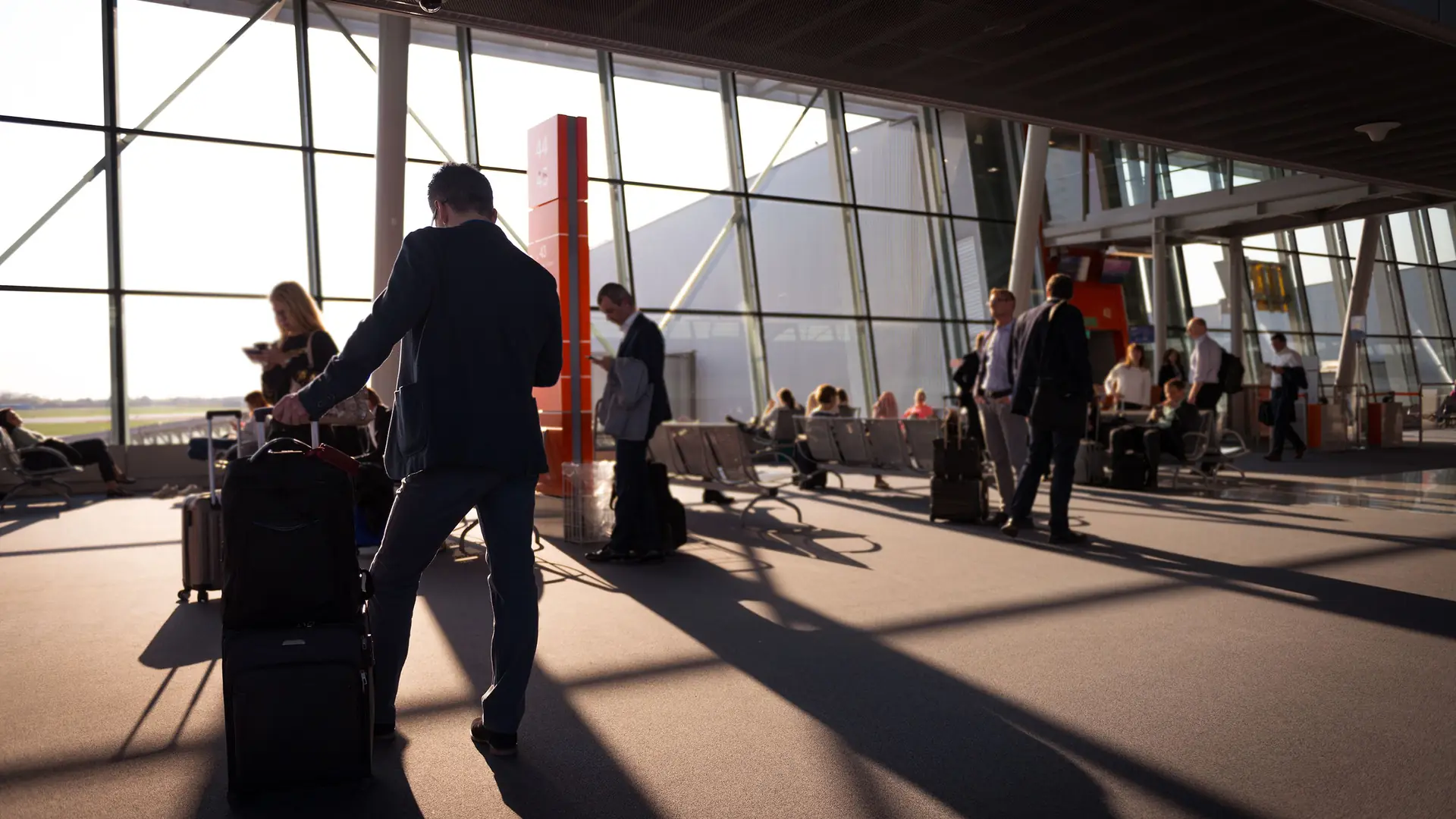
Photographs. Travelers with carry-on luggage in a sunlit terminal — Magic K, Pexels Cropped and resized for the web; not otherwise altered. Neither the photographers nor the licensors endorse this article.
This article is general information, not medical, legal, financial or safety advice. OTGG is an independent travel advisor; this article contains no affiliate links. Cruise line and supplier policies, rates, promotions, inclusions, accessibility procedures and deposit schedules change — verify all details with the operator or an accredited travel advisor before booking or payment.
Want the travel days planned as carefully as the cruise?
Send me the ship, the ports and where you are flying from. I will set the arrival window, match flights to a realistic disembarkation time, and get transfers, wheelchair assistance and equipment deliveries confirmed in writing.
Begin the Journey






















