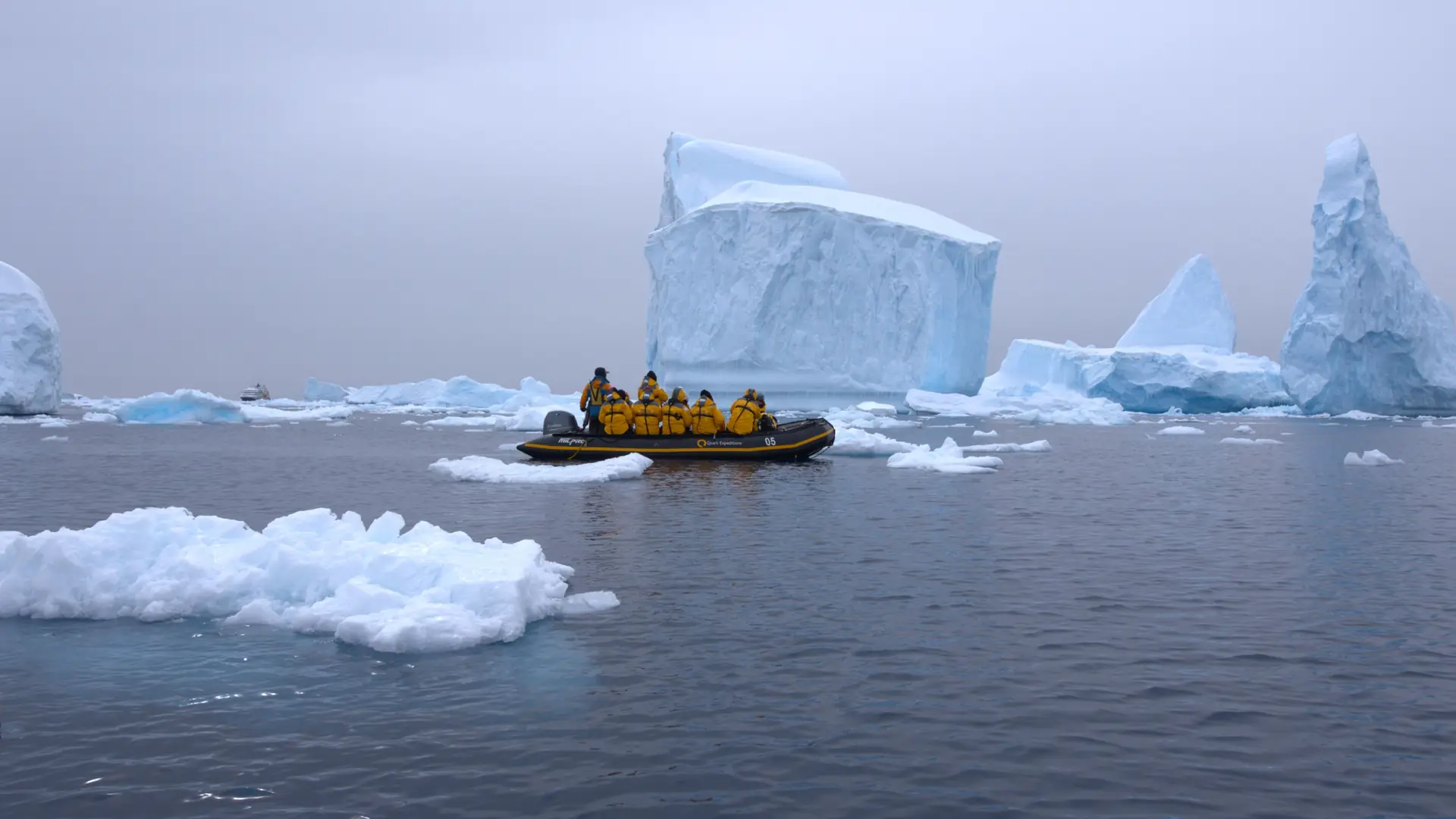
Antarctica looks effortless in a brochure.
Sources and facts checked: September 25, 2026 (America/New_York). Landings, activities and itineraries are never guaranteed, and solo offers, fares and contract terms change by departure. Check and verify with the cruise line or vendor before you pay a deposit.
A penguin appears beside a glassy iceberg. A guest in a parka raises a camera. The ship sits in the background, perfectly positioned and apparently free of wind, waves, mud, motion, and paperwork.
The actual expedition is more complicated, and that is precisely why it can be extraordinary.
Expedition cruising is not a conventional cruise with a remote port added to the itinerary. It is a flexible, weather-led operation built around small-boat transfers, natural shorelines, expert interpretation, and the possibility that the day’s headline activity may change.
The destination matters. So do the logistics.
What expedition cruising actually is
An expedition cruise usually combines:
- A smaller, ice-strengthened ship.
- An expedition team of naturalists, historians, photographers, scientists, and other specialists.
- Zodiac cruising and shore landings.
- Flexible daily programming.
- Wildlife viewing from the ship, Zodiac, or shore.
- Lectures and briefings that explain what you are seeing.
- Optional activities such as kayaking, camping, paddling, or photography programs.
Your cruise may list a series of landing sites, but those locations are not guaranteed in the way a city tour or hotel reservation is. Ice, wind, sea conditions, wildlife protection rules, and operational decisions can change the plan.
That flexibility is not a flaw. It is the product.
The Zodiac landing reality
You are not stepping onto a pier
Most Antarctic landings involve boarding a Zodiac from the expedition ship, riding to shore, and entering shallow water or approaching a rocky beach.
Expect to:
- Walk to the embarkation area in expedition gear.
- Descend a gangway or steps.
- Step into or over the side of a moving Zodiac.
- Sit on an inflatable tube or bench during the transfer.
- Exit the Zodiac with staff guidance.
- Walk across wet, rocky, uneven, or slippery ground.
A wet landing is not a cinematic detail. It is part of the transport system.
You may be standing in cold water while balancing against the movement of the boat. The beach may consist of gravel, stones, mud, snow, or compacted ice. There may be no handrail, pavement, shelter, or conveniently placed bench.
Fitness is practical, not performative
You do not need to be an athlete. You do need enough mobility, balance, and confidence to manage the transfer safely.
Before you book, ask whether you can:
- Climb stairs and a gangway.
- Step in and out of a small boat with assistance.
- Stand and transfer without being lifted.
- Walk on uneven terrain while wearing waterproof boots.
- Remain outdoors in cold, windy conditions.
- Follow safety instructions quickly.
A Zodiac landing may be easy one day and demanding the next. Weather, surf, ice, and the angle of the beach all matter.
Quark’s current expedition contract makes the operational reality clear: off-ship activities are not guaranteed, and the captain or expedition leader may change or cancel activities for safety or weather reasons. Read the current Quark Expedition Contract before treating a brochure itinerary as a promise.
Who expedition cruising suits, and who it may not
Expedition cruising can work well for travelers who:
- Prefer discovery over a fixed schedule.
- Enjoy learning from specialists.
- Want a small-ship social environment.
- Are comfortable with changing plans.
- Can tolerate cold, motion, wet gear, and early starts.
- Like the energy of a group without needing to travel with one.
That includes many solo travelers, LGBTQ+ travelers, and multigenerational families. The shared experience creates easy conversation. You already have something to discuss: the whale, the landing, the weather, or the person who packed three cameras and still forgot gloves.
It may not suit travelers who:
- Need guaranteed shore access.
- Require paved, step-free terrain.
- Cannot transfer into a small boat.
- Want a predictable port-by-port schedule.
- Dislike cold, motion, or shared outdoor operations.
- Expect every optional activity to be available every day.
A multigenerational group should evaluate each traveler separately. A teenager may want kayaking. A grandparent may prefer a Zodiac cruise without landing. Both can enjoy the same expedition, but only if the itinerary allows different participation levels.
Solo expedition cruising: the cabin math matters
Solo travelers have more options than many brochures suggest, but the details vary by ship and departure.
| Solo cabin model | What it means | What to verify |
|---|---|---|
| Dedicated solo cabin | Built and priced for one guest | Exact category, size, view, and current fare |
| Private double cabin | A standard two-person cabin occupied alone | Single supplement percentage and total fare |
| Cabin share | Shared with another solo traveler, often by gender | Matching rules, category, and what happens if no match is found |
| Solo promotion | Low to no single supplement on selected departures | Expiration, cabin limits, and written eligibility |
Quark
Quark’s official ship pages currently list dedicated solo categories on both Ultramarine and Ocean Explorer.
On Ultramarine, the Solo Panorama is a single-occupancy cabin with a twin bed and floor-to-ceiling window.
On Ocean Explorer, current categories include the Studio Single and Studio Veranda Single. The latter is designed for one guest and includes a balcony.
That does not mean every departure has availability. It also does not mean the solo category will always be the cheapest option. Compare:
- Dedicated solo fare.
- Shared cabin fare.
- Standard cabin with a single supplement.
- Current solo promotion.
- Any required transfer or hotel package.
Quark also offers a Request-Share program, which pairs solo travelers with a same-gender cabin mate specifically to avoid a single supplement. This is a distinct third solo-friendly option beyond the two dedicated solo-cabin categories, and it may or may not be cheaper or more comfortable than a dedicated solo cabin depending on the departure. Verify matching rules, cabin category, what happens if no match is found, and any current program changes in writing. Check and verify with the cruise line or vendor.
Quark’s live booking pages show that pricing can differ sharply by ship, date, cabin, and occupancy type. Treat online pricing as a snapshot, not a standing promise.
PONANT
PONANT frequently offers low to no single supplement departures, but the offer is voyage-by-voyage.
Its current No Single Supplement page shows selected departures where solo travelers may use a double cabin without the usual additional charge. The offer is capacity-controlled and subject to cabin category and availability, and some suite categories may be excluded — check and verify with the cruise line or vendor.
The correct question is not, “Does PONANT waive the supplement?”
Ask instead:
“Does this exact departure, ship, cabin category, and fare have a current written low or no single supplement offer?”
Lindblad Expeditions
Older articles often state that Lindblad has no dedicated solo cabins and always applies a supplement. That is now too broad.
Lindblad’s current Solo Travelers page lists three options:
- Private double cabins.
- Private solo cabins on select ships and categories.
- Shared cabins on select voyages.
Lindblad also promotes selected solo offers that may reduce or eliminate the additional solo cost. Availability remains departure-specific.
The practical takeaway: do not assume that “Lindblad” automatically means either “no solo cabin” or “no supplement.” Confirm the exact ship and category.
Antarctic pricing: the headline fare is only the beginning
For a standard 10- to 12-day Antarctic Peninsula expedition, $8,000–$15,000 per person is useful dated context for the mainstream expedition market. Luxury expedition pricing is higher.
Current official listings demonstrate why the range needs careful handling. Quark’s live listings for its 11-day Antarctic Explorer show 2026–27 Ocean Explorer departures starting around $20,200, with later seasons from about $12,200, before solo pricing and additional trip costs. Lindblad’s current Antarctica guide puts the average voyage at about $10,000 per person, with longer and more premium itineraries rising substantially.
PONANT generally sits toward the luxury end of the market.
Your real budget should account for:
- International airfare to South America.
- Regional flights to Ushuaia or Punta Arenas.
- Pre- and post-expedition hotels.
- Travel insurance.
- Medical coverage and evacuation protection.
- Optional kayaking, camping, paddling, or photography programs.
- Gear purchases or rentals.
- Gratuities, beverages, internet, laundry, and spa services where applicable.
- Solo supplements or private-cabin pricing.
The brochure fare may cover the ship, meals, expedition programming, and some standard excursions. It does not automatically cover the entire journey to the ship.
For additional context, review Lindblad’s Antarctica cruise cost guide.
What is usually included, and what is not
Often included
Depending on the operator and itinerary, the standard fare may include:
- Shipboard accommodation.
- Meals on board.
- Expedition lectures and briefings.
- Zodiac cruising.
- Standard shore landings, weather permitting.
- Expedition staff.
- Some loaned gear, such as boots or a parka.
- Port charges and landing permits.
- Certain transfers, hotels, or charter flights when specifically listed.
Often extra or variable
Do not assume the following are included:
- International airfare.
- Personal travel insurance.
- Medical insurance.
- Cancellation and interruption protection.
- Kayaking.
- Camping.
- Spa treatments.
- Specialty beverages.
- Internet.
- Laundry.
- Optional photography programs.
- Pre- and post-cruise extensions.
Even the word “included” needs context. An activity may be included in the fare but still require advance registration, a waiver, a physical assessment, or favorable weather.
Read the exact “What’s Included,” “Adventure Options,” and booking terms for your departure.
Accessibility reality: verify the ship, not the marketing category
There is no universal accessibility standard for expedition cruising.
A ship may have accessible cabins, elevators, or modified bathrooms while the Zodiac operation remains unsuitable for a traveler who cannot independently transfer into a small boat. Onboard accessibility does not automatically create shore accessibility.
Ask for written answers about:
- Cabin door width and bathroom layout.
- Shower thresholds and grab bars.
- Elevator access to the embarkation deck.
- Gangway slope and surface.
- Zodiac transfer procedures.
- Whether staff may assist with balance or transfers.
- Whether mobility devices can be carried in the Zodiac.
- What onboard alternatives exist if you do not land.
- Emergency evacuation procedures.
- Medical support and evacuation limitations.
Quark’s Ultramarine page identifies modified layouts and bathrooms in two Explorer Suites, but that information does not establish that all off-ship activities are accessible.
Submit medical and accessibility information early. Quark’s current contract states that medical forms are due 90 days before the expedition or immediately if booked later. Check and verify with the cruise line or vendor.
Do not rely on a phone conversation. Require written confirmation from the cruise line, ship operator, transfer provider, hotel, equipment vendor, and excursion operator as applicable.
Packing and gear: layers beat luggage theater
You need clothing that works when the forecast changes and your gear gets wet.
Prioritize:
- Moisture-wicking base layers.
- Insulating mid-layers.
- Waterproof and windproof outer layers.
- Waterproof pants.
- Warm, waterproof gloves.
- A hat that stays on in wind.
- Neck protection.
- Sunglasses and sunscreen.
- A small waterproof day bag.
- Dry bags or waterproof phone protection.
- Binoculars.
- Seasickness supplies recommended by your healthcare professional.
Many operators provide or loan boots and may provide a parka. Confirm the exact policy before buying expensive polar gear.
Pack light enough to manage your own luggage through airports, hotels, transfers, and embarkation. Quark’s current contract also notes that charter flights may impose additional baggage limits.
Devil’s Advocate: Antarctica can disappoint you honestly
The best expedition operators cannot control Antarctica.
A landing may be canceled because of wind. A whale may not appear. A planned bay may be inaccessible because of ice. A charter flight may be delayed. The Drake Passage may be calm, or may remind you that the ocean has a personality.
The “luxury” label also does not erase expedition conditions. A beautiful ship can still involve:
- Motion.
- Wet landings.
- Cold fingers.
- Early wake-up calls.
- Limited medical facilities.
- Changed itineraries.
- Additional hotel and airfare costs.
- Physical requirements that were easy to overlook in the sales copy.
If you need certainty more than discovery, choose a scenic cruise or land-based Antarctic program instead. If you want a flexible, shared adventure and accept that nature gets the final vote, expedition cruising may be a strong fit.
Verify-before-you-pay checklist
Before paying a deposit, obtain written confirmation of:
- Exact ship, departure date, and itinerary.
- Cabin category and solo-occupancy price.
- Single supplement percentage, if applicable.
- Whether a solo offer is attached to the exact departure.
- What happens if a shared-cabin match is unavailable.
- All included hotels, transfers, and charter flights.
- International and regional airfare exclusions.
- Travel insurance and medical coverage requirements.
- Emergency evacuation limits.
- Optional activity prices and availability.
- Zodiac boarding and landing requirements.
- Accessibility features onboard and ashore.
- Equipment loans, rentals, and baggage limits.
- Deposit, final-payment, cancellation, and change terms.
- Weather-delay procedures.
- Written confirmation from every relevant supplier.
Save the confirmation, not just the brochure. If the promise matters, put it in the file.
Frequently asked
Is expedition cruising suitable for first-time cruisers?
Yes, if you understand that it is an active, flexible travel experience rather than a traditional cruise. Attend every briefing and ask questions before booking.
Can I travel solo without paying double?
Sometimes. Quark offers dedicated solo categories on Ultramarine and Ocean Explorer. PONANT offers low to no single supplement departures on selected voyages. Lindblad offers private solo cabins, shared cabins, and selected solo promotions. Verify the exact voyage.
Are Zodiac landings guaranteed?
No. Landings depend on weather, sea conditions, wildlife protection rules, ice, and operational decisions.
Do I need to be highly athletic?
No. You do need sufficient balance, mobility, and stamina to board and exit a Zodiac and walk on uneven terrain. Requirements vary by operator and activity.
Can wheelchair users participate?
Do not assume. Some ships may have accessible cabins or onboard features, but Zodiac transfers and natural shorelines create separate limitations. Obtain ship-specific written confirmation before paying.
Does the fare include kayaking or camping?
Sometimes, but policies vary. Some operators include selected activities; others charge separately or limit availability. Confirm the exact departure’s activity terms.
Sources and facts checked: September 25, 2026 (America/New_York). Quark Expeditions ship pages and expedition contract, PONANT’s low to no single supplement offer page, and Lindblad Expeditions’ solo-traveler page and Antarctica cost guide were reviewed on the date shown. Fare ranges are dated context, not quotes. Offers, fares and contract terms change by departure — check and verify with the operator in writing before booking.
Sources
Photographs. An expedition Zodiac among icebergs in Antarctica — Jan Tang, Pexels Cropped and resized for the web; not otherwise altered. Neither the photographers nor the licensors endorse this article.
This article is general information, not medical, legal, financial or safety advice. OTGG is an independent travel advisor; this article contains no affiliate links. Cruise line and supplier policies, rates, promotions, inclusions, accessibility procedures and deposit schedules change — verify all details with the operator or an accredited travel advisor before booking or payment.
Thinking about Antarctica — solo, as a couple or as a family?
Tell me how active each traveler wants to be and what the budget really includes. I will compare ships and solo options on the exact departures, total the flights, hotels and insurance, and get landing and accessibility answers in writing before you pay a deposit.
Begin the Journey






















