Accessibility changes with a ship's size, age, cabin inventory, public-space layout, port infrastructure, tender operations, excursion vehicles and the type of support you need. The useful question is not which cruise line is most accessible. It is what changes on this ship, cabin, itinerary and shore day — and whether that matches what you need.
Sources and facts checked: September 12, 2026 (America/New_York). This is an informational comparison, not a ranking, recommendation, accessibility certification or guarantee. Policies, cabin inventory, equipment rules, port conditions, tendering procedures, excursion vehicles, medical services and request deadlines all change. Treat this date as a research checkpoint, not a permanent promise.
Four formats, four different trade-offs
| Format | Cabin inventory | Public-space pattern | Main access challenge | Best verification question |
|---|---|---|---|---|
| Large premium ship | Usually the broadest range, still limited by ship and category | More elevators, venues and route redundancy | Distance, crowds, lift queues, tender ports | Can I reach my priority venues without excessive walking or transfers? |
| Luxury ocean ship | Purpose-built suites may be few; standard suites vary widely | More space and attentive service, but ship-specific layouts | Assuming suite size equals accessible design | What are the exact door, bathroom, bed and balcony measurements? |
| River or small ship | Often very limited; some ships have none | Narrower corridors, partial elevator access, movable gangways | River levels, historic-port terrain, coach access | Does the accessible route reach every essential venue and the shore-boarding point? |
| Expedition vessel | Often only a few accessible cabins on selected ships | Smaller public areas, specialist crew | Zodiac boarding, uneven landings, remote medical access | Which expedition activities can I join without unsafe transfers? |
Large premium ships
These typically offer the broadest accessible-cabin inventory and the most extensive public infrastructure. Holland America publishes several accessible-stateroom types — fully accessible, single-side-approach and ambulatory-accessible — and its program addresses hearing, vision, mobility, service animals and respiratory needs. Royal Caribbean publishes detailed accessible-stateroom information including wider doors, roll-in showers and turning space, and is explicit that tendering, gangways and device storage remain separate operational questions.
The trade-off is scale. Elevators, multiple dining venues, pool lifts and more cabin choice come with a substantial route from cabin to theater or embarkation point, plus crowded lifts and busy public areas that affect sensory comfort and stamina.
Luxury ocean ships
More suite space, lower passenger density and personalized service can genuinely help. They do not remove physical constraints.
Seabourn identifies specially designed suites but also notes that standard suite doors and bathrooms may be too narrow for some wheelchair users. It recommends submitting its Special Requirements Information form at booking or a minimum of 45 days before departure, and explains that mobility devices must be stored inside the suite and that tender transfers may be limited by steps, weather, tide, device weight and port conditions. Regent Seven Seas publishes an accessible-suites resource and an onboard FAQ — use them to identify the exact ship and cabin rather than assuming category consistency.
Silversea currently identifies four wheelchair-accessible Premium Veranda Suites, one per deck in midship positions, on Silver Ray, Silver Nova and Silver Endeavor. That is useful evidence of purpose-built inventory, not proof that every Silversea ship or suite category matches. Silversea also recommends bringing a collapsible personal wheelchair, notes a standard suite may not fit a scooter through the door, and strongly recommends traveling with an able-bodied companion because it does not provide dedicated full-time wheelchair assistance. Those are separate questions from the service associated with a luxury fare.
River and small ships
Small scale has a price: fewer accessible cabins, narrower corridors, smaller bathrooms, limited elevator coverage, and movable or steep gangways affected by river levels and dock conditions. Some vessels have elevators that do not reach the sun deck or the lower deck, so public-space access can be partial even when the cabin itself works. Ask whether the accessible route reaches the dining room, lounge, reception and the shore-boarding point. Do not stop at "the ship has an elevator." Our river shore-gap guide covers this in full.
Expedition vessels
Expedition cruising has the widest gap between onboard access and destination access. Ponant's FAQ identifies accessible cabins on certain ships and states that some vessels are designed to accommodate passengers with reduced mobility — while making clear that difficult landings and Zodiac operations remain subject to the captain, the expedition leader, conditions, and the guest's ability to travel independently or with a companion.
A Zodiac landing can involve a moving boat, a step down, low seating, wet surfaces, uneven ground and no paved shore route. Ask what happens if you cannot board one, and decide honestly whether remaining onboard still represents the trip you are paying for.
Cabin inventory versus public-space access
These are separate tests. An accessible cabin may include a wider entry, greater turning space, a roll-in shower, grab bars, a lowered sink or a single-side transfer arrangement. A standard suite may offer more square footage and still have a narrow bathroom door, a tub, a threshold, or furniture that prevents turning. Before booking, confirm:
- The exact cabin number, not only an accessible category.
- Entry and bathroom door widths.
- Shower type, seat, grab bars and transfer side.
- Bed height and clearance, and turning space around bed and bathroom.
- Balcony threshold and usable balcony space.
- Elevator access to the venues you actually expect to use.
- Where your wheelchair or scooter will be stored and charged.
Devices generally cannot remain in corridors or lift lobbies. Measure yours with batteries, accessories and controls fitted. A cabin that looks spacious on a deck plan can still fail at the doorway.
Tenders, Zodiacs and gangways
Docked does not always mean step-free. Gangway angles change with tide and water level, port construction can interrupt an otherwise workable route, and a ship may switch from a pier call to tendering because of weather. Ask, port by port:
- Is the ship scheduled to dock or anchor?
- Can a wheelchair or scooter board the tender?
- Must the guest transfer into a seat?
- Can the device remain on board if the guest goes ashore?
- What happens if weather changes the operation?
- Is the shore landing level, paved, rocky, sandy or stair-based?
Service is not personal care
Seabourn and Holland America both state that guests who need help with essential daily activities must travel with a capable companion. Ship medical staff are not available for routine dressing, bathing, eating, toileting or transfers unless a guest is hospitalized. That boundary applies regardless of fare level, suite category or crew-to-guest ratio. If you need hands-on assistance, arrange it independently and confirm whether your companion or professional caregiver can travel under the line's rules.
Medical infrastructure varies too. A medical center may handle routine consultations, minor treatment and emergencies; it may not provide specialist care, ongoing treatment, dialysis arrangements or complex medication storage. Holland America describes onboard medical centers and advance coordination for respiratory needs; Ponant states that doctors and nurses are available on most of its ships, with hospital facilities on certain vessels. Read those as operational information, never as a guarantee that a ship can manage your specific condition. Our cruise medical prep guide covers the documentation side.
Excursion lift weight limits: get your number, not a number
Many accessible excursions publish a maximum lift capacity, and it is almost always the combined weight of the guest and the mobility device rather than either on its own. The figures vary substantially between one tour and the next, and between an airport transfer lift and a tour operator's bus.
That variation is why a number quoted in a general article is worse than useless — quote one too low and a traveler rules themselves out of an excursion they qualify for. Ask your specific excursion for its current limit in writing, and give the operator your device weight with batteries fitted.
Devil's advocate
A smaller ship is not automatically the poor choice. Fewer passengers can mean less congestion, easier orientation and a calmer environment, and a traveler who walks short distances and manages steps may find a compact vessel genuinely comfortable.
A large ship is not automatically the easy one either. More accessible cabins, lifts and amenities are offset by long corridors, busy embarkation and heavy demand for assistance. The honest conclusion is less glamorous than either: accessibility is not a brand adjective. It is a chain of specific handoffs, and if one link fails — cabin geometry, gangway, tender, vehicle, landing, personal care — the fare cannot repair it.
Verify before you pay
- Identify the exact ship, not only the cruise line.
- Reserve a specific accessible cabin number if you require accessible features.
- Obtain door, bathroom, bed, shower, balcony and turning-space details in writing.
- Submit the line's accessibility or medical form at booking.
- Confirm every deadline, including the longer ones for interpreting and equipment.
- Send complete device dimensions, weight, battery type and charging needs.
- Map which calls are docked, tendered, Zodiac or weather-dependent.
- Ask which shore excursions require steps, transfers, uneven terrain or standard coaches.
- Ask your specific excursion for its combined guest-and-device weight limit in writing.
- Confirm that staff will not provide lifting or personal-care assistance.
- Carry medical supplies and documentation in your hand luggage.
- Reconfirm 48 hours before boarding, and again with Guest Services after embarkation.
Frequently asked
Does a luxury cruise guarantee better accessibility?
No. Luxury may provide more suite space, lower passenger density and attentive service. It does not guarantee accessible cabin geometry, elevator coverage, tender access or suitable shore excursions. Accessibility is a chain of specific handoffs, and fare level cannot repair a broken link.
Are accessible cabins available in every suite category?
Usually not. Inventory varies by ship, and some lines identify only selected accessible suites. Silversea, for example, identifies four wheelchair-accessible Premium Veranda Suites — one per deck, midship — on Silver Ray, Silver Nova and Silver Endeavor. That is evidence of purpose-built inventory on those ships, not proof that every ship or category matches. Confirm the exact cabin before paying.
Can wheelchair users go ashore at tender ports?
Sometimes, but not reliably. Boarding may require a transfer, a collapsible device or favorable sea conditions, and the captain and crew may restrict access for safety reasons. Seabourn specifically warns that tender and gangway operations can involve steep steps, weather restrictions and device weight limits. Do not build an itinerary around a port you can only reach in perfect conditions.
Are expedition cruises suitable for wheelchair users?
It depends on the person, the ship, the itinerary and your willingness to skip activities. A Zodiac landing can involve a moving boat, a step down, low seating, wet surfaces and no paved shore route. Ask for a written activity-by-activity answer, and ask what happens if you cannot board — whether scenic cruising, lectures or another onboard program is available, and whether that still represents the trip you want.
Does the ship’s medical center provide daily care?
Generally no. Medical centers handle consultations, minor treatment and emergencies within their published scope. They do not replace a personal-care attendant, and they are not an alternative to land-based specialist treatment. Seabourn and Holland America both state that guests who need help with essential daily activities must travel with a capable companion.
What weight can an excursion lift take?
It varies by excursion and by vehicle, and the limit is normally the combined weight of the guest and the device rather than either alone. Published figures differ substantially between one tour and the next, so a number quoted in a general article — including this one — is worthless for your booking. Ask the operator for the limit on your specific excursion, in writing, and give them your device weight with batteries fitted.
Sources and facts checked: September 12, 2026 (America/New_York). Every operator claim in this article is described as that line publishes it on its own pages, and cabin inventory, suite dimensions, tender procedures and request windows all change without notice. Excursion lift capacities are the item most often misread: the limit is normally the combined weight of the guest and the mobility device, and it varies substantially between one excursion and the next and between an airport transfer lift and a tour operator's vehicle. No general figure is useful for your booking — ask your specific excursion operator for its current limit in writing and give them your device weight with batteries fitted. Confirm all cabin measurements, tender arrangements and service boundaries with the line before payment.
Sources
- Seabourn — Accessibility and the Special Requirements Information form ↗
- Holland America Line — Accessible cruising ↗
- Royal Caribbean — Guest Special Needs ↗
- PONANT — official FAQ, accessibility, tenders and Zodiac operations ↗
- Carnival — Shore excursions for guests with disabilities ↗
- U.S. Department of Transportation — Passenger Vessels (ADA guidance) ↗
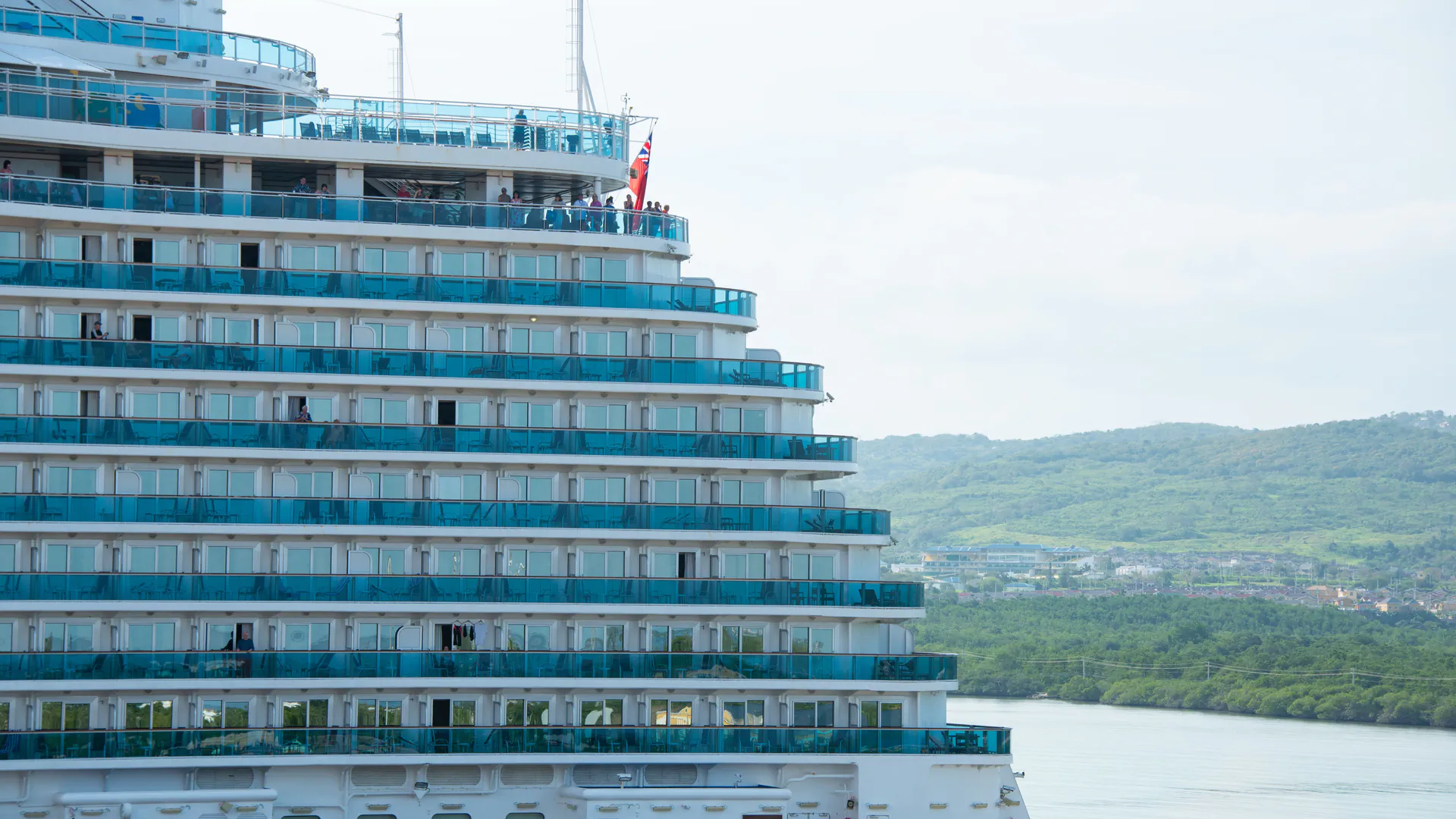
Photographs. Tiered balconies on a large cruise ship — Diego F. Parra, Pexels Cropped and resized for the web; not otherwise altered. Neither the photographers nor the licensors endorse this article.
This article is informational only and is not medical, legal, accessibility or insurance advice. OTGG is an independent travel advisor and intermediary, and this article contains no compensated or affiliate links. Cruise line policies, rates, cabin inventory, equipment rules, tender operations, medical services and deadlines are subject to change. Verify current details with the operator or an accredited travel advisor before payment. Consult an appropriately qualified professional for medical advice, diagnosis, activity suitability or individualised risk guidance.
Want the exact measurements before you commit?
Tell me the ship you are considering and what has to work — door widths, transfer side, device dimensions, which ports you actually need to get ashore at. I will get the cabin specifics and the tender and excursion answers in writing, and say so plainly when a format is wrong for you regardless of how good the ship is.
Begin the Journey