One gap, one inflated tube, one swell: the transfer decides an Antarctic landing, so confirm the handoff in writing before paying.
Sources and facts checked: October 21, 2026 (America/New_York). Boarding procedures, assistance policies and landing rules vary by ship and season. Check and verify with the expedition operator before you pay.
Cruising accessibility conversations are usually about ships: door widths, roll-in showers, lift access. Antarctica breaks the pattern. The hardest mobility problem on an expedition voyage is not onboard: it is the half minute crossing from a gangway or shell door onto a rigid-hulled inflatable, and everything on the far side.
This article takes only the Zodiac axis. The Journal already covers tender ports with a mobility device (see Tender Ports With a Mobility Device), accessibility deadlines and documentation (Accessibility Requests, Deadlines and Documentation), equipment rentals (Disability Equipment Rentals for Cruises) and the expedition reality the brochure skips (Expedition Cruising: What the Brochure Skips); those pieces own the pier, the paperwork and the kit, and this one owns the handoff.
The boarding step, described straight
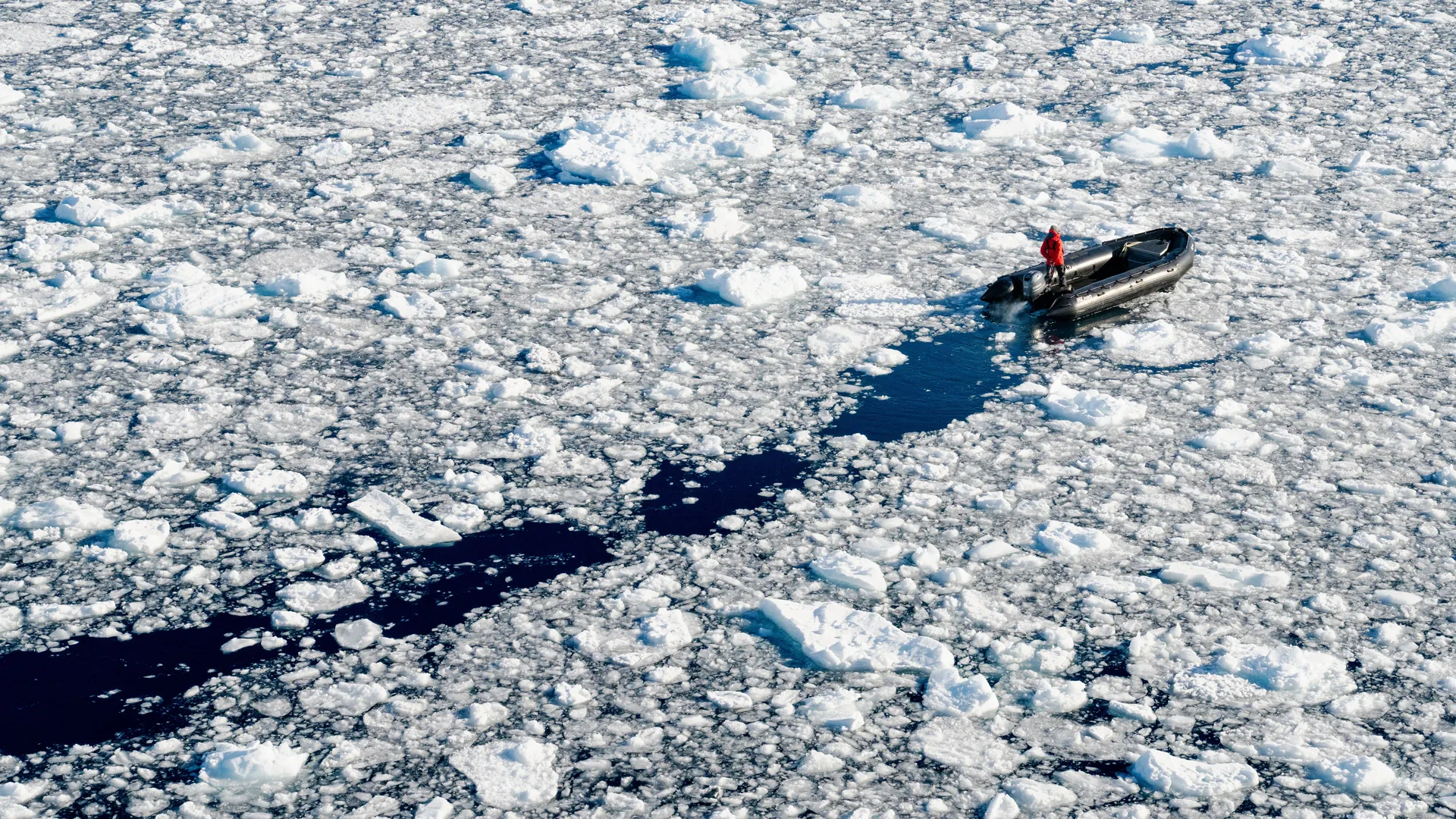
A Zodiac is a rigid-hulled inflatable: a hard hull wrapped in inflated tubes. Some ships board through a shell door at tube height; on many you descend a gangway and step across a moving gap while crew hold the boat against the hull and swell lifts it. Disembarking reverses the problem with less help: stand, cross the tube, step off onto rock, gravel, snow or, at many sites, into water.
The decisive question is not the cabin; it is what the written answer says about this step, on your exact ship.
A wet landing and a dry landing are different promises
A dry landing puts your boots on rock or a beach above the waterline. A wet landing means stepping into shallow water, ankle to knee deep, and wading ashore. The site decides, based on swell, ice and beach shape; neither the guest nor the operator's plan chooses.
A wet landing removes the last stable surface: there is no handrail in the water. Crews supply rubber boots and staff the shallows, but the floor of the landing is the sea floor. Ask which sites on your route typically run wet or dry, as a pattern, not a promise. Expedition booking terms generally give the captain and expedition leader authority to change or cancel off-ship activities; check and verify the wording in your operator's booking conditions.
Sit and hold, or straddle and hold: ask which, on the exact ship
How you ride matters as much as how you board. Some hulls seat guests on a tube or bench inside the boat. Others put you astride the outer tube, gripping a rope, which demands hip and knee flexion and grip.
Treat "sit-and-hold" and "straddle-and-hold" as our own working description of a real operational difference, not as industry terminology. No operator labels it this way and there is no published standard, so seating can differ ship to ship. Some operators' onboard safety briefings describe a specific grip and a sequence of stepping onto the sponson before entering the boat; check and verify with the cruise line or vendor. Ask each operator to describe the procedure on your hull in its own words.
Ask in writing: on your exact ship, is standard seating sit-and-hold or straddle-and-hold, and can a guest who needs one be assigned a seat? Quark's frequently asked questions, checked October 21, 2026, state that guests need a high level of mobility to get in and out of Zodiac boats, and route questions to a Polar Travel Advisor. Ask how much hands-on help staff give at the boarding step and what a guest must manage alone. Check and verify with the expedition operator. Carry the operator's exact wording into your booking file rather than flattening it into "the crew will help".
The 100-ashore cap belongs to IAATO, not the operator
Landings run in rotations: roughly ten guests per Zodiac, shuttling ship to shore. IAATO caps visitors ashore at 100 per site, excluding staff, and allows one vessel per site (checked October 21, 2026). Check and verify with the expedition operator.
The consequence for accessibility-conscious planning is structural. A dedicated landing slot, a slower rotation or an assist team must fit inside a rotation already sized to a hard cap. The guest with the greatest mobility need is not the only person waiting; the whole rotation is. So ask how the help is scheduled: who runs it, how many guests it serves per landing, where it sits in the rotation.
What some operators run, and what some do not
Some operators describe levels of assistance; some do not. Three examples, confirmed October 21, 2026:
- Hurtigruten's accessibility pages state that crew are not able to provide personal care or one-to-one assistance, including lifting. The companion point is framed as a request rather than a requirement: the line asks that guests needing that level of support travel with a companion. These are the line's own words, and the register matters if you quote it back.
- Silversea's booking conditions state that guests who use a wheelchair must tell Silversea when they book and bring their own collapsible wheelchair, and that wheel-on/wheel-off access may not be available at every port.
- Quark's frequently asked questions state that guests need a high level of mobility to get in and out of Zodiac boats, and route mobility questions to a Polar Travel Advisor before booking.
Each document draws a line between onboard access and off-ship activity, and none promises a landing. Where an operator distinguishes levels of assistance, carry their distinction into your booking file as written.
The honest limits, and the alternatives worth asking for
For a traveler who cannot step across a gap unassisted, some Antarctic landings are simply not possible, and no operator can promise them. Saying that plainly is the value of this piece.
Quark states the limit in its own words, and the bluntness is the point: “It is essential that guests have high level of mobility to get in and out of Zodiac boats.” That is the operator's phrasing, quoted directly from its frequently asked questions rather than paraphrased, and it carries more weight in a booking conversation than any summary of ours would. It also removes the assumption that an accessible cabin settles the landing question. It does not.
The alternatives, none of which should be assumed on your sailing:
- Remaining aboard with a view of the landing: does the ship anchor within sight, and are viewing areas usable?
- Scenic Zodiac cruising without a landing: does the operator run it separately? It removes the wade but keeps the boarding step.
- Shore programs that need no landing: does the itinerary include station visits, community calls or ship-positioned days?
- Dedicated assistance: does a dedicated slot, slower rotation or assist team exist on this ship, and how is it scheduled?
Dietary and medical provisioning is a written-confirmation question for the operator's accessibility team before final payment, with a reconfirmation date on the reservation; the deadlines guide (Accessibility Requests, Deadlines and Documentation) owns the workflow. This article gives no medical advice.
Devil's advocate: is honest coverage just discouragement?
The fair counter-case: many travelers with mobility needs land in Antarctica every season. Expedition teams are professional, rotations drilled, crew steadying guests in the shallows. A piece dwelling on gaps and swell can read as telling people to stay home.
That counter-case earns its concession: expedition professionalism is why the Zodiac system works for as many as it does. But the reassuring version costs money: it says the crew will help. The honest version says help means steadying rather than lifting, and asks what the written procedure says on your exact ship. Honesty here is not discouragement; it is the difference between a voyage you verified and one you wished on.
Verify before you pay
How does boarding work on this ship?
Get the exact ship's boarding procedure in writing: gangway, shell door or stern platform, and who steadies the boat.
How is Zodiac seating done, and can a seated position be assigned?
Ask whether seating is sit-and-hold or straddle-and-hold on that hull, and whether a seated position can be assigned in writing.
Which landings tend to be wet or dry?
Ask which sites on the route typically run wet or dry, as a pattern, not a promise.
What does assistance cover, and what does it not?
Confirm what assistance means to this operator, and what crew cannot do.
How are assist slots scheduled and shared?
Ask how any dedicated slot or assist team is scheduled, and how many guests it serves per landing.
Is your accessibility registration attached to the booking in writing?
Confirm the registration deadline for accessibility needs, in writing, attached to the reservation, with a reconfirmation date.
Has the operator listed alternatives for a landing that cannot go ahead?
Ask what alternatives exist if a landing is not possible: onboard viewing, scenic Zodiac cruising or non-landing calls.
What are the terms for weather-canceled landings?
Get cancellation terms for weather-canceled landings in writing.
If you are weighing an Antarctic sailing right now
You are not choosing between going and staying home. You are choosing how much of the decision gets made before the deposit leaves your account. Start with the handoff: written answers on boarding, seating, what the crew can and cannot do, and how assistance fits a capped rotation. Specific answers mean you have a plan; vague ones mean you learned that before paying, the cheapest possible moment. Treat the handoff like the pier and the paperwork: hard question first, in writing, and let the answers decide.
Frequently asked
Can travelers with limited mobility actually land in Antarctica?
Yes, many do, with assistance from the expedition team. The boarding step still requires crossing a gap onto a moving inflatable, often with a wade. Whether it is manageable for you is a question for the expedition team, answered in writing, and for your clinician; this article assesses no one's fitness.
What is the difference between a wet landing and a dry landing?
A dry landing steps onto rock, a beach above the waterline or a platform. A wet landing steps into shallow water, usually ankle to knee deep, and wades ashore. The site decides on the day, based on swell, ice and beach conditions.
How many people can be ashore at a landing site at one time?
IAATO caps visitors ashore at 100 per site at a time, excluding staff, with roughly ten guests per Zodiac in rotation and one vessel per site at once. Dedicated assistance has to fit inside that capped rotation.
Will the crew lift me into the Zodiac?
Most operators' documentation says no. Hurtigruten states its crew cannot provide lifting or personal care, and Quark states staff assist but guests rely on their own capabilities. Ask what your operator's crew can and cannot do, in writing.
What can I do instead of going ashore?
Ask about remaining aboard with a view of the site, scenic Zodiac cruising without a landing, itineraries with non-landing calls, and operators that run dedicated assistance. None can be assumed on a given sailing; each is a question to confirm.
When should I tell the operator about my mobility needs?
As early as possible, before final payment, and in writing. Silversea asks guests needing wheelchair assistance to notify them in advance. The Journal's deadlines guide covers the workflow.
Sources and facts checked: October 21, 2026 (America/New_York). IAATO guidelines and the published health, safety and accessibility pages of Quark, Hurtigruten and Silversea were reviewed on the date shown.
Sources
Photographs. A small black inflatable boat with a passenger in red among broken sea ice — Hugo Sykes, Pexels Cropped and resized for the web; not otherwise altered. Neither the photographers nor the licensors endorse this article.
This article is general information, not medical or safety advice. Ask your clinician about your own fitness for a landing. OTGG is an independent travel advisor; this article contains no affiliate links. Cruise line and supplier policies, rates, promotions, inclusions, accessibility procedures and deposit schedules change — verify all details with the operator or an accredited travel advisor before booking or payment.
Weighing an Antarctic sailing with a mobility need?
Tell me the ship and your device or mobility needs. I will draft the written questions to send the operator and tell you which answers decide the landing question.
Begin the Journey