A practical guide to sharing a small expedition ship without expecting everyone to share every landing, cabin, or pace.
Sources and facts checked: November 2, 2026 (America/New_York). Itineraries, landing rules, fares and age policies change by operator and season. Check and verify with the expedition operator before you pay.
Antarctica rewards groups that plan to diverge. On a small expedition ship, weather, ice, landing rules, and Zodiac rotations, not your family’s preferred schedule, decide who goes ashore and when.
Togetherness needs a flexible definition
A shared voyage does not mean a shared day. One traveler may want every landing; another may be content watching wildlife from the ship. Someone else may need a quieter morning or a longer break between outings.
That variation is normal. The problem begins when the group assumes it can stay together by default, and discovers that the expedition operates on a different clock.
For an overview of how Zodiac transfers and weather-led schedules work, start with Expedition cruising: what the brochure skips. This guide focuses on the group decisions that come next.
IAATO reports that most tourism voyages operate in the Antarctic Peninsula region during the austral summer season, from October to April, and depart from Ushuaia, Argentina, or, to a lesser extent, other ports. Check and verify with the expedition operator.
PONANT’s Le Boréal is scheduled to sail November 12–30, 2026 on an 18-night itinerary from Buenos Aires to Ushuaia; that is a longer, one-way voyage, not a short Ushuaia roundtrip. Check and verify with the expedition operator.
IAATO’s preliminary 2026–27 forecast, based on information available April 10, 2026 and subject to revision, breaks its estimates down by region and type. For the Peninsula, its estimates are traditional seaborne travel: 65,055 passengers, 45 vessels and 408 voyages; air-cruise: 13,498, 19 and 124; yacht travel: 235, 9 and 28; and cruise-only: 26,238, 7 and 14. The remaining estimates are Ross Sea: 385 passengers, 2 vessels and 3 voyages; East Antarctica: 98, 1 and 1; Ross Sea/Peninsula: 295, 2 and 2; and Peninsula/Ross Sea/East Antarctica: 98, 1 and 1. Check and verify with the expedition operator.
Those figures are projections, not a final passenger count or a promise about any particular landing. Also, the voyage categories describe operating types and regions; adding their vessel counts does not necessarily produce a count of distinct ships.
IAATO’s historical table records growth from 48 ships and yachts in 2015–16 to 68 in 2025–26. In the most recent season, traditional seaborne Peninsula travel involved 46 vessels, 401 voyages and 71,530 passengers. Check and verify with the expedition operator.
Landing rotations make “all of us together” a risky plan
IAATO’s landing-management measures include a maximum of 100 passengers ashore at a site at one time, a guide-to-passenger ratio of 1:20, and one ship at a site at a time.
These are IAATO operational measures, not a simple rule in the Antarctic Treaty itself. Site guidance or operating conditions may be more restrictive. The expedition leader sets the practical sequence, and weather or ice can change it.
A group of six might find four places available on a particular Zodiac rotation. Decide beforehand who would take those places, who would wait, and whether anyone would rather skip that landing. Do not make the first discussion while people are standing in their boots at the launch point.
Agree on a simple rule: no one is expected to give up a preferred activity just to keep the group together, and no one is blamed for sitting one out. Set a meeting point or check-in plan for after the activity, subject to the expedition team’s instructions.
Cabin privacy is a group decision, not a loyalty test
You do not have to share a cabin simply because you traveled together. Sharing can lower the group’s total accommodation cost, but it also means sharing sleep schedules, personal space, and the practical routines of a voyage spent close together.
Before choosing cabins, ask each traveler privately what they prefer. Then compare arrangements such as:
- Shared cabins: potentially fewer rooms, but less privacy and less control over individual routines.
- Separate cabins: more personal space and easier rest, at a different total cost.
- A mixed arrangement: some travelers share while others take separate rooms.
Compare the actual fare snapshot, checked on the date shown, for each cabin configuration. Ask the operator to explain the total price, occupancy assumptions, deposits, and cancellation terms in writing. Don’t treat a shared cabin as the default until everyone has agreed freely.
If you are comparing small-ship styles rather than polar operations, Introduction to river cruising explains why another small-ship format has its own pace and trade-offs. It is a comparison, not a substitute for an Antarctic expedition.
An expedition day has two phases, and neither belongs to your dinner spreadsheet
Think of the day as an outing phase and a reset phase. The first may mean an early briefing, dressing for the conditions, and a Zodiac outing or shore landing. The second may involve returning to the ship, drying gear, eating, resting, and listening for the next update.
The timing can move. A landing may take longer, change location, or not happen. A shipboard meal may have a service window, but it is unwise to make a fixed dinner reservation the group’s test of whether the day has gone to plan.
Ask the operator how meals, briefings, and optional activities work when outings run late. Then agree that the party can split up for meals or downtime without it becoming a family referendum.
Pacing also changes across a voyage. A shorter trip leaves less room to absorb disruptions without changing the overall rhythm. For the group, the question is not simply “Can everyone manage a landing?” It is “Can each person manage the repeated cycle of preparation, cold, motion, activity, and recovery?”
A short voyage still asks a lot of its youngest and oldest traveler
A 10-to-12-day itinerary can be demanding even when the calendar looks compact. It may include early starts, long periods outdoors, wet or uneven ground, and a sea crossing that takes up scheduled voyage time.
For younger travelers, check the operator’s minimum age and supervision rules for the exact voyage. A minimum age is an eligibility rule, not a recommendation that every child will enjoy or manage the schedule. Ask whether children can follow expedition-leader instructions and what participation limits apply to landings and other activities. Don’t assume every product suits every multigenerational family.
For older travelers, discuss the full routine, not just the most appealing landing. Consider energy across consecutive outing days, time to rest, and what the traveler would enjoy if they chose not to go ashore. Ask the operator what shipboard alternatives are available, without assuming a specific activity will be offered.
For accessibility-conscious planning, the practical questions involve each handoff and activity. The dedicated multigenerational accessibility guide covers that chain; this article does not replace it.
Solo travelers can join a group without sharing a cabin or matching everyone else’s schedule. For experience and community considerations, see the solo cruise supplement playbook.
LGBTQ+ travelers may want to check the ship, operator, and each gateway destination on their own terms. Browse the journal’s general index for relevant travel guides; no destination-specific LGBTQ+ guide is linked here.
Treat the Drake Passage as part of the itinerary
The Drake Passage is not a punchline or a throwaway sea-day detail. It is a real part of many Antarctic itineraries, and conditions can affect how comfortable the crossing feels and when the ship reaches its next planned activity.
Check the itinerary for the crossing time and ask what happens if conditions delay the schedule. Each traveler should consider the crossing when deciding whether the voyage length and pace feel right. Speak with a qualified health professional about personal medical questions; the operator can explain its onboard arrangements and applicable travel requirements.
Do not promise the group a particular landing to justify the voyage. The destination is extraordinary; the exact sequence remains subject to the expedition team’s decisions and conditions.
For a broader booking-window perspective, see When to book a cruise: wave season, flash sales, and last minute. For Antarctica, the useful booking question is whether the actual cabin arrangement and operating plan suit the group, not whether everyone can be placed on the same activity at the same time.
Devil's advocate: the format may fit better than a conventional cruise
An expedition voyage can suit some groups better than a conventional cruise. The shared focus is the landscape, the wildlife, and the day’s learning, not a full schedule of shipboard entertainment.
And if your group cannot agree on one shared schedule, that is not automatically a reason to choose another product. On an expedition ship, different travelers can make different choices about landings, rest, and time onboard.
But the format genuinely breaks down when togetherness is non-negotiable, when a traveler cannot accept changing plans, or when the group expects every person to participate in each outing. A small ship gives you fewer ways to disappear into separate corners. Be honest about how your party handles close quarters, fatigue, and disappointment before you pay.
Verify before you pay
Are the ship, itinerary, date and cabin confirmed?
Confirm the exact ship, itinerary, departure date, cabin category, and occupancy.
Do you have the total fare for each cabin arrangement?
Ask for the total fare for the cabin arrangement each traveler actually wants.
What are the age, supervision and activity rules?
Verify minimum-age, supervision, and activity rules with the operator for the specific voyage.
How are Zodiac rotations and landing order managed?
Ask how Zodiac rotations are managed and how the group will receive instructions about landing order.
What can someone do onboard if they do not land?
Confirm what options exist onboard when someone does not land.
What happens to meals and briefings if an outing runs late?
Check how meals and briefings work if an outing runs late.
Have you reviewed the Drake Passage schedule and booking terms?
Review the Drake Passage schedule, possible itinerary changes, deposit terms, and cancellation rules.
Which arrangements can be confirmed in writing?
Ask which arrangements can be confirmed in writing and retain the operator’s response.
Does the group have a plan for splitting up?
Make a group plan for splitting up without pressure, guilt, or assumed caregiving.
Plan for the group you actually have
Before anyone commits, ask each traveler what they want from the voyage, and what they would be comfortable missing. If the group can make room for separate landings, different rest needs, and private cabin choices, it can share the expedition without pretending every day will be a group photo.
OTGG acts as an independent travel advisor and intermediary, not as the cruise operator. Cruise-line policies, rates, and deposit schedules can change; verify them with the operator or an accredited travel advisor. This article is for informational purposes only; consult a qualified professional for medical advice or diagnosis. No operator has provided article-specific written confirmation.
Frequently asked
Can everyone in our group land together?
Not necessarily. Zodiac capacity, landing management, weather, and the expedition team’s decisions shape the rotation. Plan for people to take different outings or wait.
Do we have to share a cabin?
No. Compare shared, separate, and mixed cabin arrangements, then decide based on privacy, comfort, and the written fare details.
Is a shorter Antarctic voyage easier for a mixed-age group?
Not automatically. A shorter itinerary still involves the expedition rhythm and sea crossing, with less time to absorb schedule changes. Match the voyage to the group’s energy and expectations.
Can children join an Antarctic expedition?
Some operators accept children, while others set minimum ages or limits on activities. Check the exact operator’s current rules and consider whether the child is ready for the voyage’s conditions and pace.
What should we agree on before we board?
Decide who wants to land, who may choose to stay onboard, how you will handle limited rotation places, which cabins people prefer, and how the group will reconnect after separate activities.
Is the Drake Passage part of every Antarctica cruise?
No. Routes differ. Read the exact itinerary and ask the operator how the crossing and potential schedule changes affect that voyage.
Sources and facts checked: November 2, 2026 (America/New_York). IAATO papers, the Antarctic Treaty Secretariat and operator pages were reviewed on the date shown.
Sources
- iaato.org — IAATO, Antarctic vessel tourism overview and preliminary 2026–27 estimates (ATCM 48, IP 200 rev. 1) ↗
- iaato.org — IAATO, Peninsula landing-site report (ATCM 48, IP 199) ↗
- ats.aq — Antarctic Treaty Secretariat, The Antarctic Treaty ↗
- en.ponant.com — PONANT, The Great Austral Loop: Le Boréal, Buenos Aires to Ushuaia, November 12–30, 2026 ↗
- iaato.org — IAATO, Bylaws ↗
- quark-expeditions.com — Quark Expeditions, Antarctic expedition FAQ ↗
- en.ponant.com — PONANT, frequently asked questions ↗
- expeditions.com — Lindblad Expeditions, reservation terms and conditions ↗
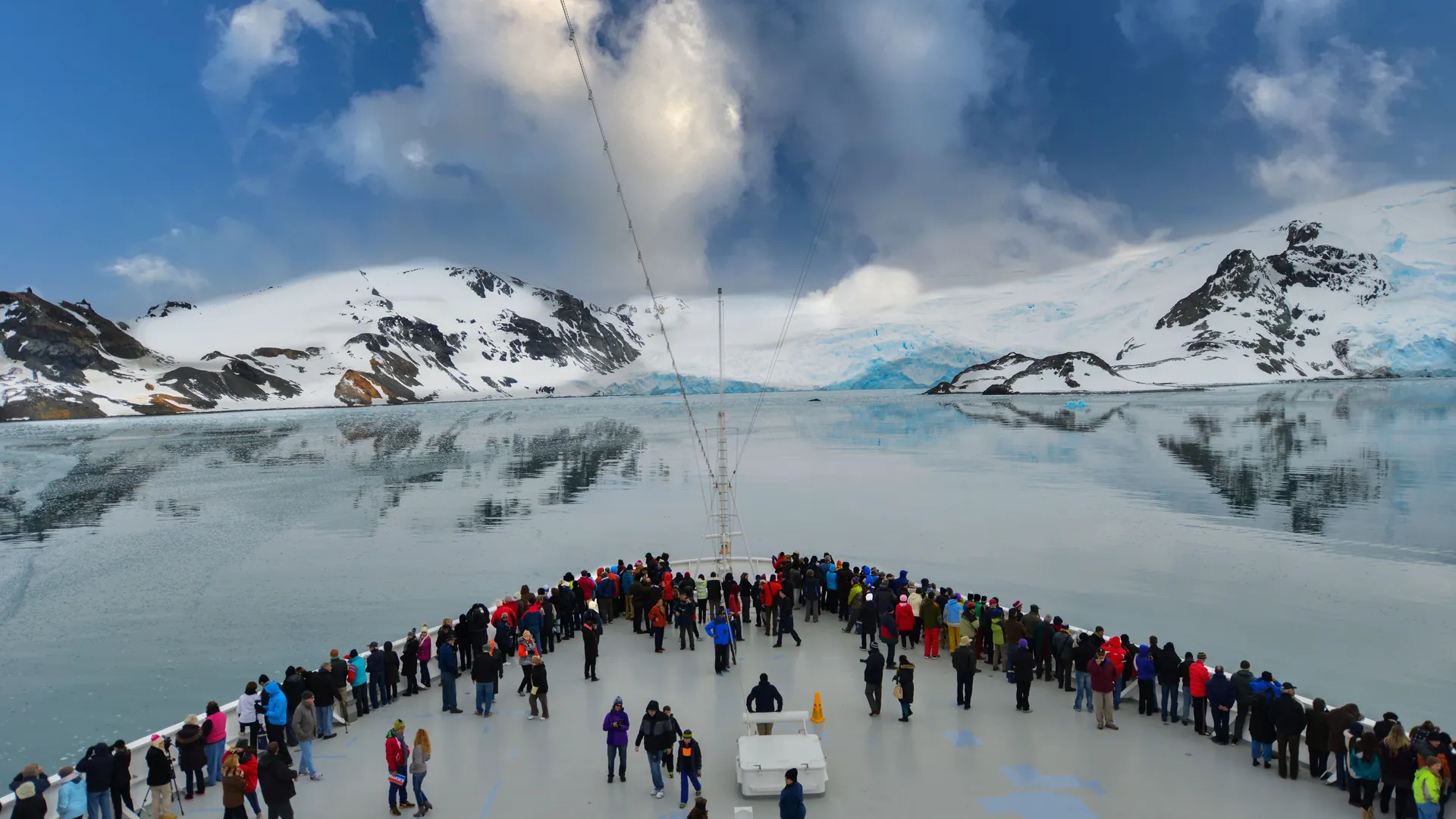
Photographs. Passengers lined along a ship’s bow facing Antarctic glaciers and mountains — Frans van Heerden, Pexels Cropped and resized for the web; not otherwise altered. Neither the photographers nor the licensors endorse this article.
This article is general information, not medical or safety advice. Ask a qualified professional about personal medical questions. OTGG is an independent travel advisor; this article contains no affiliate links. Cruise line and supplier policies, rates, promotions, inclusions, accessibility procedures and deposit schedules change — verify all details with the operator or an accredited travel advisor before booking or payment.
Planning Antarctica for a group with different needs?
Tell me who is traveling, their ages and how they like to travel. I will compare cabin arrangements and operators and list what to confirm in writing.
Begin the Journey