OTGG means Off The Grid Getaways, an independent travel advisory service. This guide focuses on logistics, documentation and written confirmation, not medical treatment decisions.
Sources and facts checked: September 19, 2026 (America/New_York). Medical capabilities, third-party programme availability, equipment rules and evacuation arrangements vary by ship, itinerary and sailing. Nothing here is medical advice. Check and verify with the cruise line and your own clinician before you book.
A cruise ship can carry medical equipment, supplies and an onboard medical centre. That does not mean it can provide continuous treatment for every chronic condition.
If you receive scheduled dialysis or depend on ongoing treatment, ask the cruise line specific questions before paying a deposit. Get the answers in writing, attach them to your reservation, and have your clinical team decide whether the itinerary is suitable.
Policies do not establish uninterrupted treatment capability for every ship or itinerary. Check and verify with the cruise line. availability and policy claim.]
What the cruise line should confirm
Ask the line’s access, special-services or medical department to answer these questions in writing:
- Does the specific ship accept your treatment modality?
- Does the line provide treatment, or must you bring and manage your own equipment?
- Is a third-party dialysis provider operating on the specific sailing?
- Can supplies be delivered to the port or vessel?
- Who clears the delivery with the ship and terminal?
- Where will equipment be stored?
- What power, water, drainage, refrigeration or waste-disposal arrangements are available?
- Which forms and medical documents are required?
- What notice period applies to your sailing?
- What happens if the itinerary changes, a port is skipped or the ship remains at sea longer than planned?
Your written confirmation should name the ship, sailing date, treatment type, equipment, supplier, delivery plan and any unresolved condition. “Medical needs noted” is not enough.

What selected cruise lines publish
Policies differ by operator and can change. The following examples show why you must verify the exact sailing rather than rely on a general internet answer.
Royal Caribbean
Royal Caribbean’s published accessibility material states that guests using continuous ambulatory peritoneal dialysis may sail, but must bring or arrange delivery of the necessary supplies and equipment, with the supplier contacting the Access Department to clear port delivery. It also states that the cruise line cannot assist with or administer hemodialysis. Self-administered hemodialysis is permitted under certain requirements set by the Access Department, and physician-assisted hemodialysis may be arranged through the independent provider Dialysis at Sea on selected sailings. Confirmed against Royal Caribbean’s own accessibility material on September 19, 2026.
Royal Caribbean lists dialysis-supply delivery among services requiring advance coordination. Its current material gives a 30-day notice point for special-needs equipment and services, with requests encouraged at booking. Confirmed on September 19, 2026.
The line’s Guest Special Needs information also says that hemodialysis guests should contact the Access Department. If the online form is unavailable, the published page directs guests to email [email protected] or call the Access Department on (866) 592-7225. Confirm the current contact route before sending private medical information. Confirmed on September 19, 2026.
Norwegian Cruise Line
Norwegian’s medical-needs page states that continuous ambulatory peritoneal dialysis guests may sail on all vessels, but must arrange for all solutions and equipment to be delivered to the ship on embarkation day, at least two hours before sailing. The page also states that NCL cannot assist with or administer hemodialysis and does not arrange dialysis in ports. Confirmed against NCL’s own medical-needs page on September 19, 2026.
NCL describes its onboard Medical Centre as able to address routine medical issues and initially stabilize serious conditions while further care is arranged. It is not a shoreside hospital or a substitute for scheduled specialty treatment. Confirmed on September 19, 2026.
NCL directs guests with medical needs to its Access Desk and Accessibility & Medical Questionnaire. Its published contact information identifies a 45-day general accessibility window, with longer notice for certain services. Confirmed on September 19, 2026.
Virgin Voyages
Virgin Voyages states that its health facilities are intended for emergencies and short-term medical needs, not specialised ongoing treatment. The line says Sailors undergoing peritoneal dialysis may bring their own equipment, but it does not describe routine onboard hemodialysis as a standard service. Check and verify with the cruise line. equipment and treatment policy.]**
Virgin also directs guests to complete its Accessibility and Medical Request Form and contact Sailor Services as early as possible. Its published guidance refers to a 45-day advance-notice period for accessibility and medical requests. Check and verify with the cruise line. deadline and form.]**
The written policy is useful because it separates emergency medical care from chronic-treatment logistics. Ask Virgin to confirm, in writing, exactly how your equipment will enter, where it will be kept and what support, if any, the ship will provide.
Carnival Cruise Line
Carnival’s published accessibility and medical materials identify dialysis as a specific pre-cruise request category. The line’s documentation states that the ships do not provide kidney specialists, dialysis equipment or supplies, and that onboard staff do not supervise hemodialysis. Check and verify with the cruise line. medical capability.]
Carnival permits self-administered peritoneal dialysis subject to its requirements. Guests should expect to bring their own supplies and complete the applicable dialysis and medical forms. Check and verify with the cruise line. treatment and documentation policy.]
The current Carnival material links to a dedicated Dialysis Form. Do not assume that submitting the form equals approval; request a written response identifying what the line has accepted and what remains your responsibility.
Holland America Line
Holland America is worth adding as a fifth example because its published requirements differ from the four lines above in two ways that matter clinically rather than administratively. Its official guidance states that guests must be stable on dialysis for at least 12 months before travelling, and must obtain medical clearance with a prescription written for the specific itinerary. The same guidance states that the ships do not carry backup battery support for dialysis equipment.
Confirmed against Holland America’s own published guidance on September 19, 2026.
That 12-month stability requirement is the clearest illustration of the article’s central point. It is not a booking formality. It is a clinical threshold set by the line, which means a traveller whose treatment
started recently may be unable to sail this itinerary at all — and no amount of planning around equipment delivery changes that.
Third-party onboard dialysis is different
Dialysis at Sea describes itself as an independent provider offering hemodialysis care on selected sailings with Royal Caribbean and Celebrity. It does not operate on Norwegian, Virgin Voyages or Carnival sailings, which is why those lines’ own published policies matter separately. Its description refers to a renal-care team that includes a nephrologist, dialysis nurses and certified technicians. Treatment takes place in the ship’s infirmary, with dialysis orders matched to the guest’s land-based prescription, and capacity is limited to 12 patients per sailing on a first-come, first-served basis. The provider can be reached on +1 800 544 7604. Confirmed against the provider’s own published materials on September 19, 2026.
That 12-patient cap is the availability limit stated in plain terms. It is also the reason a sailing marketed with onboard dialysis is not the same thing as a sailing with a place for you on it. None of this means the cruise line’s own medical centre provides dialysis.
Before booking a sailing marketed with onboard dialysis, request written confirmation from:
- The dialysis provider.
- The cruise line’s access department.
- Your clinical team.
- Your insurer or assistance provider.
Confirm the treatment schedule, equipment, supplies, medical records, payment terms, cancellation rules and what happens if the ship changes course. Any treatment charge, provider fee or insurance requirement must be quoted and verified in writing. Check and verify with the cruise line. all fees and financial terms.
Medicare and Medicaid do not cover dialysis at sea. Dialysis at Sea’s own published FAQ states that Medicare and Medicaid have never covered dialysis on the cruises it offers, although some supplemental insurers will reimburse a percentage and the provider supplies itemised statements for claims. Treatment pricing for 2026 is reported in the region of $250 to $425 per treatment, with some third-party estimates higher. Check and verify with the cruise line. the non-coverage** position and the pricing range.
That catches people out. Many travellers assume Medicare travels with them. Confirm in writing whether your specific policy, supplement or assistance provider reimburses dialysis at sea, and get that answer before paying a deposit rather than after.
What the ship’s medical centre can and cannot do
NCL describes its onboard centre as equipped for routine care and initial stabilisation. Virgin describes its facilities as intended for emergencies and short-term needs. These statements establish a boundary: the medical centre may respond to an unexpected event, but it is not automatically your scheduled treatment provider. Check and verify with the cruise line. line-specific capabili-** ty.]
Ask the cruise line to confirm:
- Whether a doctor or nurse with relevant specialty training is assigned to the ship.
- Whether the centre can store your medication or equipment.
- Whether it can provide emergency oxygen or other emergency support.
- Whether staff can dispose of treatment-related waste.
- Whether medical records can be shared with your clinical team.
- How charges are posted and whether direct insurance billing is unavailable.
OTGG’s related guides cover shipboard medical costs and cruise medical preparation. For the paperwork side of equipment and assistance requests, also review Cruise Accessibility: Deadlines and the Paper Trail, then confirm the current rule with the line.
Itinerary distance changes the planning problem
A treatment plan that depends on a port clinic, hospital or rapid evacuation is affected by sea days, remote waters, weather, port closures and itinerary changes.
No cruise line can guarantee a fixed evacuation response time for every location. A ship may stabilise a guest while arranging transfer, but the destination, transport method and timing depend on the clinical situation, weather, maritime conditions and available shoreside care. Check and verify with the cruise line. evacuation limitation.]
Ask the line and insurer:
- What is the nearest planned medical facility on each itinerary segment?
- Is the itinerary unusually remote or sea-day heavy?
- What happens if a scheduled treatment port is missed?
- Is evacuation covered from the ship?
- Is repatriation home covered separately?
- Must the assistance provider approve transport first?
- What expenses must be paid onboard before reimbursement?
Your clinical team (not the cruise line, travel advisor or internet forum) must decide whether the treatment schedule and itinerary are compatible.
Devil’s Advocate: permission is not continuity
A line may permit equipment onboard without providing treatment.
A supplier may promise delivery without controlling terminal security, port access or a last-minute berth change.
A ship may carry emergency equipment without having the staff or infrastructure to manage your ongoing condition.
A third-party dialysis provider may operate on selected sailings without being available on the next sailing of the same ship.
That is why “allowed onboard” is only the beginning. The useful question is: Who is responsible for each treatment-related task, and what is the backup if that task fails?

Verify before you pay
- Identify the exact ship, sailing date and itinerary.
- Confirm the treatment modality in writing.
- Ask whether the service is cruise-line provided or third-party provided.
- Obtain written confirmation of equipment approval.
- Confirm delivery address, port clearance, storage and collection.
- Ask about power, water, drainage, refrigeration and waste.
- Submit the required form at booking or within the applicable notice window. Check and verify with the cruise line. all deadlines.]
- Obtain clinical clearance from your own treatment team.
- Ask the insurer to confirm treatment, evacuation and repatriation coverage.
- Confirm whether Medicare, Medicaid, a supplement or a private policy covers dialysis at sea, and get the answer in writing.
- Request all provider fees and payment terms in writing. Check and verify with the cruise line. fees.]
- Reconfirm every arrangement 48 hours before departure. Check and verify with the cruise line. reconfirmation timing.]
- Carry essential documents and supplies in your hand luggage where permitted.
- Ask Guest Services to confirm the arrangements again after boarding.
Editorial and health disclosures
OTGG advisory disclosure: Off The Grid Getaways (OTGG) provides independent travel-planning information and may help travelers compare suppliers and request written confirmations. This informational article is not a guarantee that any cruise line, medical provider, insurer or vendor will accept a particular arrangement.
Frequently asked
Does a cruise ship provide dialysis?
Some selected sailings may carry an independent dialysis provider. Many cruise lines do not provide routine hemodialysis through their own medical centres. Confirm the exact sailing in writing. Check and verify with the cruise line. availability.]
Can I bring peritoneal dialysis equipment?
Several lines publish policies allowing guests to bring their own peritoneal dialysis equipment and supplies, subject to advance notification and documentation. The exact delivery, storage and waste rules vary. Check and verify with the cruise line. policy.]
Can the ship’s doctor provide my scheduled treatment?
Do not assume so. A shipboard medical centre is generally designed for emergency care, routine issues and stabilisation, not guaranteed ongoing specialty treatment. Check and verify with the cruise line. capability.]
What if the ship misses a port where treatment was planned?
The cruise line may not be able to provide an alternative treatment arrangement. Ask this question before booking and have your clinical team and insurer review the contingency plan.
Sources and facts checked: September 19, 2026 (America/New_York). Cruise line medical and accessibility pages and third-party onboard dialysis programme information were reviewed on the date shown.
Sources
- royalcaribbean.com — Royal Caribbean Guest Special Needs ↗
- royalcaribbean.com — Royal Caribbean equipment and advance-notice information ↗
- ncl.com — NCL Medical Needs ↗
- nclh.my.salesforce-sites.com — NCL Accessibility & Medical Questionnaire ↗
- virginvoyages.com — Virgin Voyages Accessibility and Additional Assistance ↗
- help.carnival.com — Carnival Shipboard Medical Services FAQs ↗
- carnival.com — Carnival Guests With Disabilities ↗
- dialysisatsea.com — Dialysis at Sea ↗
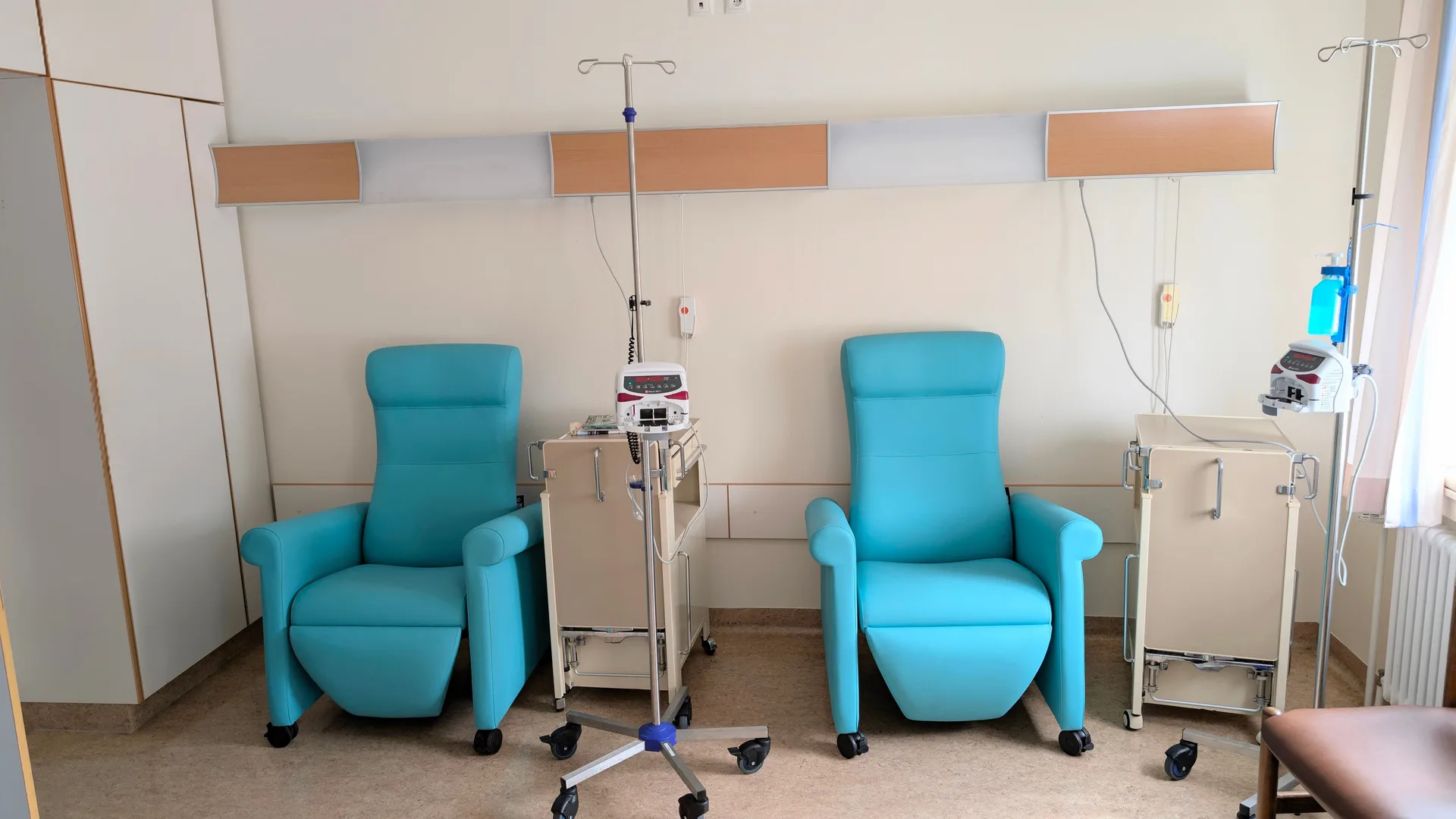
Photographs. A calm clinical treatment room with infusion chairs — Andre, Pexels Cropped and resized for the web; not otherwise altered. Neither the photographers nor the licensors endorse this article.
This article is general information, not medical advice. Consult your own clinician. OTGG is the travel-planning platform of Paolo Melendez, an independent travel advisor. This article contains no affiliate links. Policies, fares and programme terms change — verify with the cruise line, insurer or an accredited travel advisor before booking or paying.
Travelling with dialysis or a condition that needs planning?
Tell me the treatment schedule and the equipment involved. I will find out what the ship can genuinely support, what has to be arranged with a third party, and which itineraries keep you near a hospital.
Begin the Journey






















