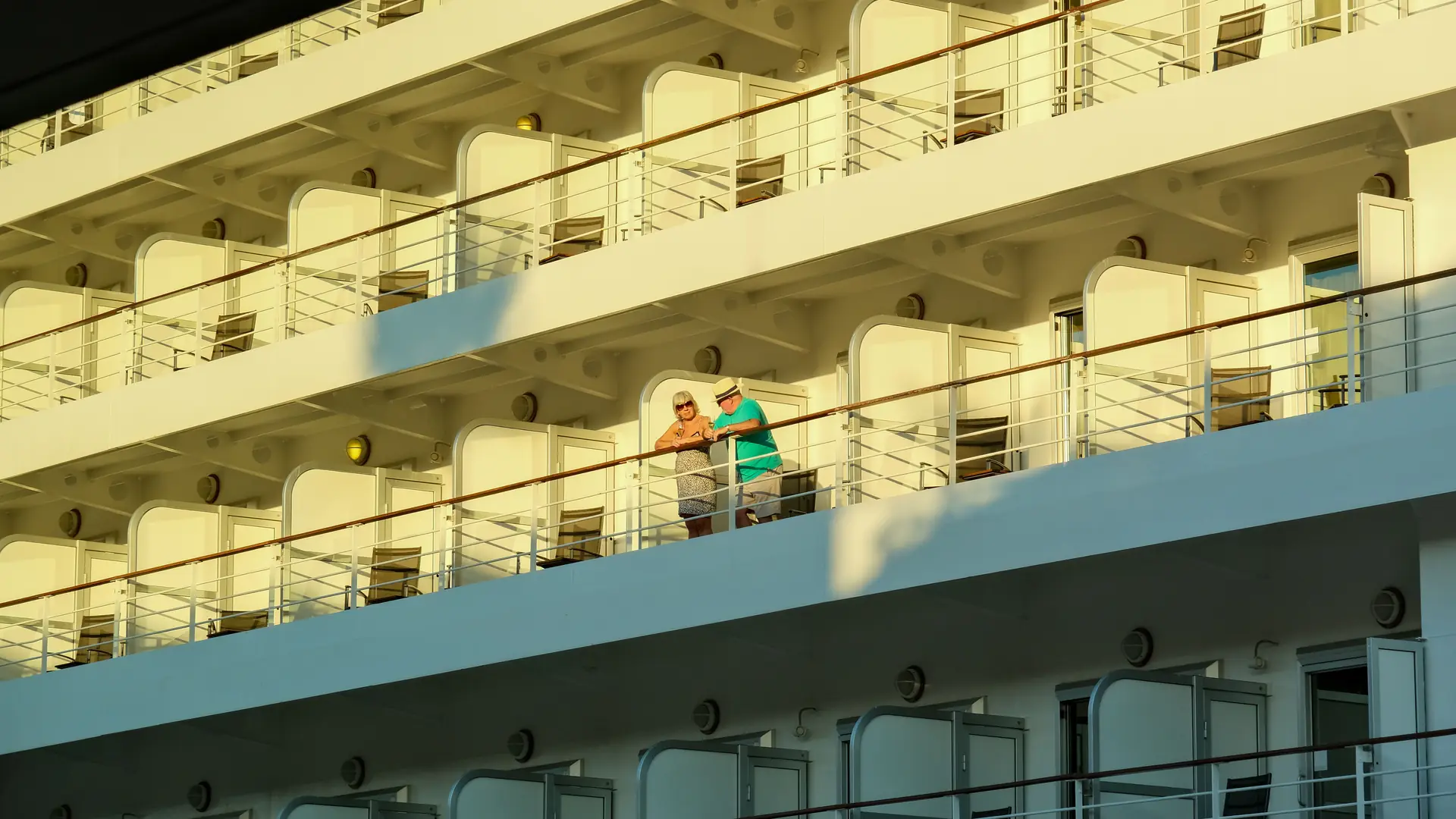
The cabin you book is not just an interior, oceanview, balcony, or suite. It is a location decision.
Sources and facts checked: September 22, 2026 (America/New_York). Deck plans, cabin configurations and assignment policies change with refurbishments and differ between sister ships. Nothing here guarantees a quiet cabin — check and verify the exact cabin with the cruise line in writing before you pay.
A beautiful balcony can feel less beautiful when the theater is directly below it. A discounted cabin can become a 6 a.m. chair-scraping alarm clock when it sits under the pool deck. A guarantee fare can save money, but it can also remove your ability to choose where you sleep.
The good news: deck plans give you more information than most booking pages make obvious. You just need to read them vertically, not only horizontally.
Deck plans show layout, not noise
A deck plan can tell you where your cabin sits. It usually cannot promise how that location will sound at 7 a.m., midnight, or during docking.
Look beyond the cabin number. Check:
- The deck directly above
- The deck directly below
- The cabins, venues, elevators, and service areas beside you
- The ship’s forward, midship, and aft zones
- Connecting-door symbols, accessible-cabin symbols, and obstructed-view notes
- Blank or unlabeled spaces that may indicate crew, storage, laundry, or technical areas
Forbes’ May 2026 cabin-noise reporting makes the central point well: the spaces surrounding your cabin often matter more than the cabin category itself.
Use the current deck plan for your exact ship. Sister ships may not have identical layouts, and refurbishments can move venues, alter corridors, or change cabin configurations.

Use the cabin sandwich method
The safest default for a quieter cabin is the cabin sandwich.
Choose a cabin with:
- Passenger cabins above
- Passenger cabins below
- Passenger cabins on both sides
- No public venue, service area, elevator lobby, or stairwell directly beside it
This does not guarantee silence. You may still hear your neighbors, hallway traffic, plumbing, or the ship itself. It simply reduces the number of predictable noise sources surrounding your room.
To test a candidate cabin:
- Find the exact cabin on the official deck plan.
- Open the deck plan for the level above.
- Align the bow, stern, elevator banks, and cabin corridors.
- Confirm that another passenger cabin sits above your room.
- Repeat the process for the deck below.
- Scan the same corridor for elevators, stairs, crew doors, laundry rooms, and connecting cabins.
- Reject the cabin if a major venue touches it, even if the category and price look attractive.
A midship cabin on a middle or lower passenger deck is often a sensible starting point for travelers balancing motion, access, and noise. But do not treat “midship” as a magic word. A midship cabin under a nightclub is still under a nightclub.
Noise zones to avoid
Under pools, sports decks, and Lido areas
Pool decks can create early-morning noise from loungers, carts, cleaning equipment, music, and setup activity. The issue is not necessarily the pool itself. It is everything the crew and guests do around it.
Avoid cabins directly below pool decks, outdoor dining areas, sports courts, and waterslide approaches when quiet sleep matters.
Below buffets, restaurants, and galleys
Buffets and casual dining venues produce more than guest conversation. Think food carts, dish handling, kitchen activity, chair movement, and cleaning.
The galley may operate on a schedule that does not match yours. A cabin beneath a restaurant can be peaceful during dinner and surprisingly active when the rest of the ship is asleep.
Above theaters, nightclubs, and live-music venues
This is the classic upgrade that backfires.
A balcony above the theater may look central and convenient. It may also receive bass vibration, rehearsal noise, show traffic, and late-night cleanup. Nightclubs, lounges, casinos, and atrium stages create similar risks.
Read the deck below, not only the deck you want to book.
Beside elevators and stairwells
Elevator banks are convenient, especially for guests with limited mobility. But the cabin directly beside one can experience:
- Foot traffic
- Conversations
- Elevator chimes
- Door slams
- People gathering while they wait
- Service bells or crew movement
If you need elevator access, aim for nearby but not immediately adjacent. Ask the cruise line or advisor to identify a cabin a short distance from the lift, rather than placing you directly beside the lobby.
Beside crew corridors, laundries, and service areas
Crew doors, service corridors, pantries, laundry rooms, and storage spaces may be active early and late. A blank rectangle on a deck plan is not automatically harmless.
If the plan is unclear, ask the cruise line to confirm what sits beside, above, and below the cabin. Get the answer in writing.
Extreme forward and extreme aft locations
Lower forward cabins can experience anchor or bow-thruster noise during arrival and departure. Low aft cabins may experience vibration or machinery hum.
These effects vary by ship and sailing conditions. They are not automatic dealbreakers, but they are worth considering if you are a light sleeper or sensitive to motion.
GTY: what “guarantee” actually means
A GTY, or guarantee, fare means you purchase a cabin category while allowing the cruise line to choose the exact cabin number and location.
You may select:
- Interior
- Oceanview
- Balcony
- Suite
But the cruise line may assign the exact room later, often closer to sailing. The assignment can be forward, aft, high, low, near an elevator, under a public deck, or beside a service area.
The tradeoff is straightforward:
- Potential benefit: Lower price and, occasionally, an operational upgrade
- Cost: Less control over location, view, motion, noise, and proximity to travel companions
CruiseBooking’s GTY explainer, updated in July 2026, describes the arrangement as choosing a cabin category without selecting the exact room.
A GTY fare can work for a flexible solo traveler who views the cabin as a place to sleep and is comfortable with uncertainty. It is a poor fit when you need:
- A specific accessible layout
- A particular location for mobility reasons
- Connecting or nearby cabins
- Reduced motion
- A quiet cabin
- A specific view or balcony orientation
Never book a guarantee cabin assuming the line will honor a quiet-room request. A request may be noted, but it is not the same as a confirmed cabin assignment.
Request a cabin change strategically
If your cabin is assigned and the location is a problem, ask promptly. Availability usually gets worse as sailing approaches.
Prepare three acceptable alternatives before contacting the cruise line or advisor:
- Your preferred cabin
- Your second-choice cabin
- Your third-choice cabin
Give the request in writing. Include:
- Reservation number
- Ship and sailing date
- Current cabin number
- Three alternative cabin numbers
- The reason for the request
- Any accessibility, sensory, medical, or mobility considerations
- The areas you need to avoid
Use specific language:
Please review whether cabin 8234 can be changed to 8228, 8226, or 8218. We are requesting a cabin with passenger cabins above, below, and beside it, away from public venues, service areas, elevator banks, and stairwells.
If you need quiet, say so directly. “A good location” is subjective. “Away from the theater, nightclub, pool deck, buffet, galley, crew corridor, elevators, and stairwell” is actionable.
Do not treat an agent’s phone call as the final record. Request written confirmation from the relevant cruise line or booking provider showing the new cabin number and any documented location notes.
Accessibility and mobility: balance distance with traffic
Accessibility planning adds another layer. The quietest cabin is not always the most practical cabin.
Consider:
- Distance to elevators
- Width and layout of the cabin entrance
- Bathroom configuration
- Turning space
- Storage for a wheelchair or scooter
- Accessible route to dining and public spaces
- Distance and route to the assigned muster or assembly station
- Whether crew assistance is available during safety procedures
Do not assume that “near an elevator” means “accessible.” Confirm the complete route.
Cruise lines publish different systems and terminology. For example:
- Virgin Voyages identifies Ambulatory and Fully Accessible Cabins, with the latter designed for regular wheelchair, scooter, or similar mobility-device use.
- Norwegian Cruise Line explains its accessibility coordination process and asks guests to document transportation, stateroom, and excursion needs.
- Royal Caribbean publishes accessible-stateroom features and its Guest Special Needs Form.
- Carnival provides accessible deck plans and interactive stateroom information.
Book the exact accessible cabin when you need the features. Do not rely on a GTY category.
Also remember that emergency routes may follow safety procedures different from normal guest circulation. Ask the cruise line to confirm the assigned muster station, the practical route from your cabin, and what assistance is available. Request that the response be documented on your reservation or provided by email.
For additional context, see OTGG’s Cruise Accessibility: Deadlines and the Paper Trail and The Complete Accessible Cruise Guide to Royal Caribbean.
Solo and group cabin strategy
Solo travelers often have more flexibility, but that does not mean location becomes irrelevant.
A Studio or other dedicated solo cabin may offer efficient pricing and access to a solo community. Its location still depends on the ship’s design. Check the exact deck plan rather than assuming every Studio is quiet, central, or close to the elevator.
Virgin Voyages solo travelers may compare an Insider, Sea View, or Sea Terrace against the total price of a standard cabin with a single supplement. The best-value category is not automatically the best-located one. OTGG’s honest Virgin Voyages review and NCL 2026 pricing guide offer related solo-planning context.
For groups, decide which matters most:
- Cabins directly beside one another
- Connecting doors
- A quieter corridor
- Accessible placement
- Shared proximity to elevators
- Matching cabin categories
Connecting rooms are useful for families and friends, but the shared door can transmit more sound. A multi-generational group may reasonably prioritize connection over absolute quiet. Confirm the configuration and exact cabin numbers in writing.
When an upgrade backfires
An upgrade is only an upgrade if it improves the trip you actually want.
A larger balcony under the pool deck may be worse for a light sleeper than a smaller balcony surrounded by cabins. A higher deck may offer a better view but more motion. A central cabin above a theater may be less relaxing than a lower cabin farther down the corridor.
Before accepting an upgrade, compare:
- Exact cabin number
- Deck above
- Deck below
- Nearby venues
- Distance from elevators and stairs
- Connecting-door status
- Obstructed-view notes
- Accessibility features
- Distance to the group’s other cabins
Never accept “higher category” as shorthand for “better location.”

Devil’s Advocate: the perfect cabin can still be noisy
The cabin sandwich is a strong strategy, not a guarantee.
A cabin surrounded by other cabins can still experience:
- Noisy neighbors
- Hallway traffic
- Plumbing sounds
- Door slams
- Weather-related movement
- Operational vibration
- Noise from a venue that the deck plan does not clearly label
- A layout that changed after refurbishment
Sister ships can behave differently. Two cabins with the same number on related ships may not have the same surrounding spaces. A deck plan can also lag behind a refurbishment or show a simplified version of a complicated service area.
GTY bookings have fine print, too. You may receive the category purchased, but a complimentary upgrade is not guaranteed, and a location request may not control the assignment.
The honest position is this: use the deck plan to remove avoidable risk. Do not use it to promise silence.
Verify before you pay
Before confirming your cruise cabin:
- Open the current official deck plan for the exact ship.
- Confirm the ship name and current configuration.
- Check the deck directly above the cabin.
- Check the deck directly below the cabin.
- Confirm passenger cabins sit above and below.
- Scan both sides for venues, crew corridors, laundries, and service doors.
- Check the distance from elevator banks and stairwells.
- Look for connecting-door symbols.
- Check for obstructed-view or unusual-layout notes.
- Avoid GTY if location, accessibility, or group proximity matters.
- For solo cabins, compare the exact location, not only the category price.
- For groups, confirm every cabin number in writing.
- For accessible travel, confirm the exact cabin features, route, muster location, and mobility-device requirements.
- Request written confirmation from the cruise line, accessibility department, or accredited travel advisor.
- Save the deck plan and written confirmation with your reservation documents.
- Recheck the live deck plan before final payment and again before departure.
Frequently asked
Is midship always the quietest cabin location?
No. Midship can reduce motion and shorten walking distances, but a midship cabin beside an elevator, under a buffet, or above a theater may still be noisy. Surrounding spaces matter more than the word “midship.”
Are cabins under the pool deck always bad?
No, but they carry a predictable noise risk from deck chairs, carts, cleaning, and activity. If quiet sleep is a priority, choose a cabin with passenger cabins above it instead.
Should I avoid a GTY fare?
Avoid GTY when you need control over location, accessibility, motion, or group proximity. Consider it only when the savings justify the uncertainty and you can accept almost any cabin within the purchased category.
Can I request a quiet cabin?
Yes. Submit a specific written request and provide three acceptable cabin numbers. Treat the request as a preference unless the cruise line confirms the cabin change or assignment in writing.
Are cabins near elevators good for accessible travel?
They may reduce walking or rolling distance, but the cabin directly beside the elevator lobby may have more foot traffic and door noise. Ask for a cabin near, but not immediately adjacent to, the elevator bank when possible.
Do sister ships use the same deck plans?
Not necessarily. Related ships may differ in cabin numbering, public spaces, service areas, and post-refurbishment layouts. Always use the plan for the exact ship and sailing.
Sources and facts checked: September 22, 2026 (America/New_York). Forbes’ May 2026 cabin-noise reporting, CruiseBooking’s guarantee-fare explainer, and accessible-cabin pages from Virgin Voyages, Norwegian Cruise Line, Royal Caribbean and Carnival were reviewed on the date shown. Use the current official deck plan for your exact ship and get cabin assignments confirmed in writing.
Sources
- Forbes — Forbes’ May 2026 cabin-noise reporting ↗
- CruiseBooking — CruiseBooking’s GTY explainer ↗
- Virgin Voyages — Virgin Voyages identifies Ambulatory and Fully Accessible Cabins, ↗
- Norwegian Cruise Line — Norwegian Cruise Line explains its accessibility coordination process ↗
- Royal Caribbean — Royal Caribbean publishes accessible-stateroom features and its Guest Special Needs Form ↗
- Carnival Cruise Line — Carnival provides accessible deck plans and interactive stateroom information ↗
Photographs. Two travelers on a cruise ship balcony — Nemika F, Pexels Cropped and resized for the web; not otherwise altered. Neither the photographers nor the licensors endorse this article.
This article is general information, not medical, legal, financial or safety advice. OTGG is an independent travel advisor; this article contains no affiliate links. Cruise line and supplier policies, rates, promotions, inclusions, accessibility procedures and deposit schedules change — verify all details with the operator or an accredited travel advisor before booking or payment.
Want someone to read the deck plan with you?
Send me the ship and the cabins you are considering. I will check the decks above and below, flag noise and access risks, and put a specific cabin-change request in writing if the assignment is wrong. Solo? See our cabin-for-one guide.
Begin the Journey






















