Cruising with a mobility scooter or power chair is manageable. It is not, however, a “show up at the pier and see what happens” situation.
Sources and facts checked: September 18, 2026 (America/New_York). Device rules, cabin dimensions, battery policies and tender limits vary by ship and sailing. Check and verify with the cruise line in writing before you pay.
You need the right cabin, accurate device measurements, a documented accessibility request, and written confirmation from the cruise line. You also need a shore plan that accounts for tenders, transfer vehicles, excursion limits, and the possibility that an accessible ship does not make every port accessible.
The expensive lesson is simple: approval of the passenger does not always equal approval of the device.
Start With the Device, Not the Cruise Fare
Before comparing itineraries, measure your scooter or power chair at its widest point.
Record:
- Overall width, including armrests, mirrors, controls, and wheels
- Length
- Height
- Weight
- Turning radius, if available
- Whether it folds or disassembles
- Number of pieces when disassembled
- Battery type and charger specifications
Do not rely on the manufacturer’s “travel width” unless that is the actual width of the device you will bring. A removable armrest, side basket, joystick, or control panel can change the measurement that matters at the cabin door.
Cruise lines commonly require the device to fit through the stateroom door and be stored entirely inside the cabin. If the device cannot be safely accommodated under the applicable cruise-line policy, boarding may be denied. Confirm the exact device and cabin requirements before travel.
The U.S. Department of Transportation recognizes mobility devices as part of passenger-vessel accessibility requirements, but cruise lines may still impose reasonable size, storage, battery, and safety limits. See the DOT passenger-vessel guidance (. Check and verify with the cruise line.) and
the ADA guidance on other power-driven mobility devices (. Check and verify with the cruise line.).

Storage and Charging Stay Inside the Stateroom
The operating rule across the major lines is straightforward:
Store and charge the scooter or power chair inside your stateroom.
Do not leave it:
- In the corridor
- Outside your cabin door
- In an elevator lobby
- In a stairwell
- Near a fire door
- In a public-area circulation path
- In a restaurant, theater, or lounge as unattended parking
Cruise lines frame this as a fire-safety and emergency-evacuation requirement. Corridors, stairways, elevator lobbies, and fire-door areas must remain clear. This is connected to the ship’s safety obligations and SOLAS-related evacuation requirements, but do not interpret that as one universal statute dictating identical rules on every ship. The specific storage rule comes from the cruise line’s policy.
Royal Caribbean, Norwegian Cruise Line, Carnival, and Virgin Voyages all publish versions of this requirement:
- Royal Caribbean mobility guidance
- Norwegian Cruise Line mobility guidance
- Carnival wheelchair and mobility-device guidance
- Virgin Voyages mobility guidance
Accessible cabins usually provide more floor space for turning and positioning the device. That does not mean every accessible cabin will fit every device. You still need to confirm the exact ship, cabin category, cabin number, door width, bathroom layout, and charging arrangement.
Declare the Device Before You Pay
Declare the scooter or power chair at booking, or immediately after booking if the need arises later.
Use the cruise line’s accessibility or special-needs process. Provide:
- Device type and model
- Width, length, height, and weight
- Battery type
- Charger details
- Folding or disassembly information
- Whether you require regular use of the device
- Whether you need an accessible cabin
- Any assistance required during embarkation or disembarkation
Do not treat a note in an online booking profile as final approval. Ask the accessibility team to confirm that the specific device is acceptable for the specific ship and stateroom.
Failure to declare the device can create serious problems. Depending on the line’s policy, an undeclared or incompatible device may be refused at embarkation. If you cannot safely travel without it, that may effectively prevent you from boarding.
Virgin Voyages’ ticket contract states that guests must notify the line in advance of “special medical, physical or other requirements” and that “any medical equipment requiring use on board must be disclosed no later than 30 days prior to embarkation and approved by us for use on board” (. Check and verify with the cruise line.; quote current contract language precisely at publication and confirm with Virgin Voyages). Royal Caribbean requires guests bringing motorized wheelchairs or scooters to submit special-needs information and warns that size limitations may apply; the line’s Access Department contact is (866) 592-7225 or [email protected]**. NCL states that medical equipment must be advised in advance so it can be cleared before sailing.
The safest rule is less glamorous but much more useful — do not pay the final balance until you have written confirmation from the cruise line that your device, cabin, and sailing are compatible.
Which Lines Require an Accessible Cabin?
Policies vary. Do not assume that an accessible cabin requirement on one line applies identically to another.
| Cruise line | Published policy position | What to confirm in writing |
|---|---|---|
| Virgin Voyages | Guests bringing wheelchairs or scooters are directed toward a Fully Accessible Cabin; Virgin’s current mobility guidance indicates that non-folding or non-collapsible devices should be stored in an accessible cabin, so treat a Fully Accessible Cabin as the default direction for powered devices that do not fold (per the line’s current published guidance; confirm with the Access Department;. Check and verify with the cruise line.). | Whether your exact device requires a Fully Accessible Cabin and where it can be charged. |
| Norwegian Cruise Line | Motorized devices are accepted in accessible staterooms. NCL’s current mobility guidance states that in a non-accessible stateroom, “your motorized wheelchair or scooter cannot exceed 26 inches in width to enter the stateroom door” (per the line’s current published guidance; confirm with the Access Department;. Check and verify with the cruise line.). | Device clearance, battery type, charger voltage, and whether your chosen cabin has adequate storage. |
| Royal Caribbean | The device must fit through the stateroom door and be stored and charged inside. Royal Caribbean’s published specifications state that standard stateroom doors have a minimum width of 23 inches and accessible stateroom doors at least 32 inches. | Exact door width for your ship and cabin, plus whether the device can be stored without blocking the exit. |
| Carnival | Carnival’s current published guidance says standard and ambulatory-accessible cabins have an entry doorway of about 22 inches, and that to book a standard cabin the mobility device must fit through that doorway and collapse or fold for storage (per the line’s current published guidance; confirm with the Access Department;. Check and verify with the cruise line.). Larger devices generally require a modified or accessible cabin. | Exact cabin compatibility, scooter-size attestation, and what happens if the device does not fit at check-in. |
Review the line’s current accessibility pages before booking. Policies, forms, cabin inventories, and technical requirements can change without much fanfare.
For additional background, read OTGG’s Cruise Accessibility: Deadlines and the Paper Trail and The Complete Accessible Cruise Guide to Royal Caribbean.
Door Width Is Only the First Measurement
A door can be wide enough while the cabin is still functionally unusable.
Check:
- Entry-door width
- Threshold height
- Clearance from the door to the bed
- Turning space beside the bed
- Bathroom entrance width
- Shower entry and turning space
- Location of the outlet
- Space needed to charge without blocking the exit
- Whether the bed, desk, or chair can be moved
- Distance from the cabin to the elevator
A standard cabin may have a doorway that technically accommodates a compact device but leaves no practical place to turn or park it. A power chair user may need a fully accessible cabin even when the chair fits through a standard door. Royal Caribbean publishes a five-foot turning radius in the sleeping areas, bathrooms, and sitting areas of its accessible staterooms, which is the kind of functionalusable-space detail that matters beyond the door itself. Royal Caribbean also publishes that accessible bathroom doors measure 32 to 34 inches depending on the vessel, and that accessible bathrooms have roll-in showers, grab bars, and no threshold.
Ask for the measurements of the exact cabin category on the exact ship. Do not rely on a generic fleet-wide diagram.
Charging Requires Its Own Plan
Cruise cabins are not designed like personal garages. Outlet locations may be awkward, limited, or shared with other equipment.
Before sailing, confirm:
- Ship voltage and charger compatibility
- Whether the charger is approved for onboard use
- Whether an extension cord is permitted
- Whether a power strip or surge protector is prohibited
- Whether the outlet is near a safe parking position
- Whether the device can remain plugged in without blocking the cabin exit
- Whether a backup battery may be carried and used
- Whether the battery must be removed or handled in a specific way
Never assume that an extension cord will be allowed simply because it works at home. Some lines restrict extension cords, power strips, or surge-protection devices. Ask the line to approve the setup in writing before departure.
Battery rules also differ. NCL’s published guidance includes requirements around gel-cell batteries and charger compatibility. Carnival lists permitted battery categories including gel, dry cell, AGM, and lithium-ion devices. Virgin’s public guidance emphasizes advance declaration and safety assessment rather than promising one universal battery setup.
Bring the manufacturer’s battery and charger documentation. Keep it with your travel paperwork.
Tenders Can Change the Itinerary
A ship may be accessible while the port transfer is not.
A tender port uses a smaller boat to move passengers between the anchored cruise ship and shore. Motorized devices may not be accepted on tenders unless roll-on capability is available. Roll-on capability is not guaranteed, and the vessel or operator may make the final safety decision.
Virgin Voyages states that motorized wheelchairs and mobility scooters are not permitted on tenders unless roll-on capability is available. Other lines use similar language and reserve the final decision for the ship’s crew.
Before booking, ask:
- Which ports on the itinerary are tender ports?
- Can the specific scooter or power chair go ashore?
- Is roll-on tender access available?
- Can a lightweight folding chair be used as an alternative?
- Can the excursion vehicle accept the device?
- What happens if the tender is technically accessible but conditions make boarding unsafe?
Read OTGG’s Accessible Shore Excursions: Coach-Step vs. Adapted Vehicle before booking a tour. Some Carnival excursion listings specify a maximum combined guest-and-device weight limit for lift use, such as 450 pounds on certain accessible Bermuda listings. That figure is an example, not a universal standard. Ask the cruise line or excursion operator to confirm the current limit in writing.
For a tender-specific planning example, see OTGG’s Grand Cayman Cruise Port: 8 Hours, Tender Only.
Solo, Group, and Multigenerational Planning
Solo travelers using powered mobility devices need more than an accessible cabin. Build a plan for:
- Embarkation assistance
- Device delivery or rental
- Shore days when the device cannot go ashore
- Emergency communication
- Independent dining and entertainment access
- A backup plan if the device fails
If you are traveling with a group, do not assume that a companion’s cabin can become overflow storage. The device must remain in the user’s cabin unless the cruise line provides a written alternative.
For multigenerational families, choose cabin locations carefully. An accessible cabin near an elevator may support the device user, but placing every family member nearby can create congestion. Plan shared time around the traveler’s pace rather than treating accessibility as a side note.
For LGBTQ+ groups and solo travelers joining a hosted or informal cruise community, confirm that meetups, transfers, and shore excursions are accessible before advertising them to the group. “Everyone is welcome” needs to include the route to the venue.
Devil’s Advocate — When a Cruise May Not Be the Right Fit
Cruising offers useful advantages: one unpacking, accessible routes onboard, and a broad range of cabin choices. It is not automatically the easiest accessible vacation.
Consider the harder possibilities:
- Your device may be allowed in principle but too large for the available cabin.
- An accessible cabin may be sold out even when standard cabins remain.
- The line may approve the form but reject the device after measuring it.
- A rental scooter may be smaller but is not automatically guaranteed, delivered, or available after a failure.
- Tender ports may leave you onboard while the rest of your group goes ashore.
- A shore excursion may advertise “accessible” but still have a weight, lift, step, transfer, or vehicle limitation.
- A power chair battery failure at sea may not have an immediate replacement; plan accordingly and confirm spares/rental options before sailing.
- The cruise line may not guarantee that a device can be repaired onboard.
- ADA obligations do not eliminate legitimate safety-based size and evacuation requirements.
Do not book an itinerary that only works if every transfer, tender, charger, elevator, and excursion behaves perfectly. Choose a voyage that still works when one component fails.

Verify-Before-You-Pay Checklist
Complete this checklist before final payment:
- Measure the device at its widest point.
- Record length, height, weight, turning radius, folding method, and battery type.
- Identify whether you require regular use of the device.
- Confirm the exact ship, cabin category, cabin number, and door width.
- Confirm that the device can be stored fully inside the stateroom.
- Confirm that charging inside the stateroom is permitted.
- Ask whether an extension cord, power strip, or backup battery is allowed.
- Submit the cruise line’s accessibility or special-needs form.
- Obtain written confirmation from the cruise line, not only a phone-agent name or verbal assurance.
- Ask which ports are tendered and whether your device can go ashore.
- Obtain written confirmation from each excursion operator or transfer provider.
- Ask about vehicle lift capacity, combined guest-and-device weight limits, steps, ramps, and transfer requirements.
- Confirm equipment-rental delivery and collection in writing if renting.
- Carry printed and digital copies of every approval, form, measurement, and vendor confirmation.
- Reconfirm the device, cabin, transfer, and excursion arrangements before departure.
OTGG’s Door-to-Ship Journey guide is useful for reviewing the land-side handoffs that can undermine an otherwise workable cruise plan.
Accessibility Review Cycle and Final Reconfirmation
Recheck accessibility details on a 90-day review cycle, especially if you book far in advance. Cabin inventories, accessibility forms, tender plans, excursion lift limits, and device-handling procedures can change between booking and sailing.
Keep every approval in writing from the relevant cruise line, port, transfer provider, hotel, equipment vendor, or excursion operator. Do not rely on a phone note alone when a device, tender, lift, or cabin fit issue could affect your trip.
A final reconfirmation 48 hours before travel is still the practical move (. Check and verify with the cruise line.), but treat it as a backstop, not the first time you verify anything important.
Frequently asked
Can I leave my scooter in the hallway outside my cabin?
No. Cruise lines generally prohibit storing or charging mobility devices in corridors, elevator lobbies, stairways, and other circulation areas. Store and charge the device inside the stateroom.
Do I automatically need an accessible cabin?
Not always, but many powered devices require one in practice. The answer depends on the line, ship, device dimensions, cabin door, storage space, and whether the device folds. Obtain written confirmation before booking.
Can I bring my own charger?
Usually, if it meets the cruise line’s requirements, but verify voltage, outlet use, extension-cord rules, and any prohibited-device policy before sailing.
Can I take my scooter on a tender?
Sometimes, but never assume it. Roll-on access, tender design, sea conditions, and the ship’s decision all matter. A motorized device may be allowed onboard but not ashore at a tender port.
Does an accessible excursion guarantee that I can remain in my device?
No. Confirm the vehicle lift, combined weight limit, ramp or step requirements, transfer policy, and storage arrangement directly with the excursion operator.
What if the cruise line accepts my accessibility form but does not confirm my cabin?
Do not treat the form as a final approval. Ask for written confirmation of the exact cabin and device compatibility. If the answer is unclear, pause before final payment.
Sources and facts checked: September 18, 2026 (America/New_York). Cruise line accessibility pages and mobility-device policies were reviewed on the date shown.
Sources
- transportation.gov — DOT passenger-vessel guidance ↗
- ada.gov — ADA guidance on other power-driven mobility devices ↗
- royalcaribbean.com — Royal Caribbean mobility guidance ↗
- ncl.com — Norwegian Cruise Line mobility guidance ↗
- carnival.com — Carnival wheelchair and mobility-device guidance ↗
- virginvoyages.com — Virgin Voyages mobility guidance ↗
- virginvoyages.com — Ticket contract ↗
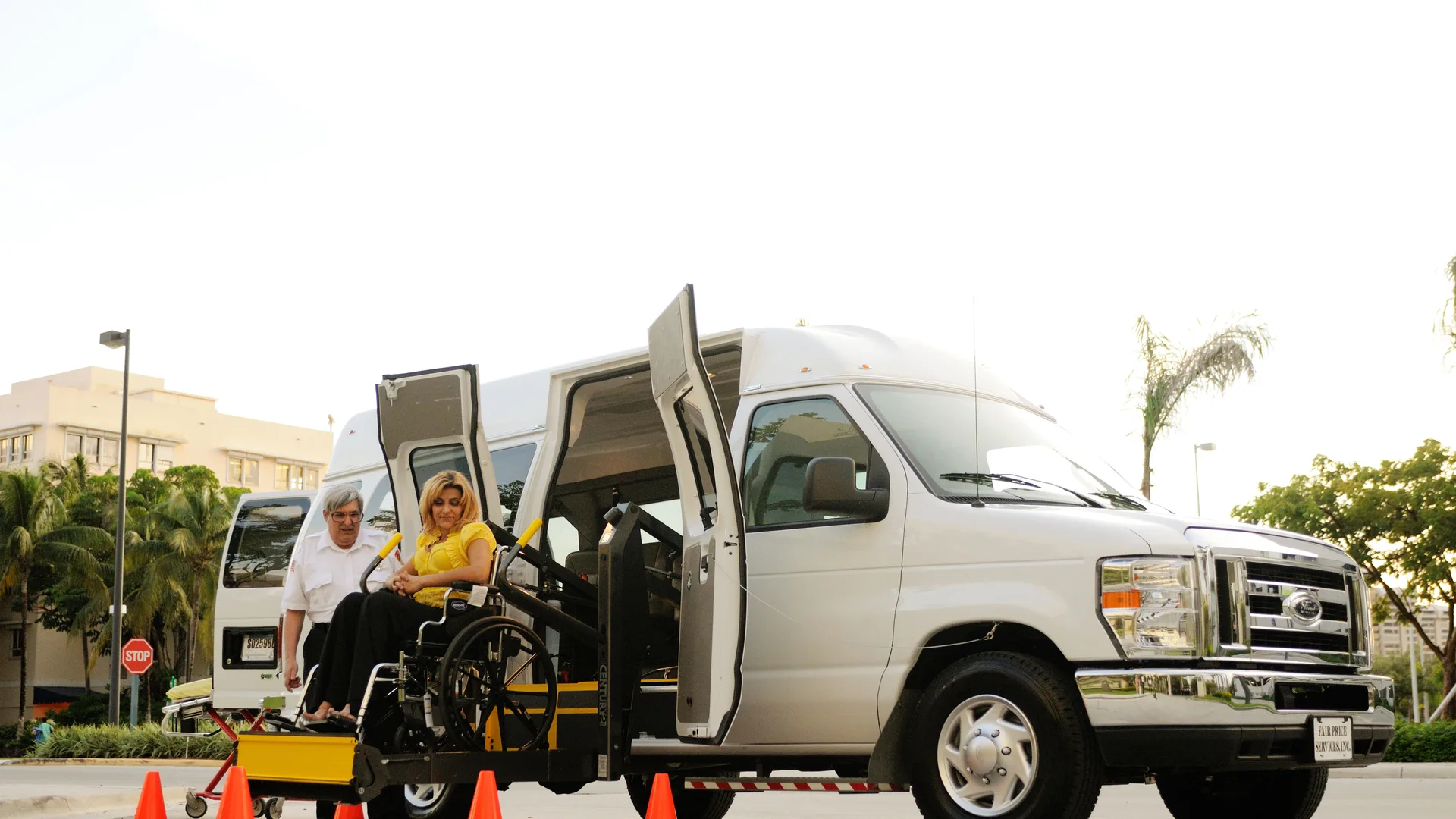
Photographs. A wheelchair user boarding an accessible van by lift — DΛVΞ GΛRCIΛ, Pexels Cropped and resized for the web; not otherwise altered. Neither the photographers nor the licensors endorse this article.
This article is general information, not medical, accessibility or financial advice. OTGG is the travel-planning platform of Paolo Melendez, an independent travel advisor. This article contains no affiliate links. Policies, fares and accessibility arrangements change — verify with the cruise line, airline or an accredited travel advisor before booking or paying.
Sailing with a scooter or power chair?
Send me the device dimensions, weight and battery type. I will match them against the exact cabin and ship, and get the tender and charging answers confirmed before you book.
Begin the Journey






















